Share this Story on Facebook, X, Text, LinkedIn, Gmail, Yahoo Mail, or Outlook
There are many reasons why Governor Abigail Spanberger should veto the collective bargaining bill headed to her desk, a bill requiring local and state governments to bargain with union bosses even if less than a third of public employees want the union or the bargaining.
There is the fact that it will force major spending increases on local governments, just as it added $350 million to Richmond City’s costs when that city voluntarily approved collective bargaining four years ago, and to Fairfax County, which giddily adopted collective bargaining, only to find it’s driven a $300 million shortfall this year.
Then there is the fact that the state estimates the bill will create new bureaucracies, add 333 new state employees to the payroll and require additional spending of up to $92 million over the next five years before any salary increases. Those costs will only grow.
There is also the fact that most local government leaders oppose it, including dozens of Democratic elected officials, who say it would add an unfunded mandate on local governments and school boards, imposing a “one-size fits all” collective bargaining approach on local governments. Those Democrats want to see collective bargaining remain voluntary.
Democrats like Prince William School Board Chair Babur Lateef (who ran for the Democratic Lt. Governor nomination) is one, as are seven urban Democratic mayors.
They are also the ones who must make local government work, as opposed to those worthies in the General Assembly who are happy to impose their idea of governance on others but not have to take responsibility themselves. Which explains why General Assembly Democrats specifically exempted their own employees from the legislation, an example of “Mandates for thee, but not for me.”
This puts Governor Spanberger between a rock and a hard place: Does she choose to support the views of local Democrats who make the state operate effectively, legislative Democrats whose vote she needs for future legislation, or satisfy the demands of national unions since, like most Virginia Governors, her staff is likely already measuring the curtains in the Oval Office?
Cynical observers like the left-wing Freedom Virginia assert that “lobbyists and special interests are buying off our politicians.” If that’s true, those special interests certainly got their money’s worth in 2025.
During the 2025 General Assembly election, the Service Employees International Union (SEIU) gave more than $400,000 to Democratic candidates for the General Assembly. Ninety-six percent won. Clearly, with total union donations of more than $13 million, organized labor walked into this year’s legislative session with a wish list aimed at consolidating their power and increasing their revenues.
The most egregious item in the SEIU’s wish list allows the union to collect dues from a whole new category of workers, even though the union can’t negotiate better pay or working conditions for those workers.
Here’s how it works: Thirty-five years ago, Medicaid began permitting states to offer “consumer-directed services” to the elderly or disabled to hire individuals providing personal care services for daily living activities, such as grooming, toileting, bathing, eating and monitoring health status. The idea was that this coverage was a better, and less expensive, alternative than placement in an institution, or using more expensive agency-directed care.
The National Academy for State Health Policy estimates that 40 percent of caregivers are family members. Having loved ones assist family members ensures that the caregiver has a long-term understanding of the patient’s needs, with a direct and long-standing relationship between the parties.
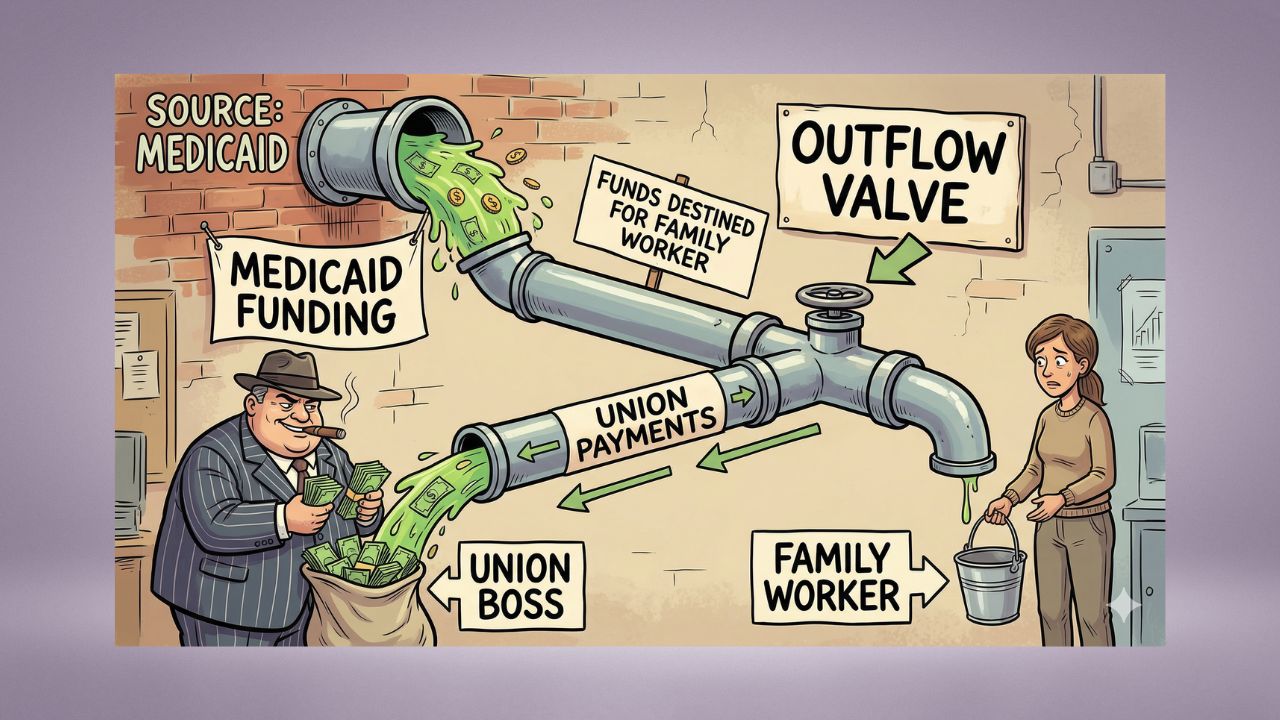
Comes now the SEIU legislation, SB378, not only expanding collective bargaining and its attendant abuses to public employees but putting the union between the patient and his or her caregiver by creating a “Virginia Home Care Authority (VHCA).” Its sole purpose: To bring these home care workers under the umbrella of SEIU without actually making them public employees, so the union can collect dues from them.
These providers are, after all, direct employees of the participant (family member) they wash, feed, and toilet. But making them “public employees” would make them subject to state pensions and state health care plans, too expensive even for profligate legislatures.
The bill makes it clear: “An individual provider does not mean ‘public employee’ in any case other than for purposes of collective bargaining….Nothing in this article shall be construed to classify individual providers as employees of the Commonwealth. No individual provider shall be eligible for state retirement programs or health care benefits.”
So … to ensure a new collection of dues-paying union members, an exception is created: It would allow a new Virginia Home Care Council to serve “as the public employer of individual providers solely for purposes of collective bargaining.” (emphasis mine)
Thus, the legislation creates the façade of private workers categorized as public for one purpose only – to put the union between family members, allowing the SEIU to claim their dues.
What could the SEIU offer?
Not salary negotiation. The stipends given these workers – family member or not – are set by the General Assembly, controlled by the same people who passed this law. SEIU might lobby but that’s not negotiation. The new Authority has no power to determine the stipends and doesn’t actually hire any providers.
As for negotiating working conditions, are Virginia taxpayers really expected to believe a labor union should stand between family members? Will union rules now dictate when and where family members can offer assistance to the relatives they are trying to help?
The deal offers nothing to the patients or the family members.
But it does offer the SEIU dues payments that otherwise would have gone to these family member workers, even if they get nothing in return. In fact, the union often takes it’s cut first, skimming its percentage before stipends even reach the caregivers.
It is a new scheme in Virginia signs the bill, but old news in dozens of other states, resulting in cuts to those most in need but a payday for the union. At its peak, this practice diverted approximately $150 million to $200 million annually from roughly 350,000 caregivers.
In states where it has been imposed, desperate caregivers are taking the issue to court, in an effort to stop the skim.
Will Virginia allow public employee unions to skim dues money from family members receiving a small stipend to help their families get through hard times? For doing nothing?
Even if the Governor finds it hard to disapprove the entire bill because of political exigencies, the advantage in Virginia is the line item veto: The Virginia Health Care Council section and any reference to unionization of family members should be deleted before the Commonwealth goes down that path.
Coming Wednesday: Trampling the Rights of Public Employees.
Chris Braunlich is Senior Advisor and former president of the Thomas Jefferson Institute for Public Policy, as well as a former member of the Civil Service Employees Association in New York. He can be reached at chris@thomasjeffersoninst.org.
Share this Story on Facebook, X, Text, LinkedIn, Gmail, Yahoo Mail, or Outlook