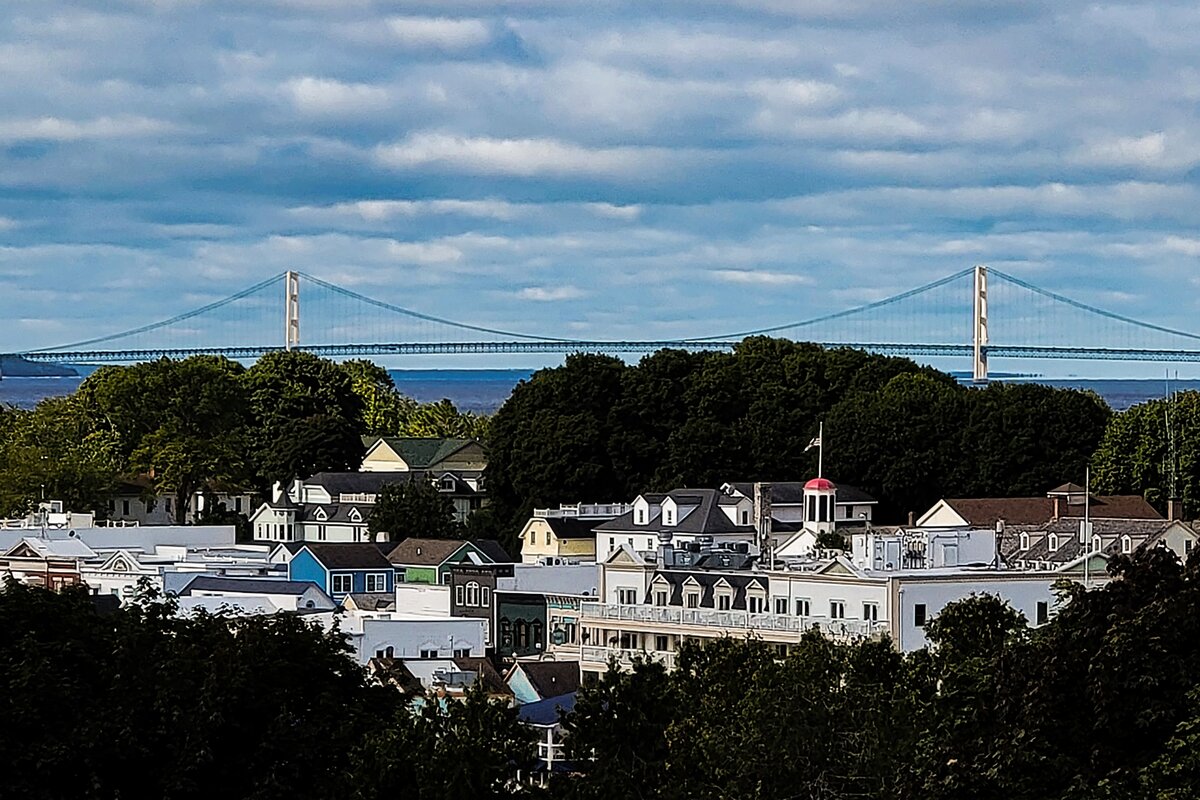
The ongoing litigation and legislation campaign against Mackinac Island ferry operators became a little clearer when a federal judge dismissed the city of Mackinac Island’s antitrust claims against the ferry companies. The city had claimed that the current arrangement among the ferry companies is an illegal monopoly and tried to assume the power to regulate ferry fares and parking fees on mainland parking lots.
“Mackinac Island is a special place,” U.S. District Judge Robert J. Jonker acknowledged in his opinion. “Located in the Staits of Mackinac between Michigan’s upper and lower peninsula, the Island boasts a summer resort community that attracts tourists from around the world. Adding to the Island’s unique nature, Michigan — by special legislation in 1899 — established the City of Mackinac Island and granted it distinct regulatory authority over the Island.”
But Jonker did not support the city’s claim that the ferries are an illegal monopoly. For many years, Mackinac Island visitors had three ferry choices: Star Line, Arnold, and Shepler’s. Star Line acquired and merged with Arnold in 2016. Shepler’s was acquired by Hoffman Marine in 2022, and then Hoffman acquired Star Line in 2024. Hoffman now owns all three ferry lines, although the company claims it has operated them as two separate companies since the 2024 acquisition.
It seems unlikely that Hoffman really has monopoly power, because the city regulates its rates. Ferries are highly mobile, and nothing would prevent a rival ferry operator from moving into the market and undercutting any excessively high rates Hoffman might charge.
Jonker ruled that the the city lacks standing to bring this case because it cannot be considered a victim under the antitrust laws. The city claims its regulatory approach is being undermined by Hoffman, but that is not the same as being harmed as a customer.
Merely having monopoly status is not, by itself, a violation of the antitrust laws. Rather, the antitrust laws prohibit monopolization, or the “the willful acquisition or maintenance of that power as distinguished from growth or development as a consequence of a superior product, business acumen, or historic accident.” The judge pointed out that the city’s allegations about how Hoffman acquired or maintained its market power all described market conditions that pre-dated Hoffman’s acquisition and did not involve the company’s trying to exclude any competitors from the market.
Though the antitrust claims in this matter appear to be settled, several other legal battles are ongoing. First, the case before Jonker also included unresolved breach of contract claims by the city against Shepler’s and Arnold Transit Company.
A separate case involves Hoffman’s suit against the city of Mackinac Island, which claims the city does not have the power to regulate ferry rates, followed by a countersuit by the city claiming that the city’s regulatory powers extend to parking lots operated by Hoffman.
In the Michigan legislature, the Senate has approved SB 304, which would give the city of Mackinac Island authority to regulate parking rates and other business activities both on the island and on the surrounding mainland. That bill is currently being considered by the House Government Operations Committee.
“The disputes between the Ferry-Companies and the City can and should be resolved under the Franchise Agreements that govern their relationship for the next two seasons,” Jonker said in his decision. “They have a common interest in reliable and reasonable ferry service to over a million tourists each season. One would hope that common interest is enough to forge a sensible resolution.”
That is very good advice from the judge. Continuing expensive litigation and running to the legislature for more regulatory powers will do nothing to help the people who rely on the ferries. The city and the ferry operator should instead look to how they can be better partners and work together to make visiting Mackinac Island a better experience for everyone.