By Randal O’Toole
High housing prices in the Portland area led to a legislative mandate for Metro, Portland’s regional planning agency, and city governments to develop a strategy to make housing affordable again. Metro’s solution, however, is simply going to make housing even more expensive, according to comments on Metro’s housing strategy that the Cascade Policy Institute recently submitted to the Department of Land Conservation and Development.
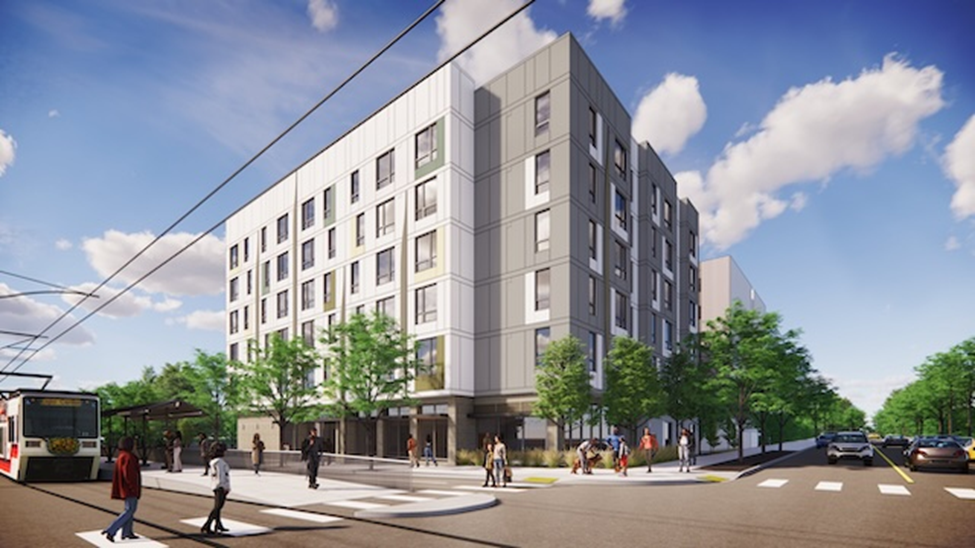
Metro’s plan for improving housing affordability calls for building more subsidized high-density developments such as this one known as the M. Carter Commons. This is costing $34.5 million and contains 63 apartments that average 591 square feet for a cost of $548,000 per apartment and $942 per livable square foot. Portland housing authority photo.
Prices are high in the first place due to Metro’s top-down planning process that prioritizes increasing urban densities over individual preferences for single-family housing. Metro’s housing strategy combines more top-down planning with increased spending on subsidized housing for low-income households.
Neither more top-down planning nor low-income housing subsidies will make housing more affordable, says Cascade Policy’s comments (which were written by Oregon land-use and transportation policy analyst Randal O’Toole). The top-down planning actions proposed by Metro remain hostile to single-family homes, the kind that most people prefer and that are more affordable than most other kinds of housing. Instead, Metro wants to emphasize tiny homes in people’s backyards and cramped apartments in mid-rise buildings.
Metro has known that density is not the solution to high housing costs at least since 1997 when a study of Portland housing co-authored by a staff member of the Portland Bureau of Housing found that “housing development costs rise dramatically as building height and housing density increase.” Those high costs can be seen in the mid-rise developments now being built with the region’s “affordable” housing funds, such as the M. Carter Commons.
Considering that the median price per square foot on homes in Portland is currently about $300, spending $942 per square foot on “affordable” housing is a terrible misuse of taxpayer resources. Worse, the taxes used to subsidize this housing are on new and existing homes, making the region’s housing even less affordable.
In the 1970s, when Oregon’s Land Conservation and Development Commission (LCDC) required all major Oregon cities to draw urban growth boundaries, the commission also required cities to regularly expand the boundaries to meet the demand for new housing. However, in the 1990s, Metro decided that, instead of expanding the boundaries, it would meet new housing demands mainly by building higher density housing.
Not only is higher-density housing more expensive than single-family homes, Americans overwhelmingly prefer single-family housing over apartments even if prices were the same. But they aren’t, and almost everyone would rather live in a 2,200-square-foot single-family home vs. a 1,000-square-foot apartment that costs more than the home.
The housing strategy’s focus on low-income housing subsidies is an example of the “Do-Something Syndrome,” in which bureaucrats and politicians take the wrong actions in response to a problem, possibly because the right actions may be politically less popular. In this case, most of the groups that Metro consulted about its housing strategy benefit from low-income housing subsidies, including the developers of such housing, so actions that could really make housing more affordable weren’t even considered.
Metro’s original justification for its density policies was the need to save farms, forests, and open space. Yet Oregon only uses 25 percent of its agricultural lands for growing crops, its forests are growing 50 percent faster than they are being cut, and more than half the state is federal lands that are permanently managed as open space and recreation areas.
In addition, a 2001 consulting report funded by 1000 Friends of Oregon and its allies found that, by 2050, only an additional 1 percent of the Willamette Valley would be developed if LCDC’s and Metro’s planning rules were eliminated. The study predicted that development would increase from the current 5.9 percent of the valley to 6.6 percent under existing rules and 7.6 percent if the urban growth boundary and other restrictions were abolished.
More recently, Metro justified its anti-single-family home policies based on the need to reduce driving and greenhouse gas emissions. While people living in denser areas do drive a little less, they also drive in more congested conditions. This uses more energy and produces more greenhouse gas emissions per capita than in lower-density areas.
Metro also relied on predictions that American tastes were changing away from single-family homes and towards denser, more “vibrant” housing. One 2006 study claimed that the United States would have 22 million “surplus” single-family homes in 2025. It turns out these projections were entirely fabricated and, if anything, the demand for low-density housing has increased.
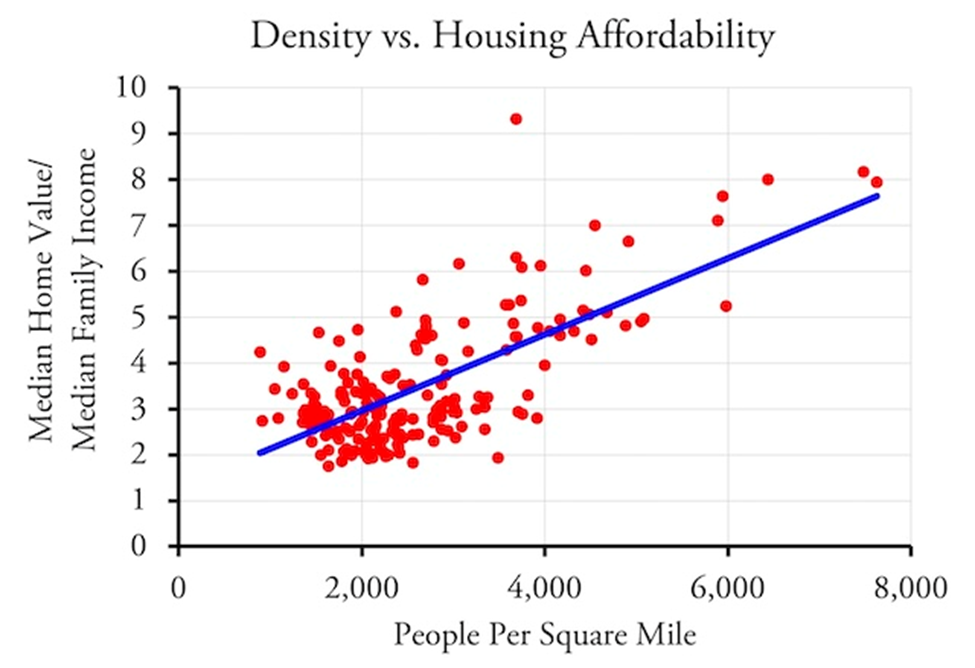
There is a strong negative correlation between density and housing affordability so Metro’s plans to increase densities are making Portland housing more expensive. Source: 2020 Census (for densities) and 2021 American Community Survey (for 2020 housing affordabilities).
Thanks to Metro’s densification policies, the density of the Oregon portion of the Portland urban area has grown from about 3,100 people per square mile in 1990, when median homes cost 2.0 times median family incomes, to 4,200 people per square mile in 2020, when median homes cost 4.7 times median family incomes. It’s hard to get a loan on a house that costs more than four times a family’s income without a huge down payment, so housing is unaffordable when median prices are more than four times median incomes. By that definition, almost no urban areas with more than 4,000 people per square mile are affordable, while most urban areas with fewer than 3,500 people per square mile are affordable.
Portland-area housing will become more affordable only when Metro admits these failures and mistakes and adopts a housing policy that allows people to live in the kind of homes they prefer. For most, this means single-family homes, which are also the most affordable per square foot.
To make the region affordable again, the Cascade Policy Institute urges Metro to expand the urban growth boundary by at least 30 percent, reducing the region’s population density to 3,200 people per square mile. This would allow developers to meet the demand for single-family homes, apartments, or whatever kind of housing people prefer by building large-scale master-planned communities and provide additional room for several years of population growth before more expansions would be needed.
See Randal O’Toole’s full 15-page report: “Comments on Metro’s Regional Housing Coordination Strategy.”
Randal O’Toole is an Adjunct Scholar at Cascade Policy Institute, Oregon’s free market public policy research organization. He is a transportation and land-use policy analyst and the author of several books, including American Nightmare: How Government Undermines the Dream of Homeownership and Romance of the Rails: Why the Passenger Trains We Love Are Not the Transportation We Need. He writes from Central Oregon.