“But is the level of facility funding really the problem for our school districts? There’s at least some evidence to say: not exactly.”
The following has been adapted from an excerpt of the Frontier Weekly Newsletter written by Cheryl Tusken for the March 12th edition.
Recently, an article in the Independent Record discussed a new report claiming Montana school infrastructure is underfunded by $100 million. Let’s peel back a few layers.
The article referenced a February presentation by the 21st Century School Fund to Montana’s decennial School Funding Interim Commission. 21CSF recommends an annual facility M&O funding level of 3% Current Replacement Value (CRV is the amount required to repair, rebuild, or replace facilities). The report showed Montana’s public school districts were short of 21CSF’s M&O funding recommendation by $103 million a year statewide:

But is the level of facility funding really the problem for our school districts? There’s at least some evidence to say: not exactly.
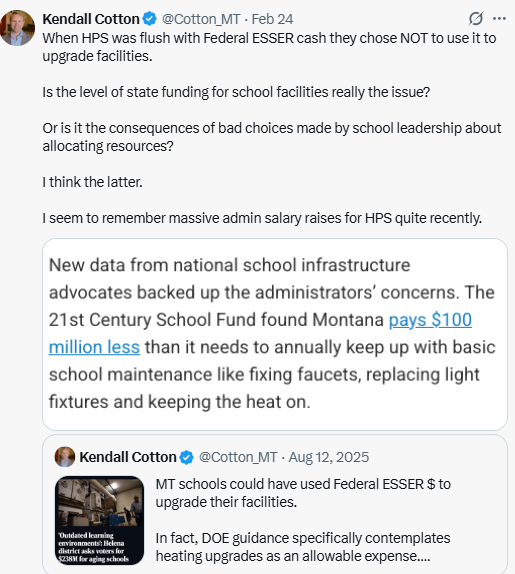
For instance, the IR article highlighted a sad story about Helena Public Schools’ aging boiler system and the lack of funds to repair it. What was left out is that when the Helena district was flush with one-time cash from federal ESSER funds during COVID, which both DOE and OPI explicitly said could be used for facility heating/cooling upgrades, the district chose NOT to use ESSER funds to fix their boiler. Instead, they hired additional staff despite knowing the funds would expire in 2024. Kendall has been covering this story on X:
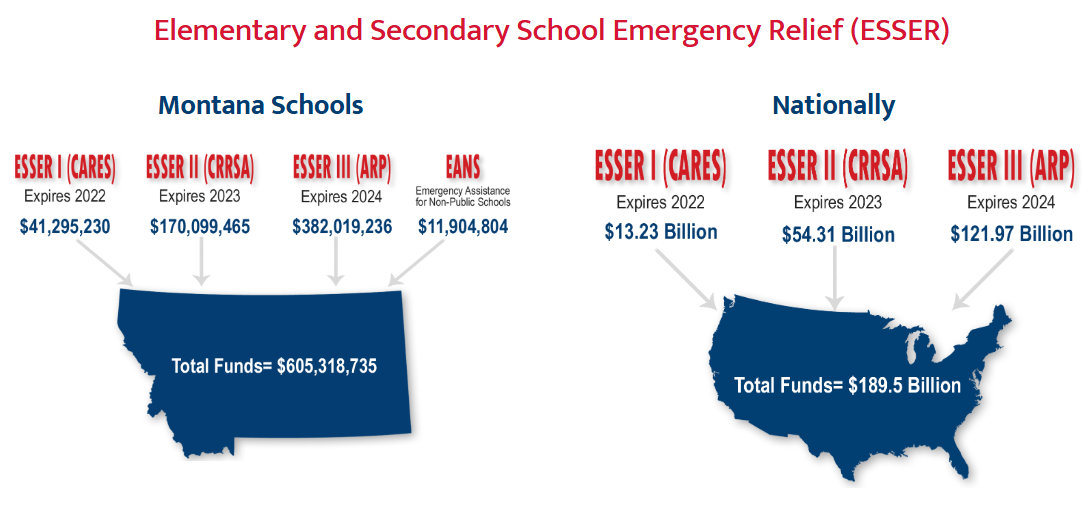
Overall, Montana schools received a $605 million windfall in federal ESSER funds during the pandemic, but only $29.5 million was directed toward maintenance and facility improvements.
Unlike Helena Public Schools, some districts actually did use those one-time COVID relief funds to update things like facility HVAC systems and address long delayed building maintenance. Townsend schools recorded nearly $500,000 in expenditures for building maintenance and ventilation systems while the Pryor Elementary district requested funds to replace windows, upgrade the ventilation system and mitigate asbestos and harmful mold.
But other schools spent one-time ESSER funds hiring staff, launching new programs that will require ongoing funding, and even items like massage chairs for the teachers’ lounge and pizza parties.
To be sure, public school facility costs are a real concern across Montana, and many districts are working hard to be responsible stewards of taxpayer dollars and the facilities they manage. But the issue is not simply a lack of funding. Reducing the conversation to “we need more money” ignores the structural problems with our system.
We’ve advocated for a transparent, student-centered public education funding model for this exact reason. As we’ve pointed out, our school funding system is complex, highly prescriptive, and divided into rigid spending silos that can prevent districts from using funds where they are needed most. A student-centered funding model would give districts greater flexibility to allocate budgets effectively.
You can learn more about our recommendations to the School Funding Interim Commission here.