
“Every dollar above what’s needed for sound fiscal management is a dollar collected from Montana families and not returned. That’s not conservative governance — it’s overcollection.”
The following has been adapted from an excerpt of the Frontier Weekly Newsletter written by Kendall Cotton for the March 5th edition.
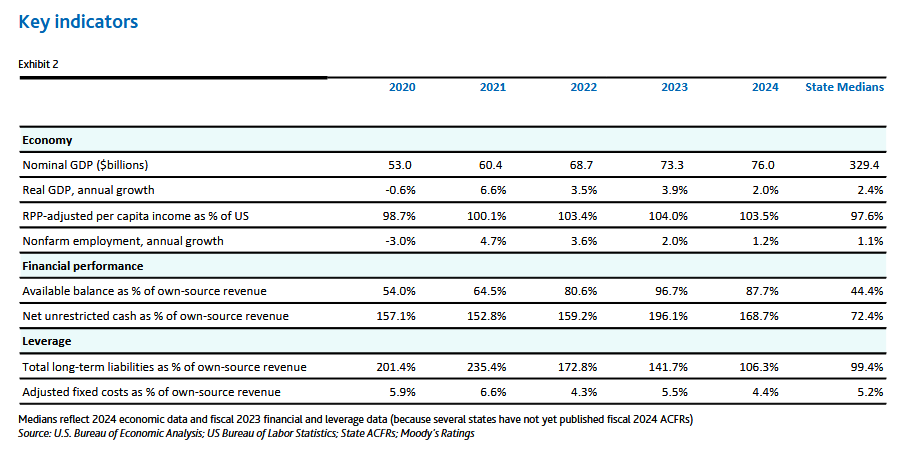
This week, the MARA Committee of which I’m a member received the latest rating report for the State of Montana from Moody’s, a global credit rating agency. Moody’s Ratings assesses the creditworthiness of companies and governments using a scale from Aaa (highest quality) to C (in default). In the latest rating, Montana’s government is rated Aa1 – one step below Aaa.
A couple of noteworthy things to point out for our readers:
- Moody’s reports Montana’s available funds balance at 87.7% of own-source revenue (vs. 44.4% 50-state median). This is basically the measure of how much the state government has saved over time. Think of available funds balance as your total savings across all your accounts: checking, savings, CDs, the envelope earmarked for the roof etc.
- Idaho is rated Aaa. Moody’s states Idaho’s Aaa rating could be at risk if the fund balances fall below 15% of revenue. So, we can reasonably infer that Moody’s considers 15% to be the “floor” for Aaa for similarly economically situated states.
- Idaho’s actual fund balances sit at about 22% of revenues — comfortably above that floor — and it earns Aaa comfortably.
- Montana holds roughly six times the level we understand Moody’s considers the floor for the best possible rating, and nearly double the 50 state median. This is BILLIONS of dollars.
- Moody’s already grades Montana at Aaa on financial performance. The only thing holding Montana back from matching Idaho’s overall Aaa rating is pension liability, not our savings levels.
- In theory, Montana could return even half of its available fund balances to taxpayers and it would STILL hold fund balances above the Aaa floor.
Why this matters:
Nobody disputes that Montana has a strong credit rating or that reserves matter. The question is how much savings is enough. Moody’s own data shows Montana holds nearly double the typical state’s savings, and its neighbor Idaho earns the highest possible credit rating with a fraction of Montana’s savings.
Every dollar above what’s needed for sound fiscal management is a dollar collected from Montana families and not returned. That’s not conservative governance — it’s overcollection.
As Pew Trusts warns, there’s such a thing as too much savings: “The maximum size of a rainy day fund should be evidence-based. It should be large enough to offset a major recession but not so large that money is set aside that could be better used for tax cuts or programs.”
As the state’s structural balance tightens in the coming biennia — driven in part by hundreds of millions committed to the GO Trust and other funds that the state holds — our leaders in Helena need to be evaluating whether our savings rate is evidence-based and whether we are collecting more than we really need from taxpayers.
Read the full Moody’s report for yourself HERE.