
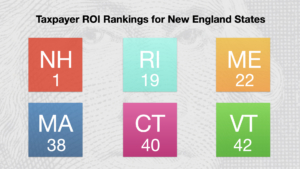
New Hampshire ranked No. 1 in taxpayer return on investment (ROI) for the 11th year in a row, according to financial services website WalletHub.
“New Hampshire is the state with the best taxpayer return on investment, which is due in large part to the fact that it has no state income tax,” WalletHub’s report concludes. “Residents only pay property taxes, sales taxes and excise taxes to the state. The Granite State’s tax resources have had a good impact on crime prevention and the environment, as the state has the lowest crime rate and the third-lowest air pollution in the country. It has one of the best public school systems as well.”
The top three states for taxpayer ROI—New Hampshire, Florida and South Dakota—have no income tax.
Of the other New England states, only Rhode Island (19th) ranks in the top half of states on taxpayer ROI.
Politicians, and voters to some degree, tend to use raw spending as a quality metric. States that spend more on a particular public service are said to be more committed to providing a high quality version of that service.
But spending by itself doesn’t measure quality. People understand this in real life. A $20 hamburger might be better than a $5 hamburger. But is it 400% better?
Higher levels of spending eventually reach a point of diminishing returns. Past that point, more spending does not buy higher quality.
And spending more can even bring quality down. Large, inefficient bureaucracies can consume vast sums of money while reducing efficiency, making service quality worse.
Measuring the effectiveness of government programs is challenging. Does New Hampshire have a low crime rate because our police services are great or because social order is a top cultural value here? Precision is elusive when trying to account for every factor that can contribute to positive outcomes.
WalletHub’s annual rankings are useful for getting political leaders to focus on linking outcomes and spending. That, not spending itself, is the right way to try to evaluate government programs.
That New Hampshire consistently hits the top of the rankings suggests that the state takes the right general approach. That doesn’t mean there isn’t room for improvement. But it offers no support for arguments that the state has its priorities backwards and should copy states that prioritize taxing and spending over efficiency.