As America prepares to celebrate its 250th birthday, half of New Hampshire renters live in units built before the country celebrated its 200th birthday.
The median renter-occupied housing unit in New Hampshire was built in 1975, making it 51 years old this year, according to U.S. Census Bureau data.
By contrast, the median renter-occupied unit in the United States was built in 1981.*
As a group, owner-occupied homes in New Hampshire are younger than rentals. The median year of construction for an owner-occupied home in New Hampshire is 1982, the same as in the U.S. as a whole.
To put that seven-year age gap in perspective, the median N.H. rental was built when Captain & Tennille’s “Love Will Keep Us Together” topped the Billboard charts. The median owner-occupied home was built when moms in leg warmers did Jazzercise to Olivia Newtown John’s “Physical.”
On the bright side, New Hampshire has the youngest rental housing stock in New England. This probably reflects the relatively late surge of migration into New Hampshire vs. the lower New England states. As a more remote and rural state, New Hampshire would not have had the pre-existing rental infrastructure of Massachusetts, Connecticut or Rhode Island when the post-war migration happened.
In the late 1960s, building permits for new rental units in New Hampshire surged until they hit parity with permits for new single-family homes.
But instead of continuing to boom, that apartment construction collapsed. Building permit data show that approvals for new rental units dropped sharply in the early 1970s and never recovered that level of parity with single-family homes.
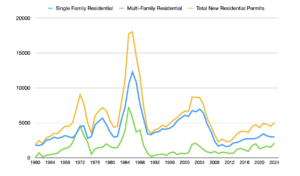
Surges in apartment construction in the late 1960s and early 1980s lifted the median age of New Hampshire rental units vs. other New England states. But compared to booming Southern states that have fewer restrictions on new housing construction and a much younger housing stock in general, New Hampshire’s rental infrastructure is quite old.
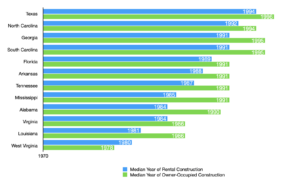
The median year of construction for rental units in New England is 1970. In Southern states it is 1987.
For owner-occupied housing, the median year of construction in New England is 1972. In Southern states it is 1991.
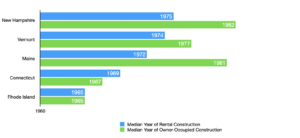
In New England and the South, the average age gap between rental and owner-occupied construction is four years. The largest gap in the South is six years (Alabama, Mississippi). New Hampshire’s seven-year gap is larger than any in the South and is the second-largest in New England, behind only Maine. Among the New England states, only Maine and New Hampshire have gaps of more than three years.
Our previous research on land use regulations in New Hampshire strongly suggests that local ordinances played a significant role in creating this age gap. Though economic conditions and consumer demand obviously played roles too, many communities responded to population growth in the 1970s and ‘80s by restricting rental housing more severely than they did single-family housing.
Today, lawmakers regularly propose bills to secure additional rights for renters by limiting the ability of landlords to set various terms and conditions regarding the use of their property. However, the data suggest that renter freedom is better pursued by enhancing, rather than restricting, property rights.
Why are New Hampshire renters stuck with a limited supply of aging apartments? The primary reason is that local governments have made it difficult if not impossible for investors to build newer rental housing options. Free the property owners, and you will free the renters.
Fewer regulations=more supply.
More supply=lower prices.
More supply=more power for renters.
The New Hampshire Housing Finance Authority estimates that New Hampshire needs nearly 30,000 new rental units to meet demand in the coming decades. Allowing builders to meet that demand will do more than stimulate the state economy. It will upgrade the condition of the state’s rental housing stock overall, leading to improved living conditions for renters.
The median New Hampshire rental unit was built as the Gerald Ford administration was finishing up its plans for America’s bicentennial celebration. This appears to be an artifact of misguided government policy.
In celebration of America’s 250th, New Hampshire would live up to the spirit of ’76 by looking for ways to let Granite Staters pursue the American dream by building the homes they want, not just the homes that planning board members would like them to have.