Introduction
Article IX, Section 2 of the North Carolina State Constitution speaks to the state’s responsibility for public education when it declares, “The General Assembly shall provide by taxation and otherwise for a general and uniform system of free public schools … wherein equal opportunities shall be provided for all students.”
By law, North Carolina is charged with funding general school operations. North Carolina General Statutes § 115C-408 stipulates that the state will fund operational/instructional expenses from state revenue. The same statute makes North Carolina counties responsible for building, equipping, and maintaining school facilities. Counties may supplement state school operating funds if they so choose.
Some state dollars are distributed in the form of supplemental funds to educate specific populations, such as special needs students, at-risk students, and gifted and talented students, or as special financial support to small or low-wealth districts.
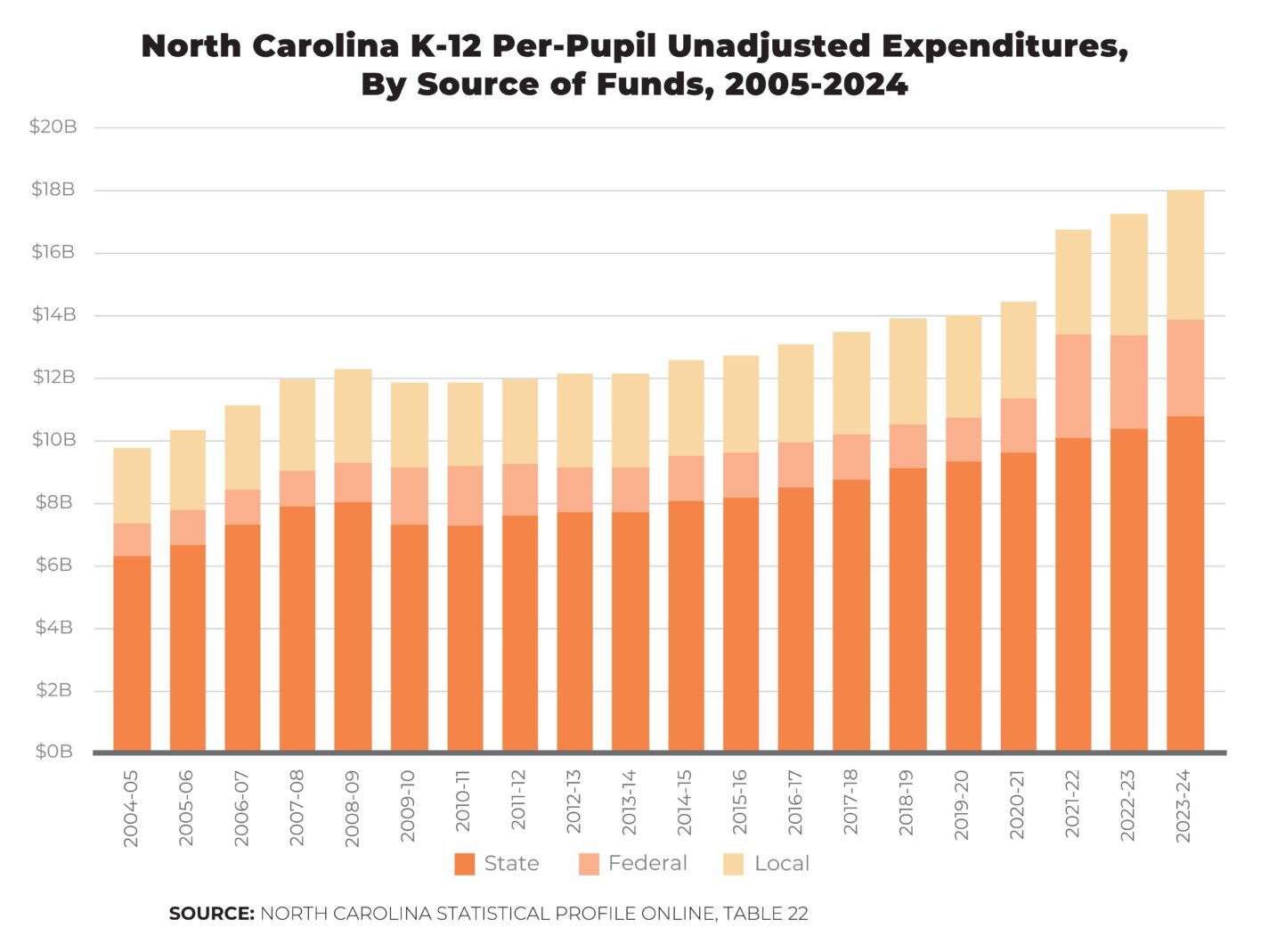
In 2023–24, North Carolina spent $18 billion on K–12 public education. Of that amount, $10.8 billion (59.7 percent) came from state government, $3.1 billion (17.2 percent) came from the federal government, and $4.2 billion (23.1 percent) came from local governments.
How the state best finances the costs of schooling while addressing concerns about effectiveness, accountability, fairness, and efficiency is a never-ending question.
The quality of a school finance system is best judged by how well it meets the goals it was designed to serve. Unfortunately, most people today equate the quality of a school finance system with the number of inputs associated with it — teacher pay, per-pupil funding, class size, and more. Such thinking exposes a flawed assumption that drives much of the public discussion on school finance: that more resources automatically mean better education and better educational outcomes.
A review of school district spending and educational outcomes reveals the linkage between spending and educational outcomes to be weak. Why do some districts have below-average per-pupil expenditures and above-average test scores, while other districts spend considerably above the average per-pupil expenditure yet produce disappointing test scores? The truth is, improving educational outcomes is a complex issue with many variables. Clearly how money is spent is just as important as how much money is spent.
The complexity of the issue should cause us to rethink how state government approaches public school finance. Thinking in terms of educational productivity instead would be one way to improve the discussion. Educational productivity describes the important ratio of funding to student performance in order to measure the return on investment, while also considering such differences as cost of living, household income, and English language proficiency.
Because educational productivity properly reflects both sides of the education finance equation — inputs and outputs — policymakers should consider using educational productivity as a better way to assess how schools in North Carolina are financed.
Key Facts
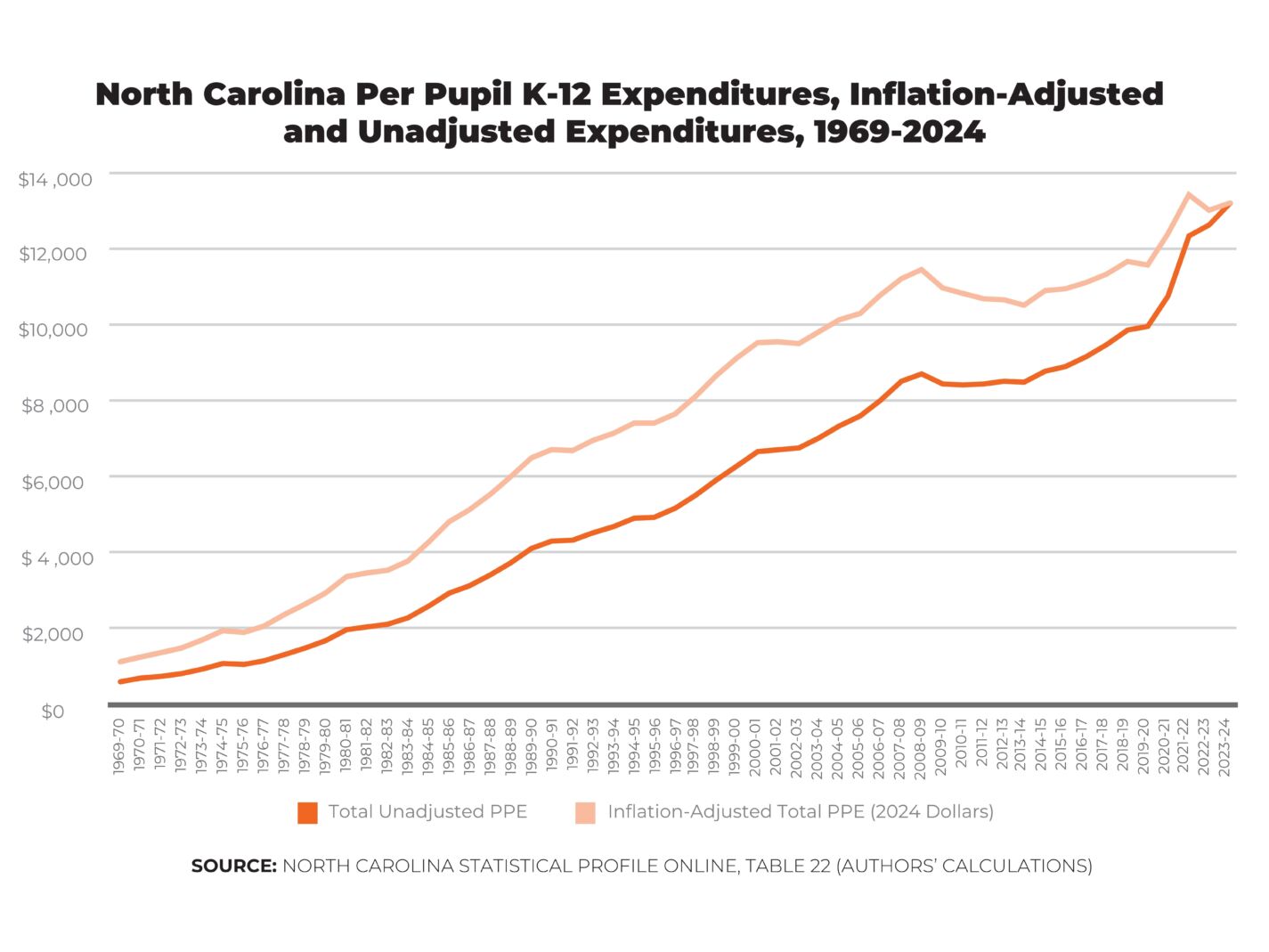
- In 2023–24, North Carolina spent an average of $13,222 per K–12 student in federal, state, and local operating funds.
- During the 2023–24 school year, state, federal, and local operating expenditures exceeded $18 billion.
- North Carolina distributes funds to local districts using a complicated system of more than 50 different formulas or allotments. The allotments function as taxpayer-funded gift cards, most of which come with restrictions on how the money can be used. The allotments are essentially state grants and range from funding teachers and instructional staff to providing funding for driver education programs.
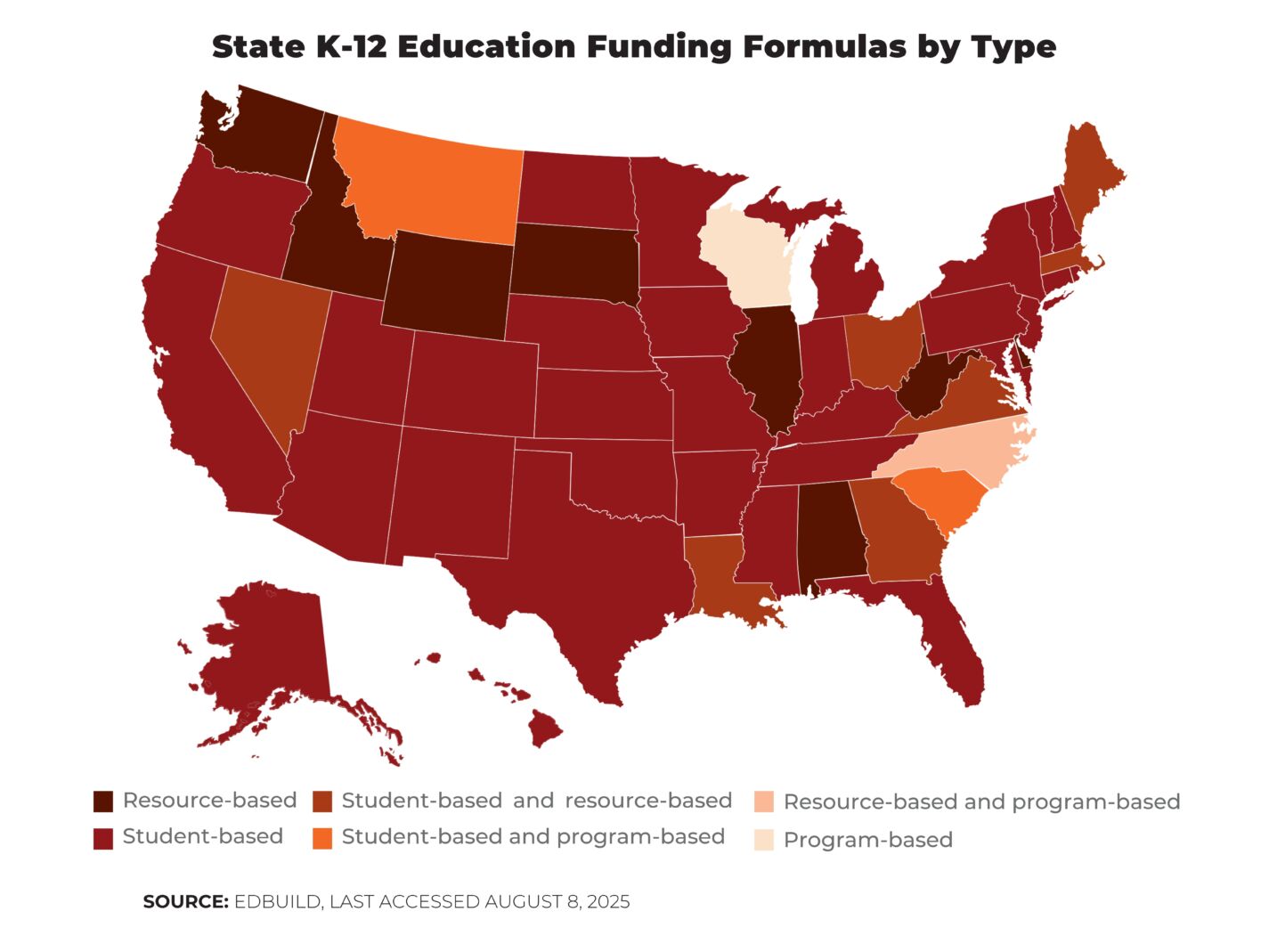
- Most states around the country distribute funds to districts based on the needs of the students they serve. North Carolina’s school finance system is an outlier that bases funding primarily on the cost of providing certain educational programs and resources.
Recommendations
1. End how North Carolina currently funds education via complicated allotments.
Policymakers on both sides of the aisle know the current method of funding schools in North Carolina is too complicated and centralized. It offers little flexibility and transparency and makes it difficult to determine if funding is being used effectively and efficiently. In place of the current system, funding should be linked to the needs of students. Doing so would ensure money gets to where it is needed and also encourage accountability by not rewarding failing systems.
2. Create an Education Productivity Index using a dashboard of inputs and outcomes for each school district and charter school.
Educational productivity is a better indicator of the quality of a school finance system than how schools are currently evaluated. A dashboard of relevant financial, institutional, academic, and economic indicators can help to inform the public of school and student performance and encourage school districts to be more transparent.
3. Publicize research on education spending and outcomes.
Policymakers and the public need to be educated about the weakness of the link between spending and educational outcomes. Good decision-making understands both sides of that equation.
4. Require school districts and charter schools to post budgets, contracts, check registers, and other financial documents online.
Parents and policymakers lack information about school and district spending. As such, it is difficult to know if schools are making wise decisions about spending. Requiring public schools to post spending records would improve financial transparency and aid decision-making.