Lawmakers are again considering a proposal that would change how the payroll tax rate is calculated for Washington state’s Paid Family and Medical Leave (PFML) program. Most W-2 employees pay into PFML, but not everyone qualifies for benefits, and some workers who qualify still can’t realistically use them.
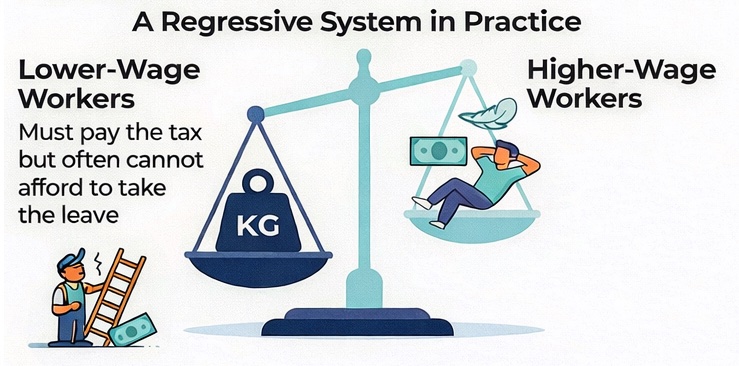
It should not be a surprise that low-wage workers use PFML least. Paid leave isn’t designed to replace a worker’s full paycheck. And many low-wage workers don’t meet the program’s eligibility requirements tied to work history. The result is that PFML functions less like a safety net and more like a worker-paid benefit that is most accessible to middle- and higher-wage earners.
Program payouts have increased alongside tax rate increases, outpacing projections. That should have been expected: When workers are forced to pay into a benefit, they will predictably look for ways to use it. PFML’s tax rate has grown from 0.4% of wages when the program began in 2019 to 1.13% as of Jan. 1, 2026. (Individual workers can estimate how much they’ll pay to PFML in 2026 here.)
Despite taking more and more money from workers, the program faces short-term deficits tied to high utilization. Fund managers believe they can reduce those swings by shifting to a more forward-looking approach to setting the tax rate. That’s reasonable — and it’s what Senate Bill 5292 would do.
The bill would not, however, solve long-term solvency concerns. That’s why lawmakers have previously discussed raising or removing the statutory rate cap (currently 1.2%), combining it with this rate-structuring bill. Some lawmakers have floated a cap as high as 2%, even though that may still not be enough to fulfill PFML’s promises. A 2% cap would mean $2 of every $100 in wages could be taken to fund paid leave benefits for others.
I testified in the Senate Labor and Commerce Committee Friday, concerned SB 5292 would once again become a vehicle for that bad idea. (See my testimony below.)
The committee chairwoman seems confident the proposal can move through the session without a drastic tax-rate-cap increase being attached to it. I hope she’s right. And before lawmakers consider higher taxes, they should first consider benefit-side reforms. Lawmakers could start by limiting repeat usage, which happens frequently. They could also reduce the maximum duration of leave. Right now, a beneficiary can receive up to 18 weeks of paid leave.
Sen. Curtis King, R-Yakima, just filed four bills aimed at solvency protections without increasing the rate cap: SB 6140, SB 6141, SB 6142 and SB 6143. Workers should hope these bills receive hearings and can be considered sooner rather than later. Many lawmakers remain committed to the program as designed, but workers — including low-wage workers who are least able to absorb payroll deductions — need paycheck protection.
Lawmakers should stabilize the PFML fund by passing an unaltered SSB 5292 and, at the same time, better protect workers’ paychecks with Sen. King’s solvency bills.