Share this Story on Facebook, X, Text, LinkedIn, Gmail, Yahoo Mail, or Outlook
Citing the high cost, the Virginia State Corporation Commission on Friday denied a request to add a battery project to the Appalachian Power Company grid. In the same decision, an out-of-state wind project for Appalachian was approved, but only if it qualifies for major federal tax credits to keep down the cost.
Without those tax credits, set to expire under legislation signed by President Donald Trump, the 261-megawatt wind project in Illinois that Appalachian plans to buy will also be too expensive to justify, the SCC ruled. Any cost overrun on the $1 billion plus construction cost will also void the Commission’s permission for Appalachian to buy the turbines, being built by another company.
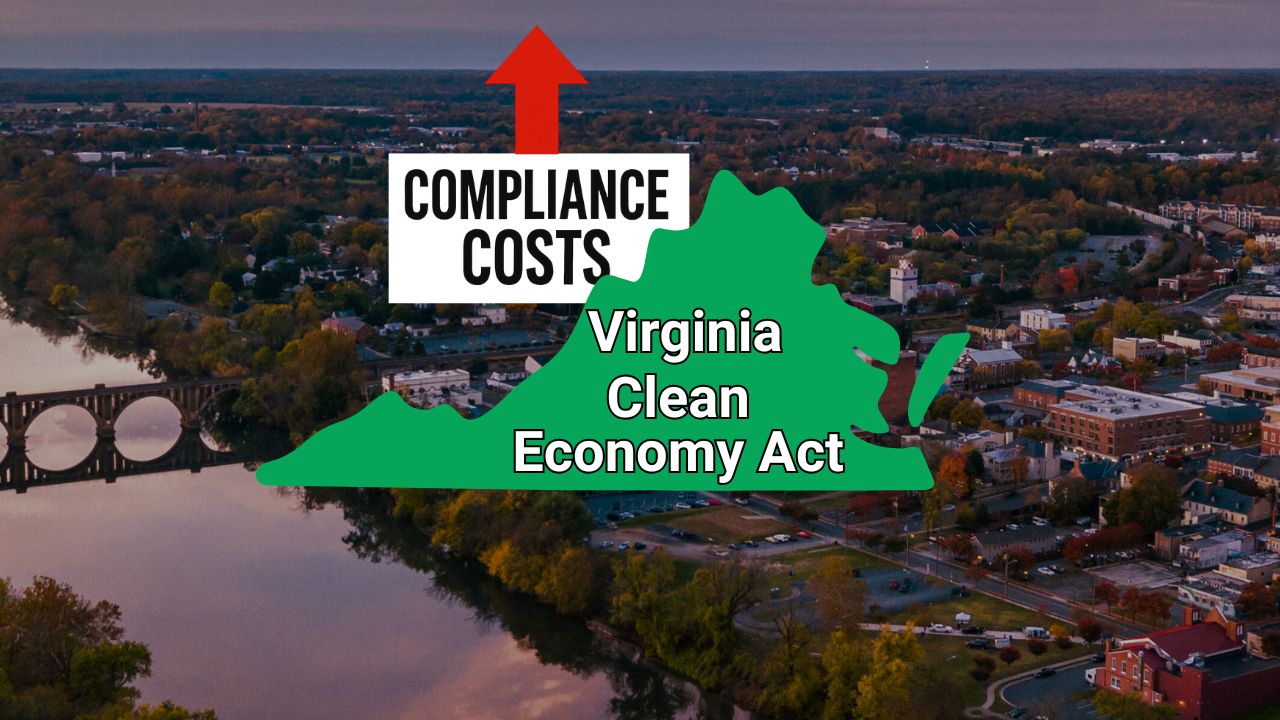
The rulings were part of Appalachian’s annual proposal for adding non-carbon emitting energy projects to comply with the Virginia Clean Economy Act (VCEA). The Commission’s order, and a more extensive discussion in the September 26 report from its hearing examiner, D. Mathias Roussy, highlight the growing costs of VCEA compliance.
Appalachian serves about 550,000 customers in Western Virginia, and most of its power generation is done out of state. Under the VCEA, it must move toward ending its use of coal, natural gas, or oil to make electricity.
The application also updated the ongoing costs of previously approved VCEA-compliant Appalachian facilities mandated by the Virginia Clean Economy Act, and one small solar addition. Those portions of the application were approved, and Appalachian customer bills will rise on March 1, 2026, to pay for them.
Appalachian’s Virginia residential customers are currently paying about $1.27 per month on 1,000 kilowatt hours of usage for VCEA compliance. As of March 1, that will rise to $5.63, the first major cost impact of VCEA on those customers since its passage in 2020.
The projects the Commission just approved, including the $1 billion wind project contingent upon getting those tax credits, are not yet reflected in those customer costs. They will be in next year’s bill increase application.
Hearing officer Roussy, who spent far more time with the detailed testimony and evidence than the commissioners probably had, was more explicit in his warnings. He wrote (with emphasis added):
“Over the past five years, APCo (and Dominion) have obtained Commission approval of a significant amount of new renewable resources at costs that, while significant, were found reasonable and prudent compared to other compliance options or payment of the non-compliance penalty. However, after a series of supply-side price shocks during this period, the costs of new renewable facilities and purchases had already increased significantly before the accelerated termination of significant federal wind and solar tax credits by Public Law 119-21 and/or recent federal tariffs. (Editor: the tax credits were changed in Trump’s OBBBA tax law)
“Unfortunately, the record of this case indicates that paying the non-compliance penalty has become a more realistic future scenario, in my opinion, for at least some quantity of future (renewable energy certificate) requirements. It is reasonable to expect, for example, that the termination of substantial federal tax credits for solar and wind resources next year will cause the price of new renewable resources to increase.”
Roussy was referring to the provision within the VCEA that imposes a “deficiency payment” or fine on Appalachian or Dominion Energy if they fail to provide enough non-hydrocarbon power from their own facilities or fail to purchase enough renewable energy certificates from others. The cash fine, which must be passed on to the customers, is more than $46 per megawatt-hour of deficit now and will be over $60 per megawatt-hour in 2050.
Roussy was implying that paying that penalty in the future will be cheaper than building new wind or solar facilities or buying the RECs created by somebody else’s wind or solar energy. Of course, the next General Assembly could increase that penalty to make those choices look cheaper in comparison again, blaming the expiring tax credits and the tariffs.
The rejected battery project would have installed 52.2 megawatts of four-hour storage in Wythe County, for a total of 208.8 megawatt hours of stored energy output. The capital cost was projected at $168 million, or more than $800,000 per megawatt-hour of output. That does not include operating costs and utility profit. Even with possible federal tax credits the SCC concluded the cost was not prudent.
The cost-benefit analysis on the wind turbines in Illinois was also a close and debated call, according to Roussy. Despite opposition from some of the case participants, he ended up recommending approval mainly because the project might get under the wire to qualify for the expiring federal tax credits, while future projects will lose them.
The wind project was also justified as having a reasonable cost by adding into the equation a claimed “social cost of carbon” of $51 per ton of emitted carbon dioxide. That figure comes from a federal study under President Joe Biden’s administration. With that assumption, Appalachian and renewable energy advocates claimed building it would “save” customers $260 to $300 million by avoiding “carbon damage” over its lifetime.
Roussy noted that Appalachian also calculated customer “carbon benefits” from $700 million to $2 billion using other, higher, estimates of the social cost of carbon. He continued:
“…these higher estimates underscore concerns about combining ratepayer net present values and social cost of carbon benefits. The capital cost of a renewable resource that would be negative $2 billion from an APCo ratepayer standpoint – but would net out to zero if combined with a $2 billion social cost of carbon benefit – would be extraordinary and in tension with the statutory consideration of whether the addition of a renewable resource “is likely to result in unreasonable increases in rates paid by customers.” As stated by Consumer Counsel, combining a social cost of carbon benefit with the APCo ratepayer costs and benefits “can significantly skew the economic picture of a project.”
In other words, any project that only passes a test as reasonable and prudent if you assume a massive “social cost of carbon” is instead unreasonable and imprudent. Perhaps, but the General Assembly has ordered that calculation, and the 2026 session is likely to double down on that approach.
The state Consumer Counsel with concerns over social cost of carbon claims skewing the numbers is the outgoing senior assistant attorney general appointed by defeated Attorney General Jason Miyares. Democrat Jay Jones is a fan of the VCEA, and he will appoint a new consumer counsel when he takes over the office in January. Expect those concerns to blow away.

Steve Haner is a Senior Fellow for Environment and Energy Policy. Steve Haner can be reached at Steve@thomasjeffersoninst.org.
Share this Story on Facebook, X, Text, LinkedIn, Gmail, Yahoo Mail, or Outlook