Introduction
The North Carolina State Constitution provides “for a general and uniform system of free public schools.” That same document recognizes that “the people have a right to the privilege of education, and it is the duty of the state to guard and maintain that right.” In the landmark school finance decision Leandro v. State (1997), the North Carolina Supreme Court defined the right to the privilege of education as the right to a “sound, basic education.” While all children enjoy those rights, it is a regrettable fact that not all children have access to schools that honor those obligations.
School quality varies, often correlating to neighborhood income. For families who live in an area where the public schools are satisfactory to excellent, it isn’t a problem. If, however, they live in an area where the schools are substandard and produce disappointing test scores or an unsafe environment, it’s a big problem.
Families who can afford to pay tuition can access a better education for their children by sending them to a private school. Unfortunately, however, quality educational options are financially out of reach for many families who are unable to afford the costs of private-school tuition or relocating to a better school or district. This reality reflects a fundamental shortcoming of the American system of public education.
School choice seeks to remedy this injustice first by transferring from school districts to parents the power to choose how and where a child is educated, and second by providing resources and the opportunity to access better educational options through public and private choice programs.
In Hart v. State (2015), the North Carolina Supreme Court upheld the state’s ability under its constitution to fund school choice programs that help parents access educational options outside of the public school system. In the opinion for the court, then-Chief Justice Mark Martin wrote, “[O]ur framers chose not to limit the State from appropriating general revenue to fund alternative educational initiatives. … [P]ublic funds may be spent on educational initiatives outside of the uniform system of free public schools.”
As a result of the policy decisions made during Covid, many families realized their need to avail themselves of some of these alternative educational initiatives. The content of lessons and instructional materials as well as the inability of many public schools to pivot successfully to online educational delivery during the pandemic propelled the popularity of school choice.
Parents demanded more choices, and lawmakers answered. In 2023, lawmakers removed income-eligibility restrictions from the Opportunity Scholarship voucher program to allow more families to apply. They streamlined the process for charter school applications and renewals by vesting authority over these matters in a new Charter School Review Board and eliminating a duplicative layer of review by the State Board of Education. Lawmakers also removed enrollment caps on certain charter schools and enabled counties to use property tax revenues for charter school capital costs if they so choose.
These were all significant victories, but there are still more opportunities to empower families by broadening access to educational opportunities.
Key Facts
- Between 2011 and 2023, the home school population in North Carolina grew 83%, increasing from 83,609 students to 152,717. During the 2022-23 school year, there were 94,154 home schools across North Carolina.
- Between 2011 and 2023, private school enrollment in North Carolina increased 32%, growing from 96,229 to 126,768. During that same time, the number of private schools in North Carolina increased from 693 to 884.
- North Carolina private schools must administer a nationally standardized test or other nationally standardized equivalent measurement to all students enrolled in grades 3, 6, 9, and 11. The test must measure achievement in the areas of English grammar, reading, spelling, and mathematics, and in grade 11, it must also measure competencies in the verbal and quantitative areas.
- In 2013, North Carolina lawmakers approved the Opportunity Scholarship Program. The program helps eligible students attend private schools by providing state vouchers worth up to 100% of the average amount the state spent per public-school student during the prior fiscal year. During the 2022-23 school year, the Opportunity Scholarship Program enrolled over 25,500 students and awarded over $134.6 million in scholarships.
- Since 2018, North Carolina has implemented the Education Savings Account (ESA+) Program. This program gives eligible special-needs students awards of up to $9,000 per year to use on a wide range of educational expenses, including private-school tuition and fees, speech therapies, tutoring costs, certain educational technologies, and more. Students with certain disabilities could receive up to $17,000 per year. During the 2022-23 school year, the state awarded 3,355 ESA+ awards worth over $37.6 million in scholarships.
- School-choice advocates won a major victory in 2020 when Gov. Roy Cooper, an opponent of school choice, signed a budget bill that not only secured federal Coronavirus Aid, Relief, and Economic Security (CARES) Act relief money for the Opportunity Scholarship program but also expanded the program’s income eligibility and lifted its enrollment caps for kindergarten and first-grade students. The legislation also allowed the state’s two virtual charter schools to enroll a total of an additional 3,800 students.
- The 2021 budget also delivered a victory for school choice advocates, as it tied the funding level of the Opportunity Scholarship Program to a certain percentage of state public-school per-student spending.
- In 2023, the General Assembly expanded the Opportunity Scholarship Program by removing income-eligibility restrictions and replacing them with a sliding-scale system that allows all families in the state to apply but awards larger scholarships to the families with the greatest financial needs. North Carolina distinguished itself as the first state to pass a universal school choice program in a political environment in which the legislative and executive branches were not controlled by the same party.
- Also in 2023, policymakers empowered home school students to take the PSAT or PreACT at their local public schools.
Recommendations
1. Increase Funding for Existing School-Choice Programs to Ensure That All Eligible Applicants Can Receive Scholarship Awards.
Because of limited funding, North Carolina’s voucher programs continually result in waiting lists, and eligible students who would greatly benefit from an Opportunity Scholarship or an ESA+ award are turned away.
2. Pass an Open-Enrollment Law to Give Students More Educational Options Within the Public School System.
Open-enrollment laws allow students to attend a public school other than the one to which they are residentially assigned. Interdistrict policies allow students to choose a public school in a different district, while intradistrict policies allow them to select a different public school within the same district. North Carolina does not currently have any open-enrollment policies at the state level.
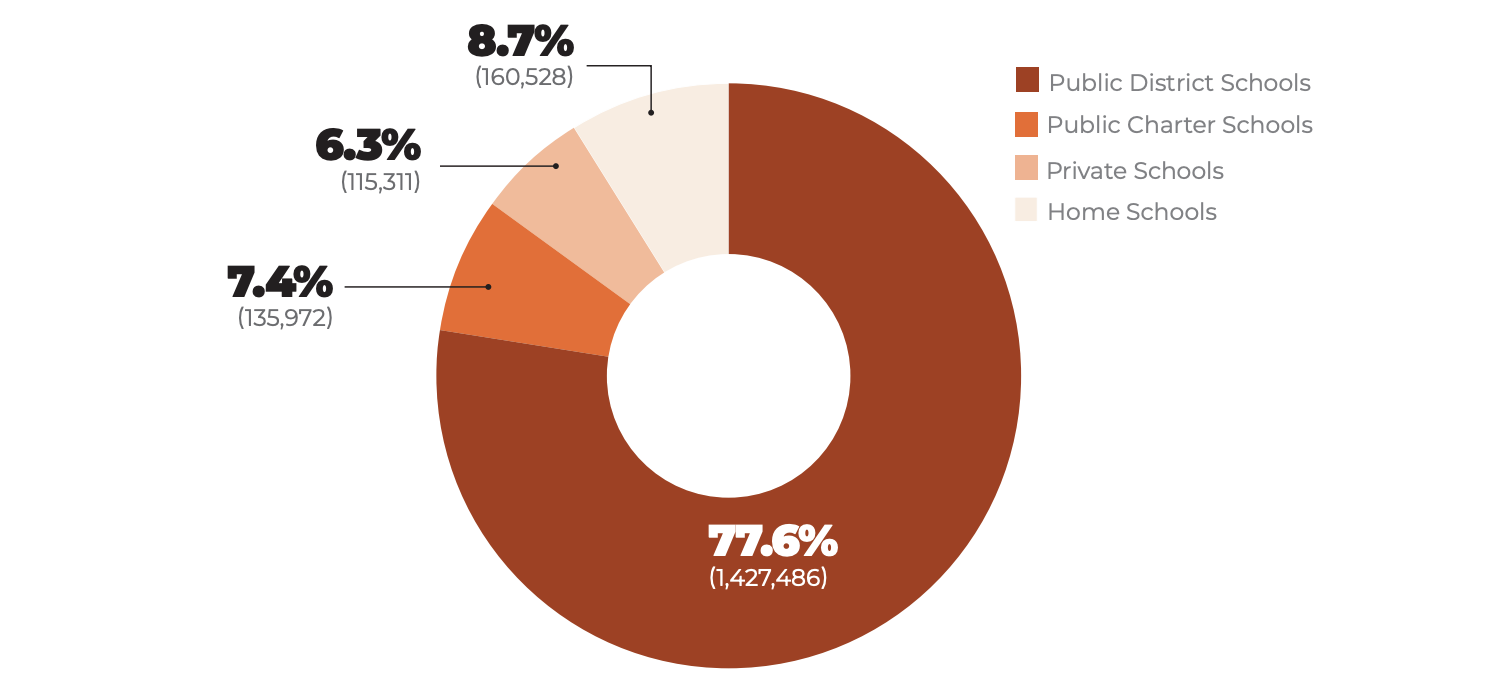
K-12 Student Enrollment Market Shares, 2021-22
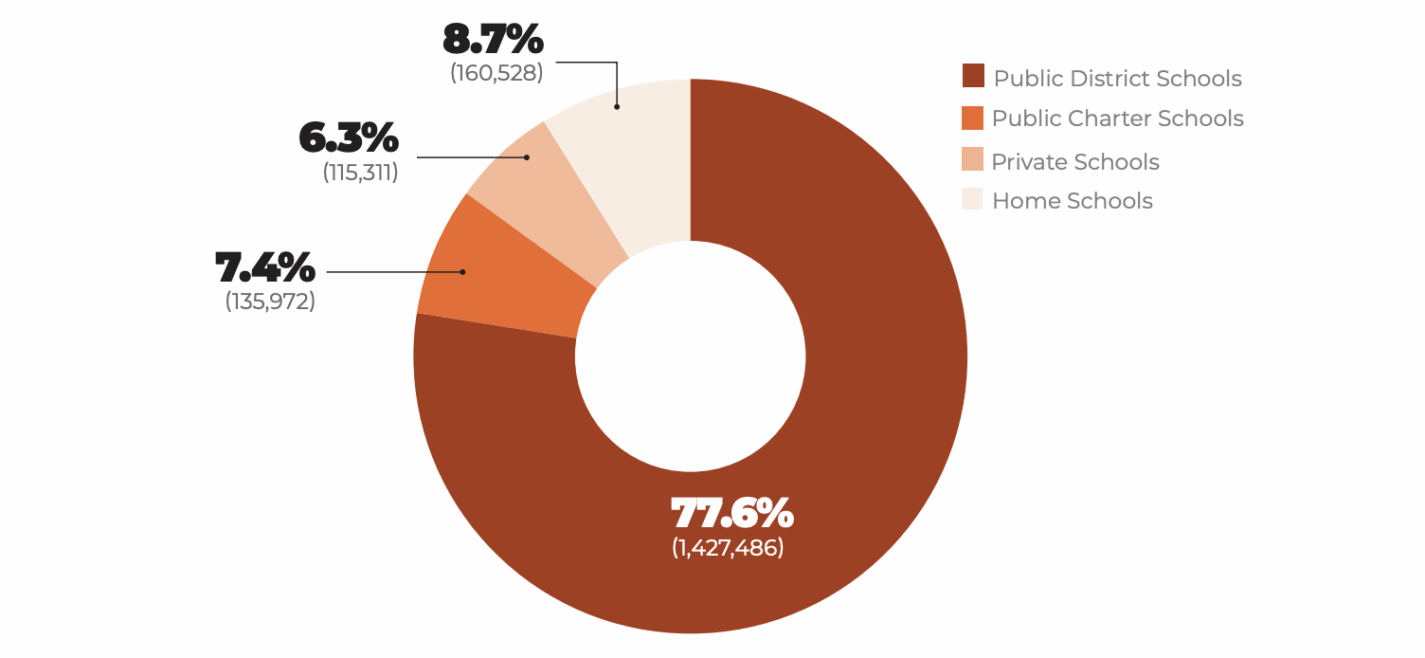
Sources: North Carolina Public Schools Statistical Profile; North Carolina Department of Administration, Division of Non-Public Education
Opportunity Scholarship Program Recipients, 2014-2023
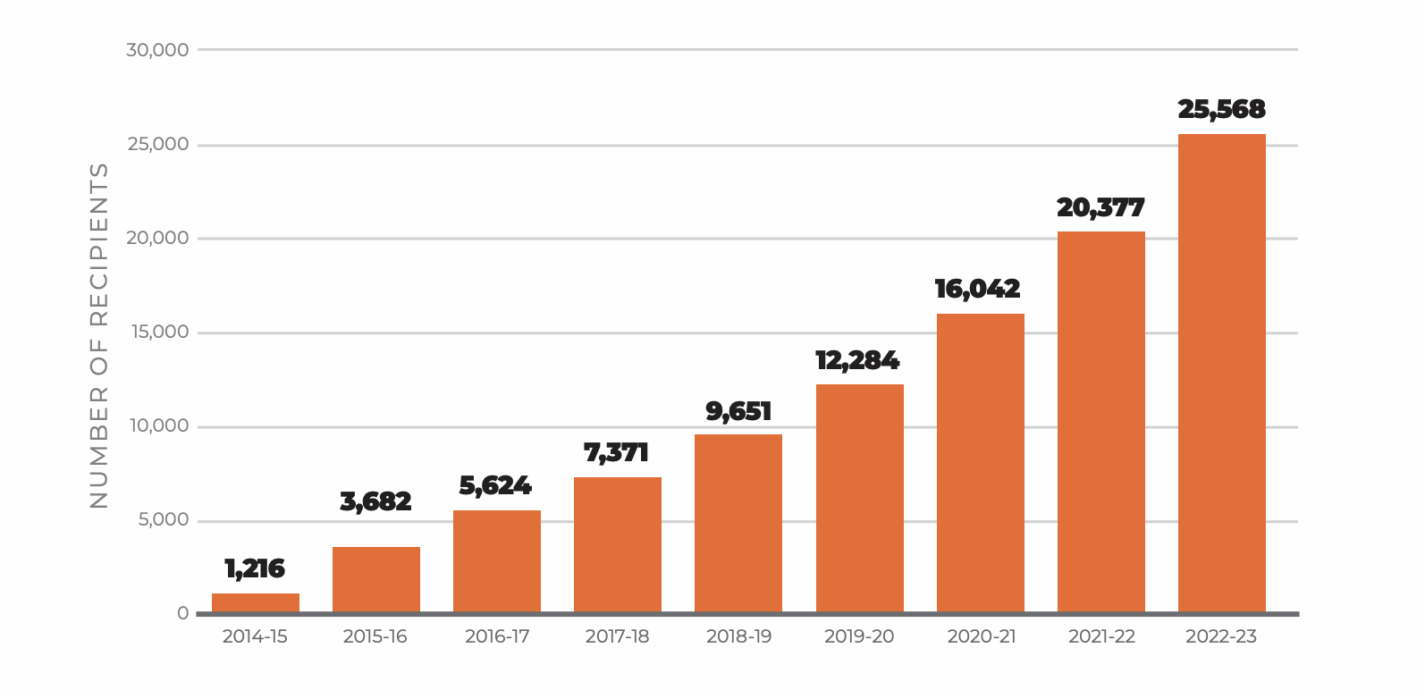
Source: North Carolina State Education Assistance Authority
Public and Non-Public School Market Shares, 2008-2022
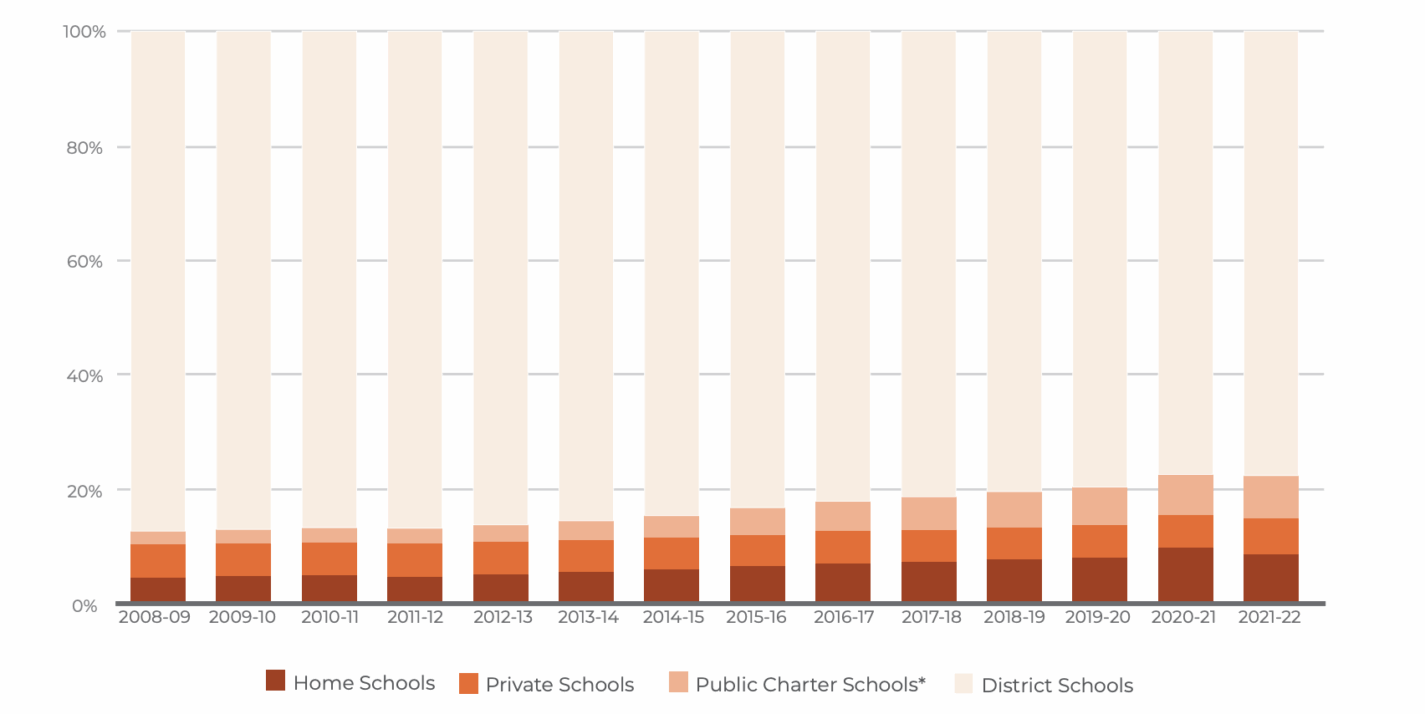
Sources: North Carolina Public Schools Statistical Profile; North Carolina Department of Administration, Division of Non-Public Education