Introduction
For patients living in rural North Carolina, quality health care can be hard to find. Currently, more than 3. 2 million people, or one-third of the state’s population, live a designated primary care health professional shortage area.
Unlike other states, North Carolina does not have a physician shortage. The supply of doctors in the state is increasing, relative to population growth. Instead, it has a physician distribution problem. As of 2018 (the latest data readily available), only 18% of North Carolina’s family physicians practice in rural areas.
As lawmakers consider ways to increase access to primary care across the state, it would be wise for them to pass legislation that allows nurse practitioners (NPs) to treat patients to the full extent of their clinical training and without physician oversight. NPs are advanced-practice nurses who have graduate-level clinical knowledge and training to provide patient care directly. They assess patients’ medical history, diagnose ailments, order lab work, and prescribe medications.
As of August 2023, if nurse practitioners want to practice in North Carolina, they must establish a collaborative practice agreement with a physician. The agreement outlines patient management and describes how the providers will interact. Interestingly, NPs are not required to be in the same geographic location as the overseeing physician, and they are required to meet only twice a year. The lack of oversight, then, demands asking why the contracts are even necessary.
Because nurse practitioners in North Carolina aren’t geographically tied to the collaborating physician’s practice location, one might believe the state’s existing practice arrangements wouldn’t necessarily hold back NPs from extending their reach into underserved areas. But these contracts can add uncertainty to the NPs’ practice. For example, an NP may want to operate his/her own clinic, but the collaborating physician moves to another state. The NP must now find another physician who is willing to sign onto a new collaborative practice agreement.
If a collaborating physician becomes employed by a hospital system, that hospital’s policy may also prevent the physician from signing or renewing a collaborative agreement with a nurse practitioner. Moreover, collaborative practice agreements can be expensive, which makes it difficult for some NPs to grow their own clinics. If an NP would like to recruit another to work at his/her clinic, the cost may be prohibitive because the collaborating provider asks for a specific percentage of the clinic’s revenue.
Key Facts
- Twenty-seven states and Washington, D.C., have granted full practice authority to nurse practitioners (as of 2023).
- Nurse practitioners are valuable assets to the health care workforce. According to the Kauffman Family Foundation, there were 4,582 professionally active nurse practitioners in North Carolina in 2023, many of whom work in a primary-care setting and focus on managing chronic disease.
- Nurse Practitioners will likely play a huge role in the future of the North Carolina health care workforce. There are still significantly more physicians than nurse practitioners however, between 2000 and 2017 the number of NPs in non-metro areas grew by 187%, compared to less than 10% growth for physicians in rural areas.
- A report conducted by Dr. Chris Conover of Duke University found that the economic benefits of extending full practice authority to advanced practice registered nurses would result in potential annual health cost savings ranging from $433 million to $4.3 billion.
- Ending the requirement for a contract with a physician would open opportunities for nurse practitioners to deliver patient care in more rural and underserved areas. Arizona, for example, granted nurse practitioners full practice authority in 2002. Five years later, the state reported a 73 percent increase in the number of nurse practitioners serving rural counties.
- In 2023, legislators introduced the SAVE ACT (HB 218, SB 175) which would grant full-practice authority for Advanced Practice Registered Nurses. Both bills stalled in committee.
Recommendations
1. North Carolina lawmakers should grant full practice authority to highly trained nursing professionals.
Policymakers should change how nurse practitioners and other advanced-practice nurse professions, i.e., certified nurse midwives, nurse anesthetists, and clinical nurse specialists, are governed in order to free them from their current constraints. Passing the SAVE Act would accomplish that.
Primary Care Professional Shortage Areas in North Carolina
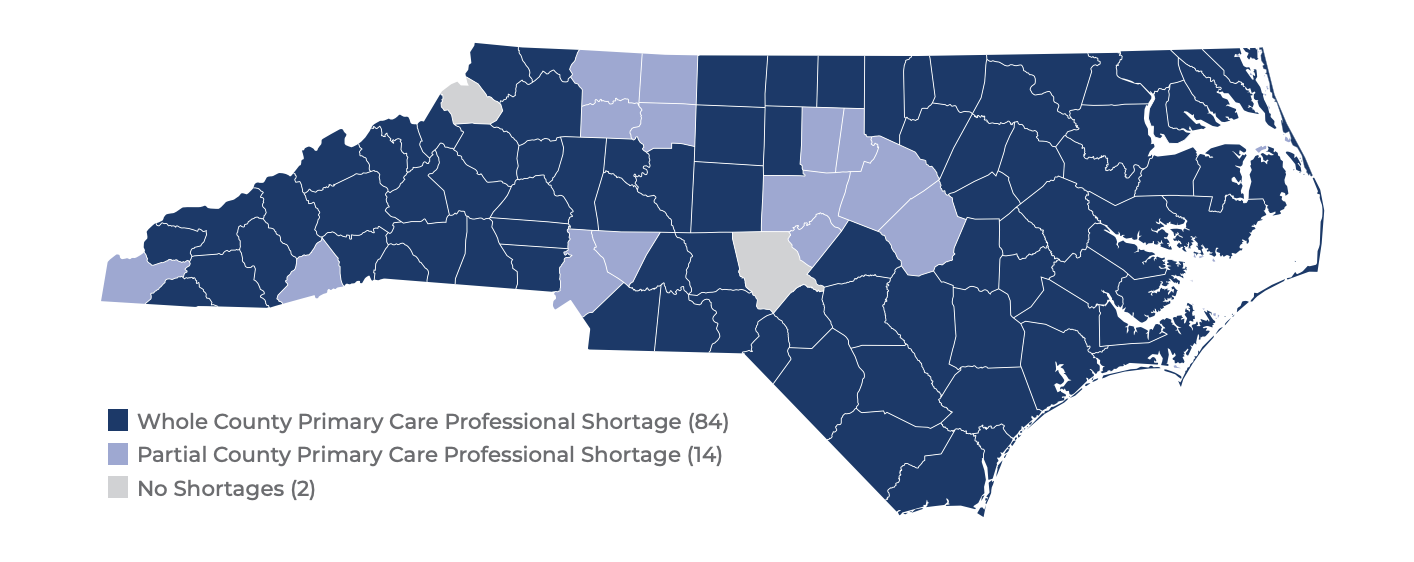
Source: North Carolina Office of Rural Health
The post Scope-of-Practice Reform appeared first on John Locke Foundation.