Last year, North Carolina was the only state expected to pass a budget that failed to do so. In fact, the General Assembly never even sent a budget proposal to Gov. Josh Stein’s desk.
One of the most contentious issues during negotiations was the Medicaid rebase, with disagreement over how much additional funding the program required and how to incorporate it into the budget. The Medicaid rebase is the budget adjustment that reflects the annual increase in the program’s operating costs.
Stein’s administration estimates the Medicaid rebase at $819 million, which would increase state appropriations for Medicaid in FY 2025–26 to roughly $6.99 billion — a 13.3 percent increase from $6.17 billion in FY 2024–25 and a 51.7 percent increase from $4.61 billion in FY 2022–23. A “mini-budget” bill passed last August allocated $500 million to the rebase, falling $319 million short of the amount Stein deems necessary.
In October, Stein cut Medicaid reimbursement rates to address the projected shortfall. Those reductions proved premature, however, as the program still had sufficient funding to operate in the near term — something underscored when the administration ultimately reversed the rate cuts in December.
Now, in March, Stein has declared the Medicaid shortfall urgent and proposed a “Critical Needs Budget” for FY 2025–26 to address “funding needs that cannot wait until next year.” The proposal primarily focuses on funding the Medicaid rebase and increasing compensation for teachers and other state employees.
if a $33.26 billion budget is sufficient to address North Carolina’s critical needs, why did the governor initially recommend spending nearly $400 million more?
Stein’s “Critical Needs Budget” in context
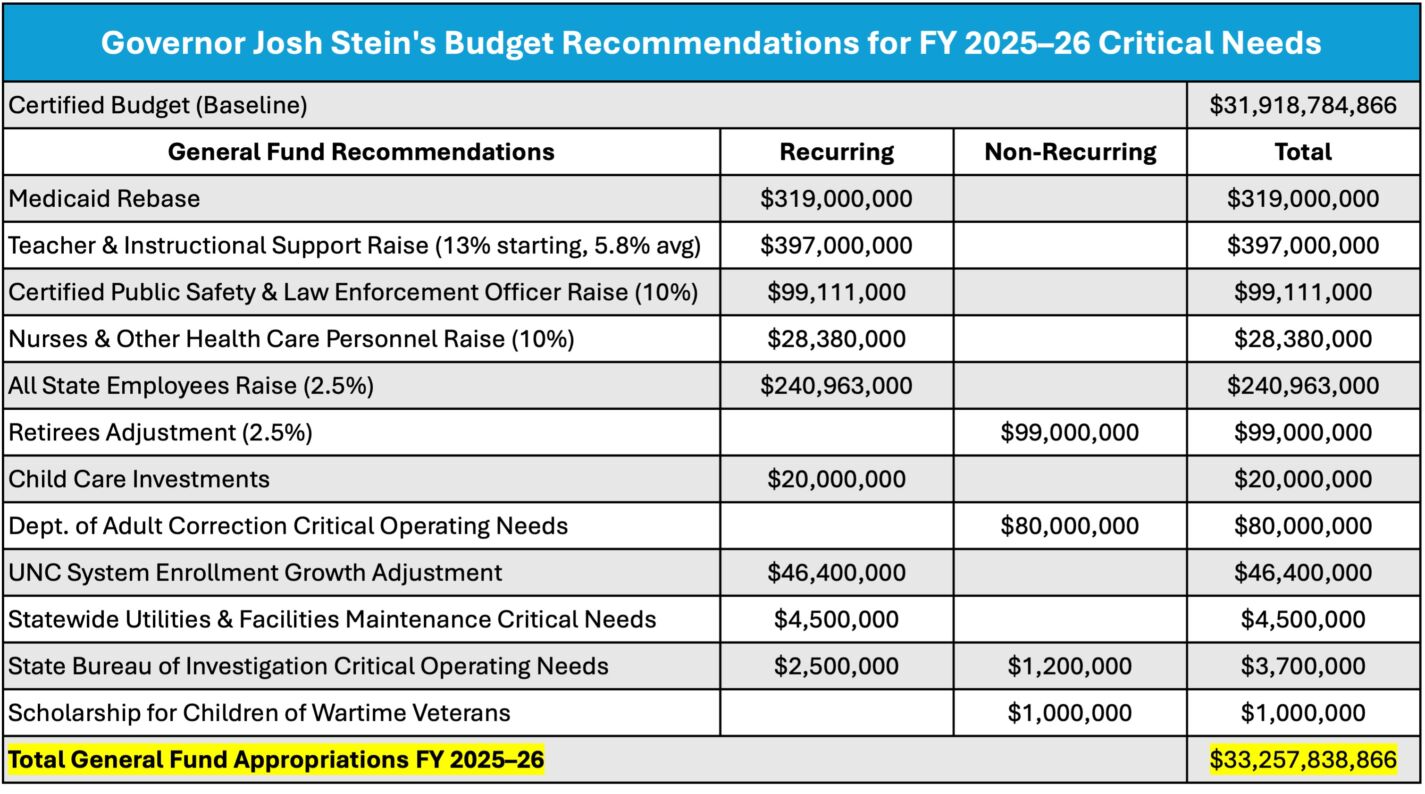
Stein’s proposal includes roughly $1.34 billion in General Fund adjustments for FY 2025–26, bringing the total recommended General Fund spending level to $33.26 billion, or about a 5.1 percent year-over-year increase.
For context, General Fund spending for FY 2024–25 totaled $31.65 billion, while the current certified FY 2025–26 budget stands at $31.92 billion, reflecting incremental spending increases from a series of mini-budgets passed over the past year.
Stein’s original FY 2025–26 proposal, released last year, would have pushed General Fund spending even higher, to $33.65 billion. By comparison, both the House and the Senate had previously agreed to a $32.59 billion General Fund budget for FY 2025–26.
While it is laudable that Stein’s revised plan is smaller than his initial FY 2025–26 proposal, the change raises an obvious question: if a $33.26 billion budget is sufficient to address North Carolina’s critical needs, why did the governor initially recommend spending nearly $400 million more?
Breaking down the critical needs
The governor’s proposal focuses primarily on four categories of General Fund spending:
- Medicaid rebase: The proposal allocates $319 million to address the projected Medicaid funding gap.
- Teacher raises: The plan includes $397 million for teacher and instructional support raises, including the restoration of master’s pay. Starting teacher pay would see an increase of 13 percent, while the overall increase would average out to 5.8 percent.
- State employee compensation increases: Stein’s plan also includes $241 million for a 2.5 percent raise for most state employees, $99.1 million for a 10 percent raise for public safety and law enforcement personnel, $28.4 million for a 10 percent raise for nurses and other state health care staff, and a $99 million one-time adjustment for state retirees.
- Other agency and operational items: The remaining funds address targeted areas across state government, including $80 million for the Department of Adult Correction, $46.4 million for UNC system enrollment growth, $20 million for child care subsidies, and smaller allocations for facilities maintenance, the State Bureau of Investigation, and scholarships for children of wartime veterans.
In addition to the General Fund adjustments discussed above, the proposal also recommends $10 million from the State Emergency Response and Disaster Recovery Fund to cover winter storm costs, along with $21.6 million from the Highway Fund to address receipt shortfalls at the Division of Motor Vehicles.
Closing thoughts
North Carolina’s failed budget process has created the conditions for proposals like the governor’s “Critical Needs Budget.” Yet labeling a proposal “critical” does not necessarily make every item within it urgent.
Recommendations such as restoring master’s pay for teachers may sound appealing, but research has consistently shown little connection between advanced degrees and improved student outcomes, making this funding difficult to justify as an urgent priority.
The Medicaid rebase should be fully funded, and teachers and state employees should receive raises for FY 2025–26. However, as Medicaid continues to consume a larger share of the state budget, policymakers must recognize the growing tradeoff between funding an expansive Medicaid program and supporting the state workforce.