Introduction
One truth about education has been underscored repeatedly over the last decade: a high-quality teacher is one of the most significant influences on student achievement. It’s a truth regularly confirmed by personal experience and research. As such, there are compelling reasons why North Carolina should work hard to ensure every classroom is staffed with a well-trained, caring, and qualified teacher.
Regrettably, many policies work against that happening. Reformers correctly identify education schools as the root of many problems. North Carolina’s teacher preparation programs too often attract mediocre or low-quality students. Graduates of the state’s education schools frequently lack mastery of relevant content along with the skills to teach literacy or basic math. What’s worse, most education schools in North Carolina reject this diagnosis and resist the impulse for reform.
Another barrier to ensuring classrooms are staffed with quality teachers is the North Carolina salary schedule. The teacher salary schedule awards pay differentials based on years of service or academic credentials (e.g., master’s or doctoral degree or national board certification) not on job performance, which is teaching students. If teachers are paid to teach, shouldn’t teacher pay, in part, be tied to how well students learn? The teacher salary schedule lays out clearly what teachers are rewarded for, and it’s not student learning.
Tying pay to time on the job and academic credentials creates disincentives for excellence. Great teachers will be limited in how much they can be paid. Oftentimes they will be paid the same as teachers who are not so great. Placing limits on what teachers can earn and when causes the best teachers to rethink a career in education. What sort of message does that send?
Likewise, knowing your pay will be the same regardless of job performance inevitably has made it possible for subpar teachers to remain in the workforce – for years. It’s a reality that seldom gets discussed but adversely impacts the education and future lives of millions of students.
One effort to help redress these concerns is the Professional Educator Preparation and Standards Commission (PEPSC). The commission was established to advise the North Carolina State Board of Education on matters of teacher preparation and entry as well as professional conduct and training. In February of 2023 the commission developed a proposal that would move teacher pay from the current model based on years of experience to a new one based on different levels of licensure and pay. The proposed model would award teachers significantly higher compensation than under the current plan and would also provide a range of licensure options from apprentice to advance leadership roles. The commission and State Board of Education are hoping to develop pilot programs to test the new pay model in selected school districts in the 2023-24 school year.
Teacher recruitment and teacher retention are two indicators of a healthy teaching profession. Compensation (pay and benefits) is one of the ways state policy influences teacher recruitment. After losing ground with small or no raises for the first half of the last decade, increases in salaries and in the value of benefits both helped to improve North Carolina’s ranking on average teacher pay to 32nd nationally and boost North Carolina’s teacher compensation to third best in the Southeast behind Virginia and Georgia. Other factors also influence recruitment and retention, however, including a high quality of life and low cost of living — two realities that can temper the importance of salary and benefits.
Lastly, a healthy and active array of alternative pathways to the teaching profession can enrich the profession with diverse teaching skills and help local school districts address growing vacancies in hard-to-fill subject areas. A law passed in 2019 did just that, making it easier to obtain an initial professional license and creating a new limited license for teachers already licensed in other states. The reform also allowed districts to rehire retired teachers in certain high-need areas.
Key Facts
- In the 2022-23 school year, North Carolina public schools employed 92,681 full-time teachers. Charter schools employed 9,127 full-time teachers.
- As of 2023, 23,418 teachers in North Carolina held National Board Certification. It is the highest number of board-certified teachers of any state. North Carolina teachers who achieve certification receive a 12% supplement to their pay.
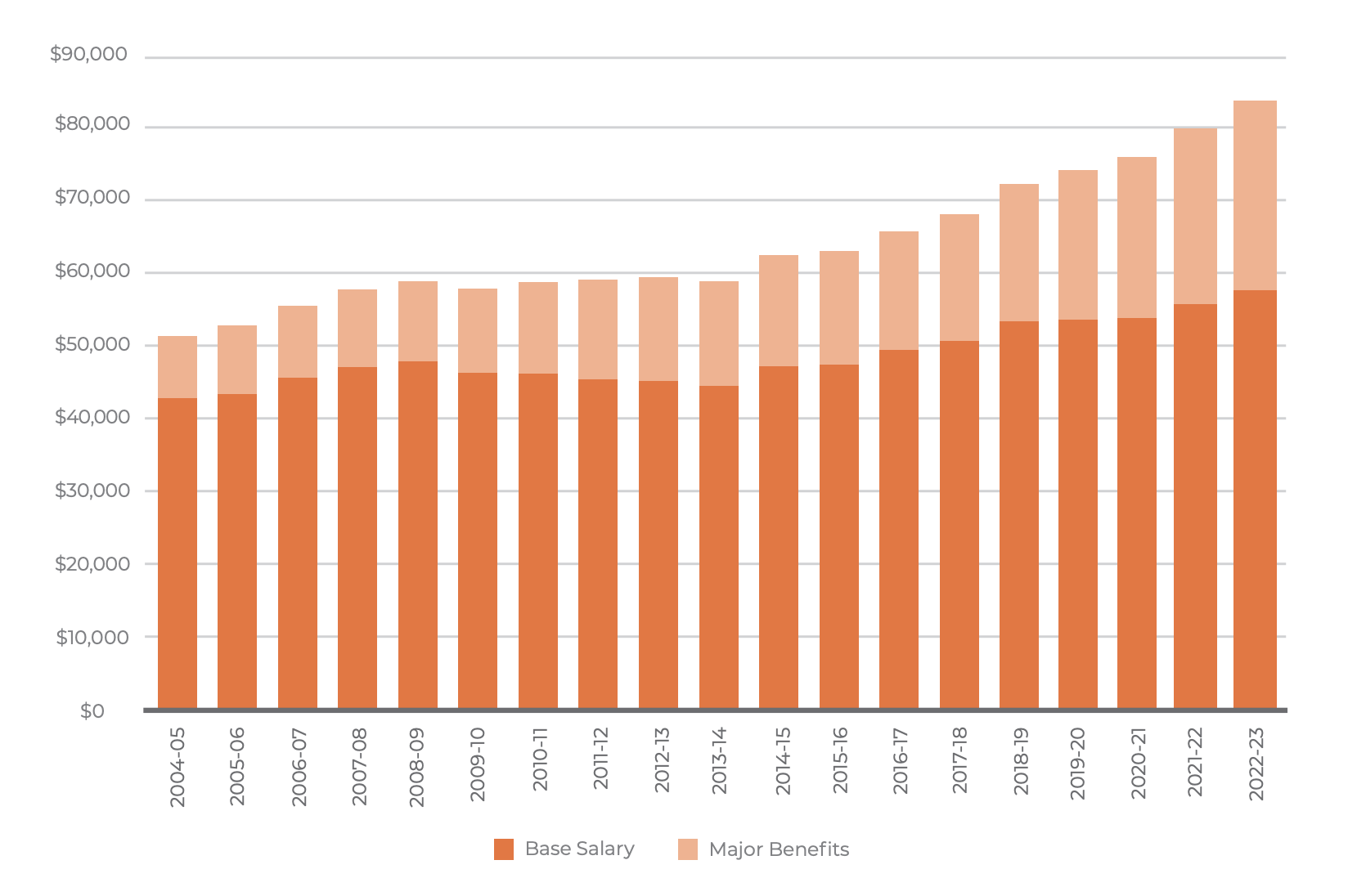
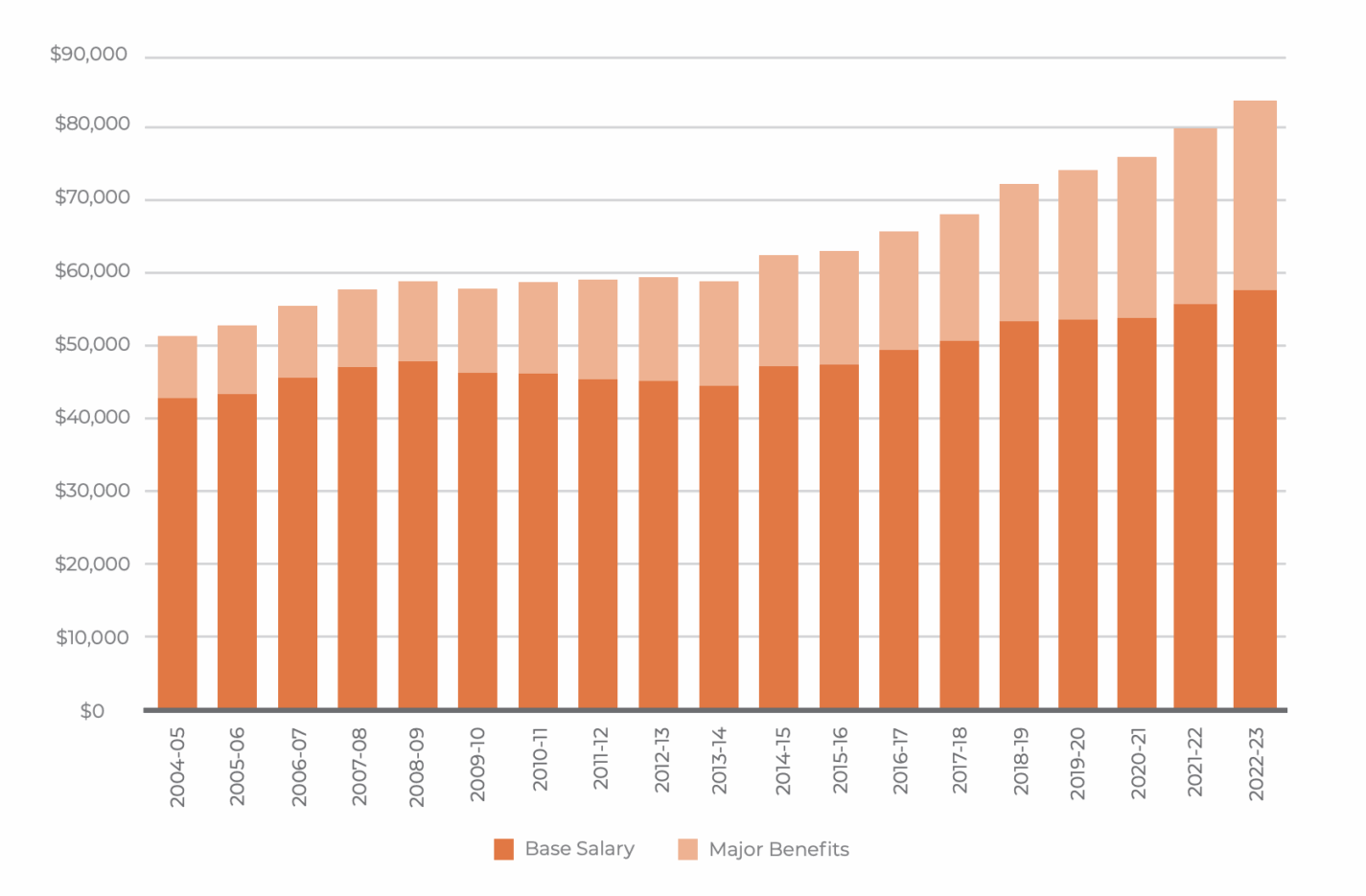
- Over the past decade North Carolina’s unadjusted teacher pay increased from $45,737 (2012-13) to $57,805 (2022-23), an increase of 26.3%. From 2001-02 to 2022-23, annual pay for state employees was increased by 42%, while teacher pay grew by 84.1%. Over the same period, the Consumer Price Index rose by 72.9%.
- According to the state salary schedule for 2022-23, a beginning teacher with a bachelor’s degree on a typical 10-month contract had a base salary range of $37,000. Likewise, a teacher with a doctorate with over 25 years of teaching experience and National Board Professional Teaching Standards Certification (NBPTS) will earn $68,410. These figures do not include local supplements.
- Most teachers also receive an annual salary supplement from the local school districts. In 2022-23, the average local salary supplement for teachers was $6,053. Two districts, Graham County Schools and Weldon City Schools, provided no local salary supplement. Chapel Hill-Carrboro Schools provided the largest salary supplement ($10,135), while Mitchell County Schools provided the smallest supplement ($216).
- For academic year 2022-23, North Carolina’s estimated average teacher pay was $57,805. This figure does not include benefits, which include Social Security, medical/hospitalization insurance, retirement benefits, and liability insurance. With the value of benefits included, average North Carolina teacher compensation was $83,786.
- The cost of benefits continues to climb, with hospitalization and retirement costs rising faster than all other costs. Over the past decade, the total cost of benefits for the average teacher increased from $15,242 in 2013 to $25,981 in 2023.
- According to the 2021-22 “State of the Teaching Profession in North Carolina” report, the teacher attrition rate for the state’s 115 school districts was 7.78%, slightly more than the 2020-21 rate of 7.53% and the 2018-19 rate of 7.39%. The rate includes teachers who retired or resigned due to personal circumstances.
Recommendations
1. Broaden teachers’ pathways to the classroom by easing or eliminating certifications or licensure requirements.
The case for certification is weak. There is little evidence that certification contributes to teacher quality or raises student achievement. One way to address these concerns is by encouraging alternative certification programs for teachers in North Carolina, just as the state already has alternative licensure programs. Another is to make the candidate selection process more democratic and focused on the needs of schools. Giving local education agencies more leeway in supervising and selecting candidates is a step in the right direction.
2. Eliminate the teacher pay schedule.
The current salary schedule has significant flaws. It limits what a teacher can earn and links salary to time on the job or educational credentials instead of student learning. Tying pay to time on the job provides a disincentive to excellence. To remedy these flaws, replace the salary schedule with grants to school districts that give districts and principals the flexibility they need to have more say over local pay schedules and ability to respond to individual personnel needs and labor markets. Since principals and superintendents are the most knowledgeable about teacher performance and local labor markets, they should have the flexibility to influence salary levels.
3. Raise Admission Requirements for Teacher Preparation Programs.
Standardized test scores of education graduates are some of the lowest of any subject area. Raising admission standards for colleges of education and calling for more rigorous subject-area course requirements would improve the quality of the graduates. In addition, providing greater academic value for students with rigorous instructional, research, or subject-specific backgrounds can boost the quality of the graduates and help schools develop graduates who have subject mastery and can effectively teach children of different backgrounds.
Average Teacher Compensation, 2022-2023
| Compensation | Amount |
|---|---|
| Salary | $57,805 |
| Social Security | $4,422 |
| Retirement | $14,162 |
| Health Insurance | $7,397 |
| Total Benefits Package | $25,981 |
| Total Average Compensation | $83,786 |
Source: Highlights of the North Carolina Public School Budget for Selected Years, published by the North Carolina Department of Public Instruction
Teaching Profession
Source: Highlights of the North Carolina Public School Budget for Selected Years, published by the North Carolina Department of Public Instruction