Share this Story on Facebook, X, Text, LinkedIn, Gmail, Yahoo Mail, or Outlook
There is a difference between redistricting and rigging. One is a constitutional necessity. The other is political temptation. Right now, Virginia stands at the crossroads between the two. On April 21st the voters will decide which way we turn.
Using current congressional delegation data and 2024 presidential vote totals, we can measure fairness in a straightforward way: compare a party’s statewide vote share in the last Presidential election to the percentage of congressional seats it holds. Basically, the larger the gap between popular votes and Congressional seats, the more distorted the map. Yes, it is a crude measure, but it is insightful and measurable across all states.
By that standard, the Commonwealth is currently one of the fairest large states in America. In Virginia, Democrats hold 6 of 11 seats or (54.5%) and Kamala Harris won 51.8% of the presidential vote in 2024. That creates a current seat/vote gap of just +2.7 points.
In district drawing terms, that is remarkably proportional. Compare that to:
- Maryland: a +24.9-point gap
- California: a +24.2-point gap
- North Carolina: a +20.5-point gap.
Virginia, thanks to a non-partisan map process blessed by its voters just a few years ago, is closer to voter proportionality than almost any state currently engaged in this distressing mid-decade redistricting. But that is about to change dramatically. Under the new Democratic map, Democrats would hold 10 of 11 Virginia seats (90.9%) compared to the presidential vote of roughly 52%.
That would create a projected seat/vote gap of +39.1 points, from a current gap of +2.7 points. That is not a tweak. It is not “fairness.” It is theft.
Virginia would move from one of the most proportional delegations in America to one of the most lopsided.
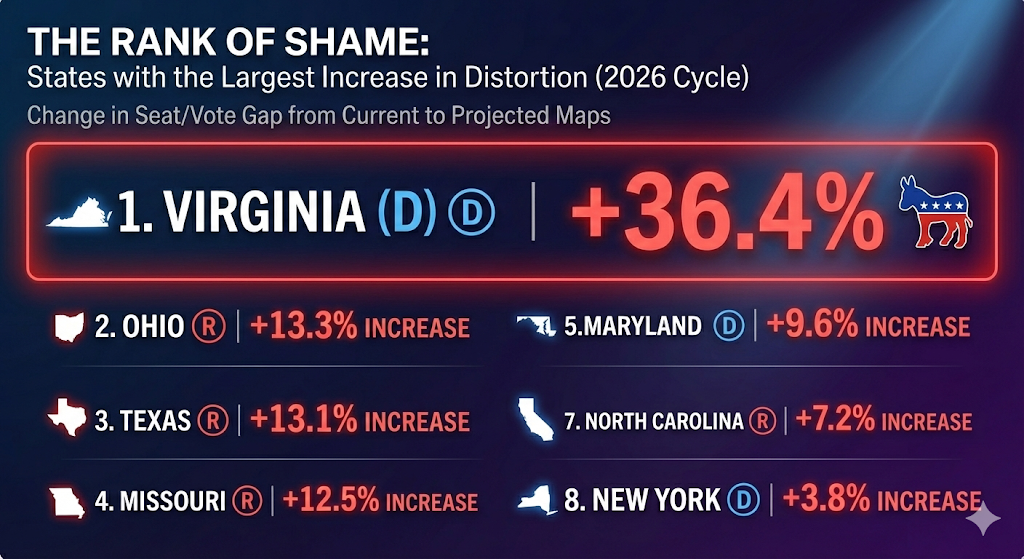
Among all states examined in current redistricting battles – and none of them should be doing this — Virginia would experience the single largest increase in distortion, a +36.4-point expansion in the seat/vote gap. No other state comes close.
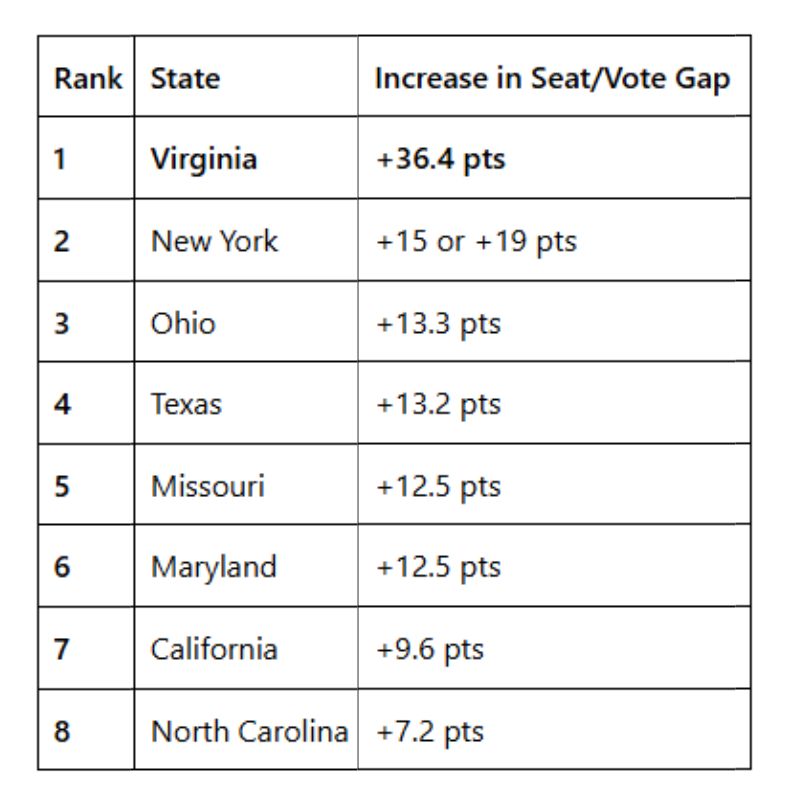
The National Picture: Who Benefits? What is “Unfair?”
The intentionally misleading ballot question in Virginia states:
Should the Constitution of Virginia be amended to allow the General Assembly to temporarily adopt new congressional districts to restore fairness in the upcoming elections, while ensuring Virginia’s standard redistricting process resumes for all future redistricting after the 2030 census?
The question of what is “fair” is critical to the fairness of that ballot question. Clearly, the new map is not “fair” on a state level as we have shown above, but does it ensure “fairness” nationwide?
When we aggregate the projected changes across mid-decade redistricting states, the likely outcome is a Democrat (CA, NY, MD, VA) pick up of between 14 and 15 seats, with a Republican (TX, OH, MO, NC) pick up of 9 seats. The net result is a likely Democrat pick up of between 5 and 6 seats. Republicans are seeing the adage “what goes around comes around” blow up in their faces. Interestingly, If Virginia opted against redistricting, the net outcome nationwide would be a wash.
More revealing evidence comes from a scatter plot of the data comparing vote share to projected seat share. When plotting:
- X-axis: 2024 statewide presidential vote %
- Y-axis: projected congressional seat %
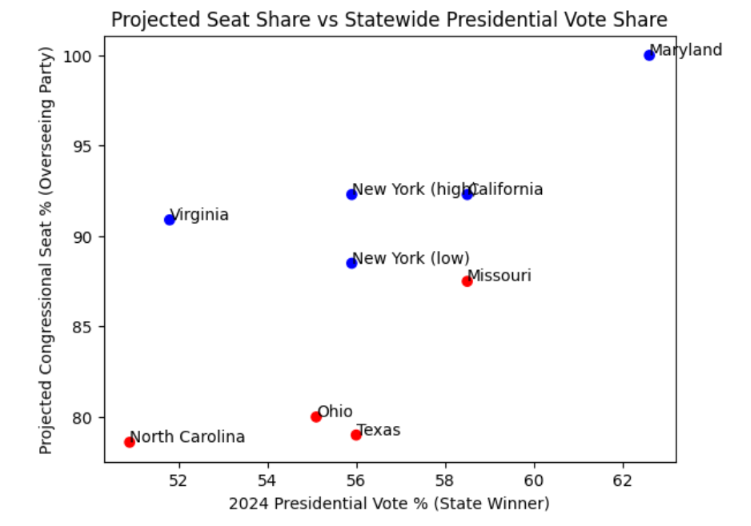
Every state sits above the proportional line (meaning both parties are engaged in advantage-seeking). But the most extreme outliers cluster in Democrat-controlled states:
- Maryland: 62.6% vote → 100% seats
- California: 58.5% vote → 92% seats
- New York: 55.9% vote → up to 92% seats
- Virginia: 51.8% vote → 91% seats
By contrast, Texas and other Republican States which are cited as the reason for “restoring fairness” for Virginia to redistrict, don’t even come close to what is happening in Democrat controlled states:
- Texas: 56% vote → ~79% seats
- Ohio: 55% vote → ~80% seats
- North Carolina: 51% vote → ~79% seats
Republican states clearly show distortion, but Democratic states show supermajority-level distortion.
The largest seat/vote gaps in the dataset are overwhelmingly in blue states. Virginia would vault to the top of that list. Virginia’s seat/vote gap would almost triple the gaps in each of Texas, Ohio, and Missouri.
Virginia’s current map is not perfect, but it reflects voter preference well. The proposed map would mean a party winning barely over half the statewide vote, capturing more than 90% of congressional seats.
That is not representation. That is unfair entrenchment. That is a classic gerrymander.
It also undermines the moral high ground the Democrats claim in this national redistricting debate. Democrats are criticizing partisan maps elsewhere, despite Democratic states having higher seat/vote gaps. Where Democrats hold full control, maps often produce the largest distortions.
If enacted, Virginia would become Exhibit A for gerrymandering. This is not the “Virginia Way” and reasonable voters on both sides should reject this proposed map (vote No).
Let’s all be honest, mid-decade redistricting is not about correcting census errors. Improving community of intertest or even ensuring fairness in the outcome of a multi-state, mid-decade redraw. It is about maximizing political advantage – a fact both sides should be embarrassed about. Virginia, before this month, was one of the few states with a constitutional barrier in place to limit such political influence.
But if this cycle proceeds as projected:
- Virginia moves from being the fairest to being the most distorted.
- Democratic-controlled states would hold the largest vote-to-seat disparities.
The national House balance shifts left not because voters shifted or because of an anti-Trump sentiment, but because district lines moved. This is election theft. But when a state that is currently near-proportional is deliberately reshaped into one of the most lopsided in the country, that is no longer routine mapmaking. That is escalation.
Virginia voters need to fully understand how disproportionate and out of line Virginia’s proposed redistricting map actually is. Beyond the fact that the newly drawn districts are not compact nor contiguous, voters need to know that the districts are drawn to give a partisan advantage that is indefensible by any measure of “fairness.”
While a judge in Tazwell has enjoined the redistricting amendment again yesterday afternoon, voters are still likely to have the final say on April 21st. Reasonable voters from both parties should reject this map. Vote NO!

Derrick Max is the President & CEO of the Thomas Jefferson Institute for Public Policy and may be reached at dmax@thomasjeffersoninst.org.
Share this Story on Facebook, X, Text, LinkedIn, Gmail, Yahoo Mail, or Outlook