Share this Story on Facebook, X, Text, LinkedIn, Gmail, Yahoo Mail, or Outlook
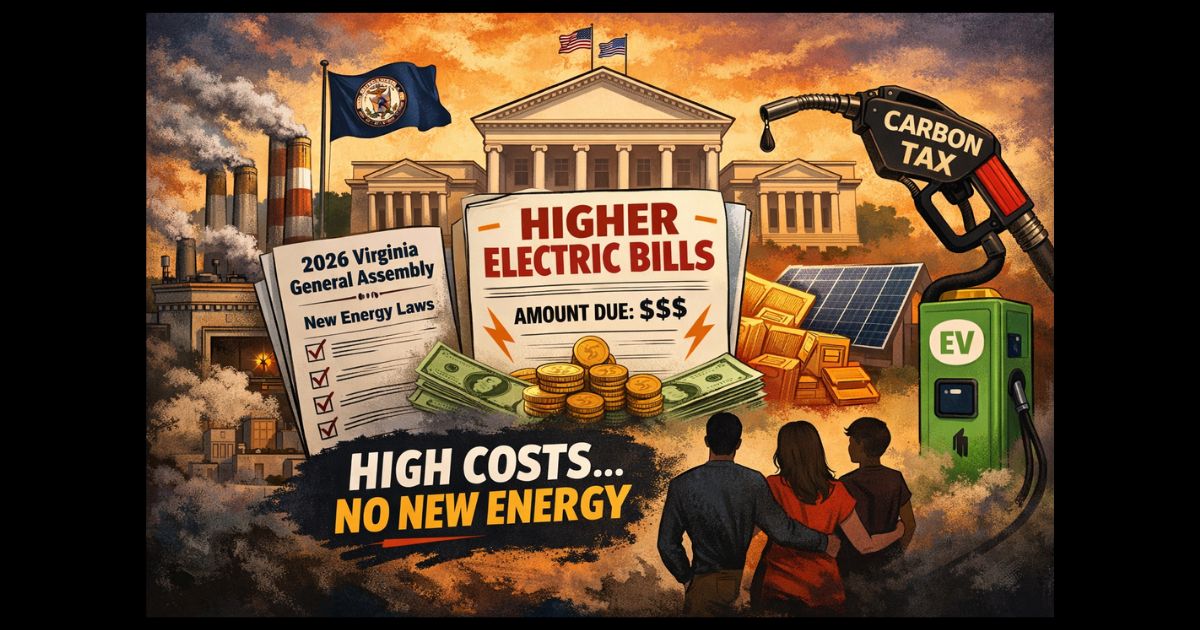
The 2026 Virginia General Assembly has passed at least nine separate new laws that will increase the cost of your electricity. Not one of the bills creates a single megawatt of additional energy for our use.
Most of the bills create new ways for the utilities to take money from all their ratepayers and spend it to benefit a small set of their customers, mainly based on their low income. Those will be praised by advocates as “affordability” measures, at least for those beneficiaries, but for the vast majority they will mean added cost.
Few of these bills have cost estimates. The list:
#1. Over the next twenty years, the largest increase in customer cost will come from the expansion of the Virginia Clean Economy Act to include construction of huge battery storage complexes, perhaps as much as 140 gigawatt hours of storage. The battery bill, also passed in 2025 but vetoed, will create a ratepayer revenue requirement in the tens of billions of dollars, much of it profits for utility investors as the plants are amortized over decades.
#2. Right behind the battery construction mandate in customer cost impact will be the return of Virginia to the Regional Greenhouse Gas Initiative (RGGI), which imposes a carbon tax on any power plant that uses natural gas, coal, oil or biomass as fuel. Based on the recent carbon auction price of about $25 per ton, Virginia’s many such plants will pay more than $550 million in carbon taxes starting no later than next winter.
The carbon tax amount will grow over time. One way or another, the carbon tax will come out of the pockets of the utility customers. When Virginia was last in RGGI, Dominion Energy Virginia simply passed the cost along as a surcharge on its monthly bills and may do so again.
#3. Another bill vetoed in the past but now likely to be signed by Governor Abigail Spanberger (D) allows Dominion and Appalachian Power Company to develop their own chains of retail electric vehicle charging stations. They are required to take on the task of promoting electric vehicle use in the Commonwealth and to develop incentives. The bill authorizes them to charge all their customers for the effort, including the many customers with no interest in owning electric vehicles.
Six more bills can be lumped together as transfer programs, taking money from all ratepayers and using those dollars to benefit only a few. Three are new programs and two are expansions of existing programs, but by expanding them the Assembly has guaranteed costs will rise higher than they would have otherwise.
#4. The two large electric utilities are directed to identify their low-income customers who use propane or heating oil and then take ratepayer dollars to convert those houses to electric heat. The goal is to convert 30 percent of those customers to heat pumps. No estimate of the conversion cost per residence was even discussed in the committee meetings.
#5. Another energy conversion program to be financed at least in part by ratepayers will install solar and battery storage equipment on private homes, this effort targeted at low-income, disabled or elderly energy users.
#6. Both of those programs will be dwarfed by the ratepayer impact of yet another bill that promises a “whole home energy efficiency retrofit” along with traditional weatherization services, this time intending to reach “all” the households eligible based on income. This is not limited to Dominion and Appalachian customers. There will first be a study to develop some cost estimates, which could dampen ambitions. And this is ambitious:
“Whole-home energy efficiency retrofit” means renovations or upgrades following a comprehensive energy assessment that are designed to increase housing quality, resident health, safety, resilience, and efficiency of a home while reducing energy costs, with such upgrades including but not limited to removing mold, lead, and asbestos, upgrading electrical panels, providing weatherization, improving energy efficiency, or conducting repairs necessary for electrification”. (Electrification is the real goal.)
#7. The existing Percentage of Income Payment Program is expanding to cover low-income households with higher incomes (up to 200 percent of the federal poverty guideline) and to provide a more generous subsidy for their electric bills. In this case, a fiscal impact estimate of up to $360 million per year was provided legislators, but nobody broke down how much that would mean customer monthly bills would rise to provide the subsidy cash.
#8. Dominion’s on-going program to bill all its ratepayers to cover the cost of placing select residential neighborhood lines underground was due to expire in 2028. The legislature has now granted it five more years of life. The State Corporation Commission told legislators this adds about $5 per month to a residential 1,000 kilowatt hour bill and much of the money is utility profit. At least this is just a five-year hit, unlike all these other bills.
#9 Legislation that only cleared the Assembly on the last day will authorize the burial of several miles of large transmission lines, several of which are planned to help Virginia import the electricity we need (because our General Assembly has no interest in building reliable generation in state.) The cost of buried construction far exceeds the cost of building them overhead, and customers will provide all the extra dollars.
This bill does impose some of the marginal cost on the locality in question, but all Dominion ratepayers will provide the rest of the money for these projects. The requirement that localities must share the cost may doom this idea, but the 2026 “Session on Affordability” thought it a good idea.
What Virginia needs is new generation, especially reliable generation such as natural gas or nuclear power. None of these bills, none of the dollars they will extract from family and business budgets, will build a single power plant.
Share this Story on Facebook, X, Text, LinkedIn, Gmail, Yahoo Mail, or Outlook