Share this Story on Facebook, X, Text, LinkedIn, Gmail, Yahoo Mail, or Outlook
As the Virginia General Assembly enters the final weeks of its 2026 session, a wave of new labor mandates is about to reach the Governor’s desk, two of which she has promised to sign, and one she seems inclined to support as well.
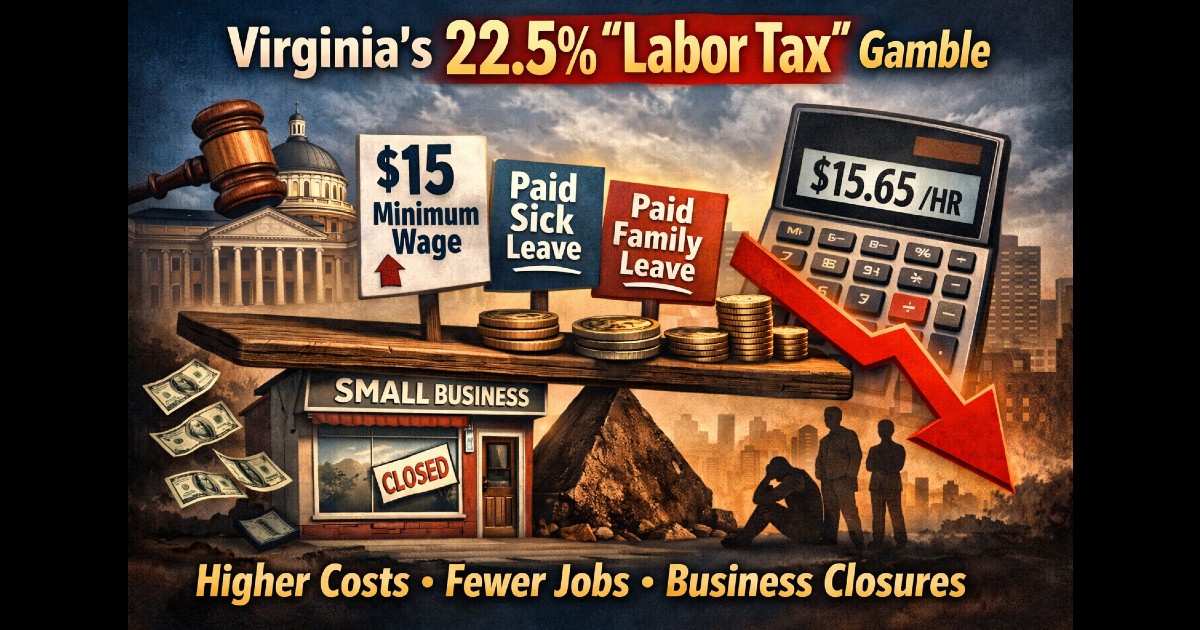
House Bill 5 (Paid Sick Leave), Senate Bill 2 (Paid Family and Medical Leave), and House and Senate Bill 1 ($15 minimum wage) are moving through both chambers, putting the Commonwealth on the verge of a fundamental transformation in its labor market — one that carries a rigid and predictable consequence for every small and medium sized business in the Commonwealth.
For those tracking the economic health of Virginia, these aren’t just “wage and benefit” bills; they represent a coordinated, multi-layered surcharge on the act of hiring. When you combine a $15 minimum wage with a new sick leave mandate and a paid family and medical leave tax, you are pricing growth out of reach for many smaller firms, and reducing employment for low productivity, entry-level employees.
The 3.3% Base
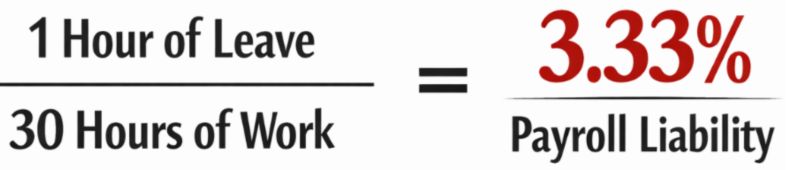
House Bill 5 mandates one hour of paid sick leave for every 30 hours worked. This calculates to a fixed 3.33% mandatory increase in the cost of labor.
With Virginia’s current minimum wage at $12.77, this mandate adds a “hidden” 43 cents to every hour worked. Across a year, that is nearly $900 in accrued costs per full-time, entry-level employee.
The 1% Second Layer
Senate Bill 2 mandates 12 weeks of 80 percent paid family and medical leave. This is funded through a payroll tax that is estimated to be equal to 1 percent of payroll. Again, using the current minimum wage, this equals almost 13 cents for every hour worked. Across a year, that is $270 in accrued costs for that same entry-level employee.
The above costs assume that there are no added costs to hiring coverage for employees that take leave. Of course, this is an unrealistic assumption. Most firms will use existing employees at overtime rates (1.5 times wage) or hire temporary help at a premium to cover for absent employees. Alternatively, employers may take the productivity hit of having one less employee – which has its own economic costs. It is safe to assume that the actual costs of absent employees are higher than the payroll hit estimated above.
The Compounding Effect
The real danger to employment, of course, lies in the “stacking” of these mandates. If both bills pass, this adds $0.53 to the cost of every hour of minimum wage employment or $1,170 per year in accrued annual employment costs for every entry level employee a firm hires.
But the above costs will increase with the passage of House and Senate Bill 1, which mandates a 17.46% increase in the minimum wage — to a new minimum of $15 per hour. With a higher $15.00 minimum wage, the above percentage-based costs compound as follows:
- New $15 Minimum Wage: Adds $2.23 per hour.
- Paid Sick Leave (3.33%): Adds $0.50 per hour.
- PFML Tax (1.0% estimated): Adds $0.15 per hour.
- Total Hourly Cost: $15.65
While the “headline” is a $15 minimum wage, the actual cost to hire a Virginian will jump from $12.77 to $15.65 per hour — a 22.5% explosion in total labor costs.
The Annual Bottom Line
These “cents per hour” translate into massive annual expenditures. Moving to this “new minimum with benefit surcharges” adds approximately $6,000 in new costs per full-time minimum wage worker annually. For a firm with 5 employees, that is a $30,000 hit; for 10 employees, it is $60,000; and for 20 employees, it reaches $120,000.
These costs erase the margins businesses use to expand, invest in new inventory, hire more employees, or to improve their services. Many smaller businesses, especially those in price competitive markets, will not be able to pass these costs on in the form of higher prices, and will be forced to close.
The Ripple Effect
When the minimum wage goes up, employers often increase pay for workers who were previously earning just above the new minimum to maintain morale, experience differentials, and internal hierarchy. At higher earnings levels, the cost of covering absentee employees is also higher. And, as the added costs of paid sick leave and paid family and medical leave are applied to the higher salaries, even more money will be drained from Virginia’s businesses.
The Bottom Line
Governor Spanberger’s administration has emphasized affordability, yet these mandates create a “tax wedge” that will either lower employment or drive-up consumer prices while suppressing longer term wage growth.
You cannot mandate prosperity or affordability by taxing the act of employment. Virginia’s economy will suffer under a 22.5% labor cost surcharge – which is nothing more than a formula for stagnation in the Commonwealth.

Derrick Max is the President & CEO of the Thomas Jefferson Institute for Public Policy and may be reached at dmax@thomasjeffersoninst.org.
Share this Story on Facebook, X, Text, LinkedIn, Gmail, Yahoo Mail, or Outlook