Share this Story on Facebook, X, Text, LinkedIn, Gmail, Yahoo Mail, or Outlook
By Ali Ahmad, Senior Fellow for Energy and the Environment
Over the last four years, I served as a senior aide to former Governor Glenn Youngkin, including as Policy Director and Deputy Chief of Staff for Strategy. One of my main roles was in support of the Governor’s weighty responsibility to review legislation sent to his desk by the General Assembly. A governor’s “bill review” is a critical but underappreciated part of the legislative process.
Governors get 30 days to review the hundreds of bills passed within 7 days of the end of the legislative session, and only 7-days to act on bills passed before that window — firm deadlines which bring a clarifying sharpness to the importance of words.
Words are important throughout the entire process, even before they are ink on paper. And “Affordability” is the most important word of the 2026 General Assembly session.
This is especially true for the party that holds Virginia’s three statewide offices and majorities in both chambers. Governor Abigail D. Spanberger’s disciplined campaign drove home the message that she would be laser focused on “affordability,” which she echoed again in her response to the State of the Union this week.
Speaker of the House Don Scott leveraged the affordability branding into a historic victory for his caucus. Scanning the press statements and social media posts of these two leaders and their allies, it’s abundantly clear they, too, believe that maintaining the “affordability” brand is essential to their continued electoral success.
Case in point: Speaker Scott’s valentine to the people of Virginia. Or the placards at the House Democrats press conference celebrating the death (so far) of a plethora of tax bills they, themselves, had proposed.
With the legislative crossover and “Budget Sunday” behind them, the 2026 General Assembly is now solidly in the phase where priorities of the Democratic majority can be measured by the black ink on the parchment on which the legislation is printed; not just the black pixels on a blue-lit screen in the palm of your hand as you scroll through Facebook or X.
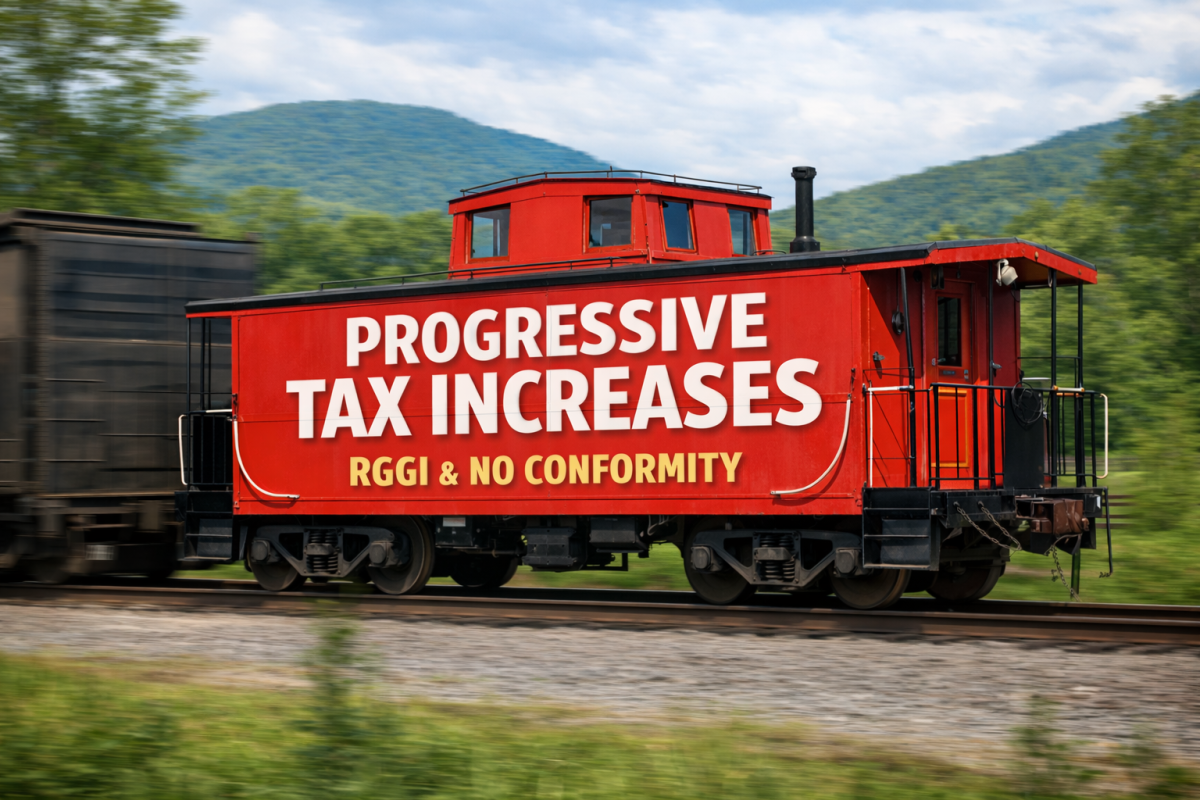
On Friday, February 20th, Governor Abigail D. Spanberger signed House Bill 29, a budget bill patroned by House Appropriations Committee Chairman Luke Torian, into law. Commonly known as the “caboose” budget, every two years another “HB 29” starts its life as a bill drafted and presented by the Governor and introduced in its original form by the House Appropriations Chair.
A cognate (SB 29) is introduced in the Senate, never to move, and sister bills designated HB and SB 30 are introduced as well, appropriating funds for the next biennium. Historically, caboose budgets are “clean-up” bills that sweep unspent balances back to the general fund or make other small adjustments needed in the last half of the second fiscal year of the biennial budget. Major policy changes are saved for the biennial budget itself, though the caboose moves through the process at a similar pace.
This year, the caboose budget led the entire process, rocketing through the House and Senate and was signed by the Governor before the House Appropriations Committee and Senate Finance and Appropriations Committee had even presented their markups of their respective biennial budgets.
According to the Legislative Information System, in the entire 21st century, HB 29 has always been signed into law at the tail end of the legislative session or the 30-day bill review period after session. That is if it made it to the Governor’s desk at all during the regular session.
So, what fueled the “rocket caboose” of the 2026 General Assembly?
For starters, 2026’s HB29 includes the illegal and constitutionally proscribed language to replace the Commonwealth’s grade-A Congressional voting map with the most aggressive gerrymander in the county. The need to race ahead of court challenges and speed up the disenfranchisement of rural and Republican voters to impact this November’s mid-term elections certainly led to the historically rapid adoption of a caboose budget.
This, alone, is an excellent example of the vast difference between the rhetoric and the reality of legislating. Governor Spanberger made clear during her campaign that she had “no plans” to launch this voter-picking scheme. Speaker Scott said that the “10-1” map would be “succinct and community-based.” But the lobster-like creature drawn by, and for, Delegate Dan Helmer to make another run at Congress, would make even George Orwell’s O’Brien blush at the pro-gerrymandering group using the moniker “Virginians for Fair Elections.”
But the Democratic gerrymander was not the only passenger on board the rocket caboose.
In stark opposition to the affordability agenda, and counter to the pledge of House and Senate Democrats that they did not and are not planning to raise taxes, HB 29 did just that.
First, it directs the Commonwealth to rejoin the Regional Greenhouse Gas Initiative (RGGI), an interstate compact which requires the imposition of a mandatory tax paid by everyone who uses electricity. No market incentive is created to lessen carbon production, making the scheme indistinguishable from any other regressive tax. Virginians were taxed to the tune of $828 million for the three years it previously participated in RGGI and saved $937 million after Governor Youngkin’s successful “RGGIcide.” A conservative estimate of the costs of reimposing the tax is $500 million per year paid by Virginia families and businesses; only to ratchet up over time.
Second, and much harder to track, is the fact that HB29 as introduced by Governor Youngkin largely conformed to the relevant tax cuts enacted by President Trump and Congress in H.R. 1, the Working Families Tax Cut Act, and included modified versions of “No Tax on Tips” and “No Tax on Car Loan Interest,” as well as reforms to make Virginia’s business climate more tax friendly.
As amended and signed by Governor Spanberger, the bill now reimposes those taxes, to the tune of $200 million of costs in FY26 put back on Virginians, as plainly stated in both the budget amendment language (“Striking the tax conformity language included in the introduced budget results in increased general fund revenues of $200.3 million in FY 2026”) and repeated during the presentation of the amendments to the biennial budget this past Sunday.
But this is a “long” session, and longer-still is the period the Governor has to review bills. While the “caboose” may have run far ahead, the record of whether the results match the rhetoric on affordability is not yet fully written. The first chapter, unfortunately, is not promising.
Ali Ahmad is a Senior Visiting Fellow at the Thomas Jefferson Institute for Public Policy.
Share this Story on Facebook, X, Text, LinkedIn, Gmail, Yahoo Mail, or Outlook