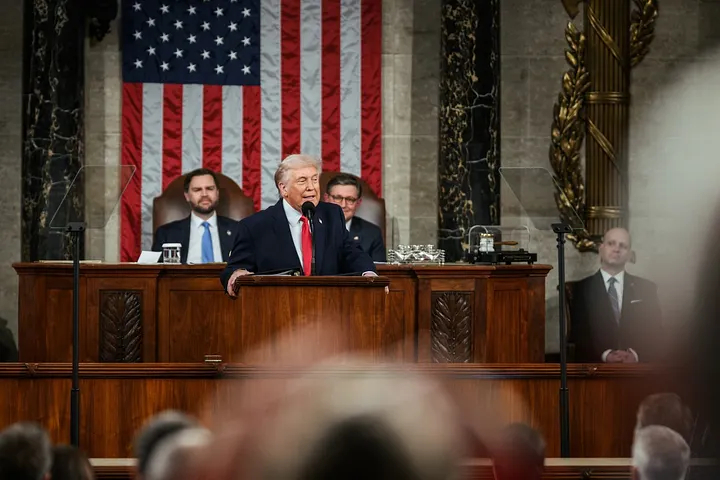
Recently, President Trump delivered his State of the Union address, underscoring a clear message: the State of the Union is exceptionally strong. As Americans remain deeply concerned about the economy, especially as it relates to inflation and cost of living, Trump rightly emphasized the robustness of the U.S. economy, a message that holds by nearly every economic indicator.
The economy is on the minds of most Americans, particularly the challenges posed by rising inflation that directly impacts their purchasing power.
But it’s not just economic factors weighing on the public; concerns about the integrity of our democracy and the state of our healthcare system loom large over voters’ minds too.
When it comes to healthcare, we must acknowledge that the last significant legislative effort to reform our system, the Affordable Care Act (ACA), debuted in 2010 with high hopes.
Unfortunately, this highly partisan law fell short of its three central goals: reducing healthcare costs, increasing insurance coverage, and improving care quality.
Despite the ACA’s well-intentioned reforms, it encountered notable shortcomings, such as dramatically increased premiums and only a slight increase in coverage percentages.
Additionally, many Americans found themselves compelled to switch healthcare providers, often experiencing a decline in the quality of care as they were forced to terminate long-time personal doctor relationships.
Trump sought to address these issues back in 2017 with a proposed “skinny repeal.” That bill, which cleared the House, faced a pivotal moment in the Senate when GOP Senator John McCain, battling brain cancer, returned from the hospital to cast his vote.
Without McCain, the tally was a narrow 50–49 against the repeal. The hope was that McCain would align his vote with his previous statements supporting necessary reforms to the ACA. Had he voted in favor, a tie would have allowed Vice President Pence to cast the decisive vote to pass the repeal.
However, McCain’s unexpected no vote dashed those hopes, leaving the ACA intact.
In his recent State of the Union speech, Trump recognized that a deeply fractured Congress would likely block any comprehensive overhaul of the ACA.
Instead, Trump’s plan outlines efforts to lower prescription drug prices and enhance transparency in medical care pricing while addressing Medicaid fraud. He will also establish direct federal payments to patients instead of routing through the large profit insurance companies.
He dubbed this initiative the “Great Healthcare Plan.” Although it doesn’t fully resolve the crisis, it represents a constructive first step toward reducing healthcare costs in today’s challenging political climate.
Turning to the preservation of American democracy, voter integrity remains a cornerstone issue. Trump has long argued that millions of non-citizens are voting in elections, resulting in victories for politicians who may not have the genuine support of the majority of eligible American voters. To rectify this, he advocates for the passage of the SAVE Act.
Returning to American concerns, the economy looms largest, particularly issues surrounding inflation and high interest rates. Trump asserts that he has taken substantive action to combat these challenges, and based on his comments, we can anticipate significant progress ahead.
When Trump assumed office, the inflation rate stood at 2.9%. Under the prior administration, it soared to a staggering 9.1%. The reduction to 2.9% was largely due to the Federal Reserve tightening the money supply and raising interest rates dramatically.
Fortunately, Trump managed to lower inflation to 2.4% through his supply-side economic policies, which include reducing regulations, maintaining low corporate tax rates, and fostering an environment conducive to business investment.
Trump has keenly recognized that much of the inflation stems from soaring energy prices and from multi-trillion-dollar annual federal budget deficits.
In response, he took swift action to boost domestic energy production. That will continue to reduce energy prices and put downward pressure on inflation.
He is trying to reduce government spending to cut the budget deficit, but Congress makes any budget cuts nearly impossible.
Trump will increase tax revenue by keeping the current tax rates and growing the economy. He continues to increase government revenue by collecting hundreds of billions from his very successful tariff program. But that looks to be very challenging.
Looking ahead, after addressing global conflicts that may temporarily spike energy costs, there is an expectation that increased domestic production could help stabilize or lower energy prices. As this unfolds, interest rates are expected to follow suit.
Trump’s policies are setting the stage for vigorous economic growth, low inflation, and low unemployment. More importantly, these measures will foster opportunities for every well-prepared American. He calls it “the Golden Years.”
Indeed, the state of the American economy is strong, and it is poised for even greater strength as the year progresses.
Agree/Disagree with the author(s)? Let them know in the comments below and be heard by 10’s of thousands of CDN readers each day!