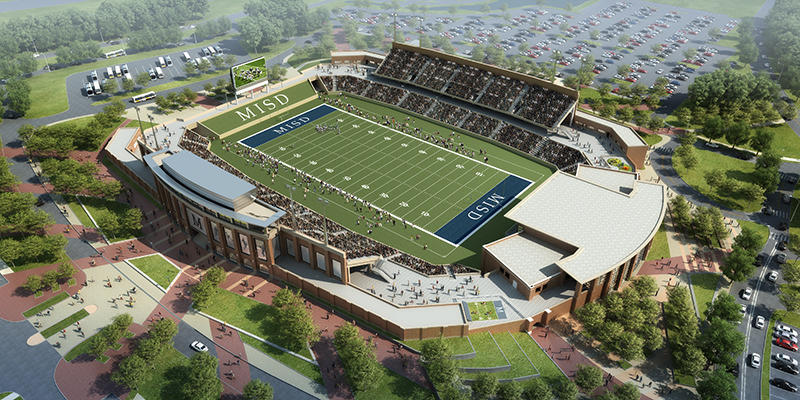
Texas is home to some of the most opulent high school football stadiums in the U.S. In fact, according to one recent ranking, the Lone Star State is home to 8 of the 10 most expensive stadiums nationwide, with only Ohio’s Tom Benson Hall of Fame Stadium ($175.8 million, inflation-adjusted) and Georgia’s Phillip Beard Stadium ($62 million) making the list.
Given Texas public education’s penchant for pricey stadiums, it’s only fitting to ask—which one(s) cost taxpayers the most?
To answer this question, the Houston Chronicle’s writers compiled a helpful list that spotlights expensive high school football stadiums and ranks them according to cost. Their article—which appeared to contain a few very minor slip-ups, as noted in #5 and #7 below—is quite illuminating, especially when combined with other context, like student enrollment and outstanding debt.
Thus, without further ado, here are the top 10 most expensive school district stadiums in Texas and some supplemental detail.
#10: Clear Creek ISD’s Challenger Columbia Stadium
#9: Beaumont ISD’s Doggett Family Stadium
#8: Aldine ISD’s WW Thorne Stadium
#7: Prosper ISD’s Children’s Health Stadium
* As of this article’s publication date, the Houston Chronicle lists “Ponder” as the school district home to the Children’s Health Stadium, instead of Prosper.
#6: La Porte ISD’s Bulldog Stadium
#5: Conroe ISD’s Woodforest Bank Stadium
- Opening Year: 2012
- Cost: $59.6 million
- Capacity: 10,000 (Includes “artificial turf”).
- 2024-25 Enrollment: 72,914
- FY 2024 Total Debt: $3,046,297,065
- 2024 Total Debt Owed Per Student: $41,779/student
* As of this article’s publication date, the Houston Chronicle lists Woodforest Bank Stadium’s capacity at “18,000.” This estimate appears to be almost double its advertised capacity, i.e. “a 10,000-seat artificial turf stadium.”
#3: McKinney ISD Stadium & Community Event Center
#1: Cypress-Fairbanks ISD’s Federal Credit Union Stadium
The list above is enlightening in a few regards.
First, it is obvious that Texas’ most expensive high school football stadiums are centered near Houston and in the Metroplex. Outside of those two regions, pricey sports palaces appear less common.
Second, most of the school districts noted above are deeply in debt. Consider that 6 of the 10 aforementioned ISDs have accumulated debt that, in the aggregate, exceeds $1.4 billion (i.e., Cy-Fair: $4.76 B; Katy: $3.75 B; Prosper: $3.27 B; Conroe: $3.05 B; Aldine: $1.98 B; and Clear Creek: $1.48 B). The top 2 ISDs alone owe more than $8.5 billion, which is a truly staggering sum considering the size of the districts. Of course, these totals include more than just stadium spending; but the smaller portion (i.e., stadium extravagance) may help explain the larger problem (i.e., excessive debt), as it suggests a tax-and-spend mindset that places a premium on luxury.
Third, an odd relationship exists between student enrollment and stadium seating capacity. For instance, in La Porte ISD, the district’s stadium contains more seating than there are students enrolled. In other instances, like Allen ISD, seating capacity is nearly on par with the number of students attending. In yet another instance, the seating capacity in Beaumont and McKinney ISDs’ stadiums are roughly half the student population, which includes healthy amounts of elementary and middle school students. From an outside perspective, it appears as if these districts may have overbuilt, especially in light of larger enrollment decline trends—but admittedly, I am not a seating capacity expert, so perhaps these are curious-but-appropriate numbers.
Whatever the case, it’s clear that ISDs enjoy spending Other People’s Money on colossal creations and may even be engaged in an “arms race,” of sorts. This begs the question: Do these mile-high expenditures and debt advance the core function of Texas public schools, i.e., to teach children to read, write, and do math? If not, then perhaps it’s time to press the Legislature to adopt tax and spending constraints to prompt a more thoughtful and prudent handling of taxpayer resources.