Share this Story on Facebook, X, Text, LinkedIn, Gmail, Yahoo Mail, or Outlook
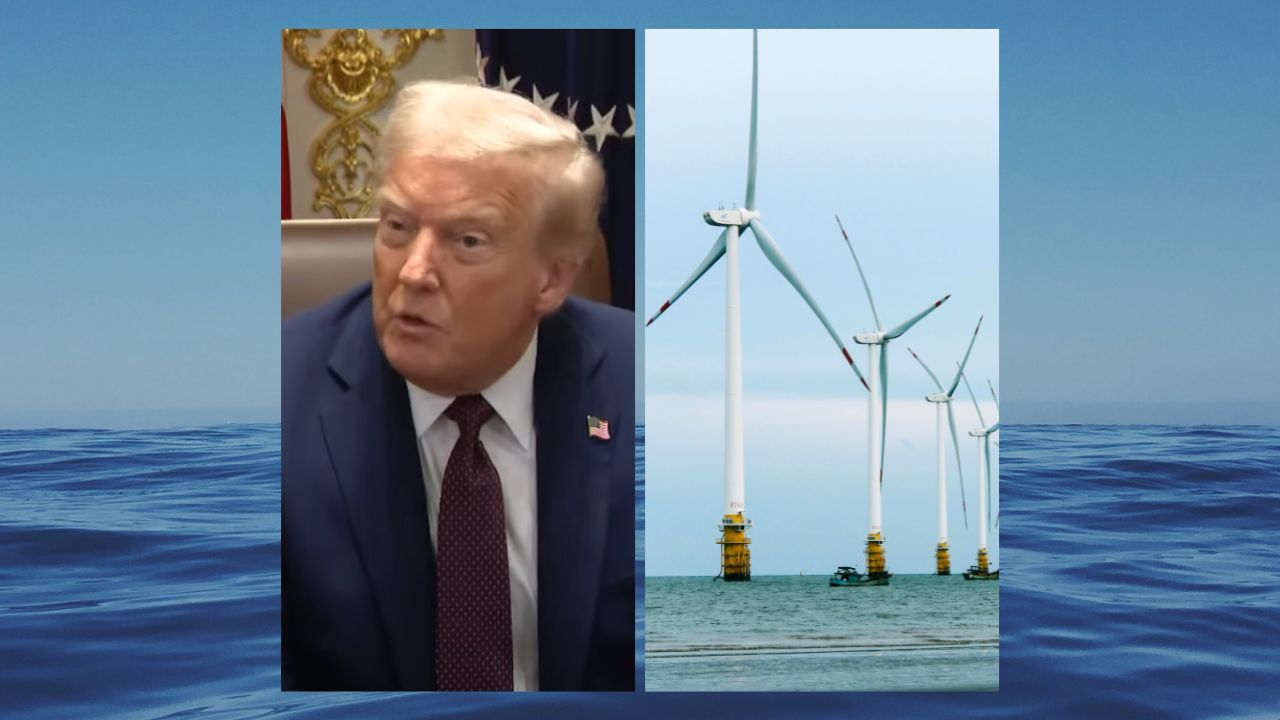
President Trump’s decision to suspend Dominion Energy’s massive Coastal Virginia Offshore Wind (CVOW) project is sure to stir up another gale of political fights across the Commonwealth. While some will hail it as a triumph for fiscal and national security; others will see it as an assault on clean energy. Both sides are worthy of debate before such projects are ever approved but are now trumped by one single fact – ending this project at this point of construction will strand at least $8 billion on Virginia ratepayers without getting a single kilowatt of power in return.
CVOW is no ordinary renewable project. It was created by legislative command. The 2020 Virginia Clean Economy Act (VCEA) declared Dominion’s 2.6-gigawatt wind farm “in the public interest,” effectively tying the hands of the State Corporation Commission and guaranteeing Dominion full cost recovery and profit. The risk doesn’t sit with shareholders — it sits with Virginia’s ratepayers.
The Thomas Jefferson Institute opposed that structure from the start. We warned that forcing captive customers to underwrite an unproven, high-cost project located in a hurricane prone region would expose Virginians to escalating bills with little accountability. Yet when a group recently asked the federal government to shut CVOW down, we declined to join. Why? Because government shouldn’t pick winners and losers — not when it mandates projects, and not when it stops them. Especially when a project is in its final stretch and no economic analysis of such a decision has been completed (or shared).
If the project were canceled in its final buildout phase, Dominion would still seek recovery for billions in sunk costs, leaving consumers paying for turbines that never turn. That would be even worse for ratepayers than finishing the project.
The Trump administration’s pause is tied to classified national security concerns involving foreign-made components — undersea cables, turbine electronics, and data systems linked to Chinese suppliers. Those concerns are legitimate. The U.S. has already barred Huawei from telecom networks for similar reasons, and it would be naive to ignore potential risks in critical energy infrastructure.
But these questions should have been asked before Virginia mandated offshore wind. Federal vetting and domestic sourcing reviews are sensible. A political freeze near the end of construction is not. National security should be pursued with transparency and prudence, not used as a blunt instrument that could leave ratepayers holding a massive bill.
Trump’s suspension also covers Vineyard Wind 1 off Massachusetts and Revolution Wind serving Rhode Island and Connecticut. Those projects are merchant developments, funded by private investors and backed by long-term contracts — not guaranteed profit. When costs spiked, their developers had to renegotiate or face losses. That’s how markets work. Such projects operate on sound economic analysis, not political calculations.
Dominion’s project, by contrast, is rate-based within a monopoly system. Every dollar Dominion spends ends up on customer bills through state-approved riders. Vineyard and Revolution operate under market discipline; CVOW is a political command.
Once construction begins, unwinding a project like this becomes legally and economically complex. Pulling the plug would waste billions, damage Virginia’s business reputation, and disrupt port and manufacturing jobs that have only recently taken root in Hampton Roads. Even market skeptics should recognize the importance of contract stability and predictability.
Worse, Virginia is in the middle of an energy crisis. While CVOW is expensive and lacks the reliability of dispatchable thermal energy options that don’t rely on the weather — like gas, nuclear or even coal – the 176-turbine CVOW will generate enough power for 600,000 homes. At a time when PJM, Virginia’s regional grid operator, is failing to procure the energy it needs to ensure grid stability, cancelling this project will be a huge blow to the entire region.
Not to mention that ratepayers would be further strapped with paying for even more Renewable Energy Certificates to make up for its failure to meet the renewable energy mandates under the VCEA.
Anticipation of CVOW’s completion has also delayed or put off investments in other energy-producing options. Cancelling the project at this stage, given that developing sufficient replacement capacity would require significantly more time than completing CVOW, may pose risks to all residents of Virginia.
If Trump’s pause creates a valuable opportunity to correct important national security concerns that may have been overlooked in the zealous pursuit of clean energy, so be it. If it leads to a reconsideration of the Virginia Clean Economy Act’s mandates even better.
But reform in energy should come from Richmond, not Washington. Lawmakers should rewrite the VCEA, remove its one-size-fits-all renewable mandates, and restore the State Corporation Commission’s authority to judge prudence and cost-effectiveness. Energy policy should balance economics, reliability, and security — not political timelines or ideological goals. If anything, this pause should wake up Richmond to the fact that Virginia’s energy future can’t be based on projects that rely on real weather, or political winds.
Virginia’s offshore wind story shows how risky it is when government drives energy decisions by decree. One administration mandates a massive buildout; the next halts it over security fears. Businesses can’t plan around that. Ratepayers shouldn’t have to pay for it.
Offshore wind can still have a role in Virginia’s energy future — but only if it can compete on a level playing field alongside nuclear, gas, and other dispatchable resources. National security and fiscal responsibility both matter. The right path is steady reform, not political whiplash.
Trump’s pause isn’t a punishment. It’s a reminder that sound energy policy must start with accountability, transparency, and the consumer in mind. If Virginia uses this moment to rethink its mandates and safeguard its grid, some good may yet come from this latest Washington storm.

Derrick Max is the President and CEO of the Thomas Jefferson Institute for Public Policy. He can be reached at dmax@thomasjeffersoninst.org
Share this Story on Facebook, X, Text, LinkedIn, Gmail, Yahoo Mail, or Outlook