I was recently quoted in an article in the Carolina Journal that asked, “Are progressives strategically running in NC GOP primaries?” I noted that such occasional infiltrations are an inevitable part of our system:
“Having ‘unwelcome guests’ as candidates is a natural consequence of having a primary system (as opposed to nominating conventions),” Jackson told Carolina Journal. “It is exacerbated by North Carolina’s open primaries, which are now mandated by law.”
Although there is little evidence to suggest that such efforts are successful, Democrats resort to this tactic with some regularity. This year seems to have a bumper crop of such candidates.
Noteworthy recent runs by “Republicans”
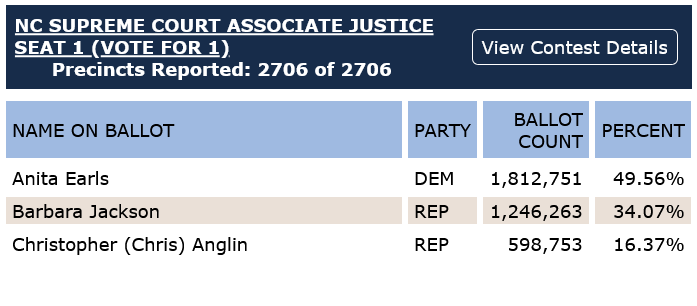
Perhaps the most prominent and successful example of a “fake Republican candidate was Chris Anglin, who switched parties to run as a Republican for North Carolina Supreme Court in 2018. His effort led to the defeat of incumbent Republican Justice Barbara Jackson. A quirk in the 2018 election allowed multiple candidates of the same party to run in judicial general election contests. Anglin took advantage of that loophole to split the Republican vote, allowing Democrat Anita Earls to win despite receiving less than half of the total vote.
Dallas Woodhouse, executive director of the North Carolina Republican Party, called Anglin a “fraud” who “partnered with Democrats in a sneaky, dirty way to fool the electorate.”
It would be much more difficult for fake Republicans to beat or damage real Republicans in a Republican primary. Such an effort would take money and organization, which would alert Republicans to what is happening and cause them to reject the interloper. When Anglin ran for the Republican nomination for the 2019 “do-over” election for the 9th congressional district, he received only 1.26 percent of the vote.
There was also a concerted effort by progressives to defeat Madison Cawthorn in the 2022 Republican primary for the 11th District. As I wrote, that showed the difficulty of such an effort. The leaders of the “fire Madison” campaign added around five percent of voters (who changed registrations to vote in the Republican primary) at best. They also backed Wendy Nevarez, rather than Cawthorn’s most prominent challenger, Chuck Edwards. Nevarez received 5.13 percent of the vote in the primary, indicating that few “regular” Republicans supported her.
(Former?) Democrats flock to Republican General Assembly races
A group calling itself NC Educators on the Ballot (NCEB) has recruited six candidates to run against Republicans in the Republican Primary. They are:
- Pamela Ayscue, running against Frank Sossamon in North Carolina House District 32 (rated D+2, Lean Democratic, in the Civitas Partisan Index). According to the North Carolina State Board of Elections’ (see the 2025_party_change_list.csv file), she switched from Democrat to Republican on September 3.
- Michele Joyner-Dinwiddie, running against Mike Schietzelt in House District 35 (R+0, Toss-up). She switched from Democrat to Republican on August 15.
- Pamela M. Zanni, running against Larry Potts in House District 81 (R=20, Safe Republican). She switched from unaffiliated to Republican on September 2.
- Lisa Deaton Koperski, running against Mitchell Smith Setzer in House District 89 (R+23, Safe Republican). She switched from unaffiliated to Republican on August 8.
- Kelly Van Horn, running against Tricia Cotham in House District 105 (R+0, Toss-up). She switched from Democrat to Republican on September 29
- Dr. Christopher Wilson, running against Jennifer Capps Balkcom in House District 117 (R+6, Likely Republican). He switched from unaffiliated to Republican on August 18.
Why all the party switches in August and September? That is because state law (GS 163‑106.1) requires candidates who want to run in the Republican primary to be registered as Republicans at least 90 days before filing to run. Since the deadline to file was December 19, they had to be Republicans by September 20.
(The September 29 date for Van Horn’s change reflects when it was processed by the Mecklenburg County Board of Elections. She had reportedly submitted her paperwork by the September 20 deadline.)
NCEB left this little gem on their webpage:
We may also be adding pro-public education Democrats to this site in the future, but our current focus is on the Republican primary elections coming up on March 3, 2026.
In other words, they will support Democrats in general elections but are currently focused on long-shot Republican candidates, allowing them to claim to be nonpartisan ahead of the general election.
Republican recruiting failures leave the door open for faux Republicans
Perhaps the most prominent of the party-switching Republicans is LaKeshia Mashonda Ruddi Alston, who is running in Senate District 22 (D+31, Safe Democrat). She switched from Democrat to Republican on June 9. In an interview with The Daily Caller, Alston appeared unencumbered by typical Republican policy positions, although she later clarified that she was pro-life and supported Second Amendment rights. She made a splash, however, by wearing a niqab for her candidate photo.
Unlike the NCEB candidates, however, Alston will win the Republican nomination since she is the only Republican who has filed to run in the district. (Again, I suspect the NCEB’s choice of only running candidates in contested primaries they are almost sure to lose was made to avoid the awkward situations of having to support a Republican against a Democrat in November.)
That reflects a weakness in Republican candidate recruitment. While Democrats are running candidates in all but two of North Carolina’s 170 state legislative districts, Republicans have nobody running in 28 House and five Senate districts.
To be sure, most of the districts without Republican candidates are safely Democratic (likewise, the two districts without Democratic candidates are safely Republican). It matters little if a party nominates candidates in districts where they can’t win, as supporting those candidates is largely a waste of resources. However, two of those districts are only rated as likely Democratic: House districts 2 (D+7) and 50 (D+9).
The Republicans’ biggest recruiting failure by far is in House District 54, where they failed to recruit anyone to run against House Minority Leader Robert Reives. Reives district in Chatham and Radolph counties is rated D+5 (lean Democratic). That failure not only shuts them out of a district where they could have at least potentially won (a Republican won in a similarly situated lean Democratic district in the 2018 midterm election), but it also frees Reives to spend more of his time and resources helping Democratic candidates in other districts.
Controlling who can represent the parties
If the parties want to have more control over who can represent them in general elections, there are several options, each of which has drawbacks:
- Switch to closed primaries (which would require a change to the law and can still be subverted by people changing registrations to vote in the other party’s primary).
- Require party registration changes at least several months before a primary (which might not survive a legal challenge over people being able to register as they wish).
- Going back to nomination by committee or convention (however, folks might not want to go back to the days of backroom deals).
The other option is to make sure people who represent your party’s values run for your party’s nominations in more races. That is something Republicans failed to do in 2026. While that will not solve the problem of non-Republicans messing with Republican primaries, it will at least give them a better handle on who represents them.