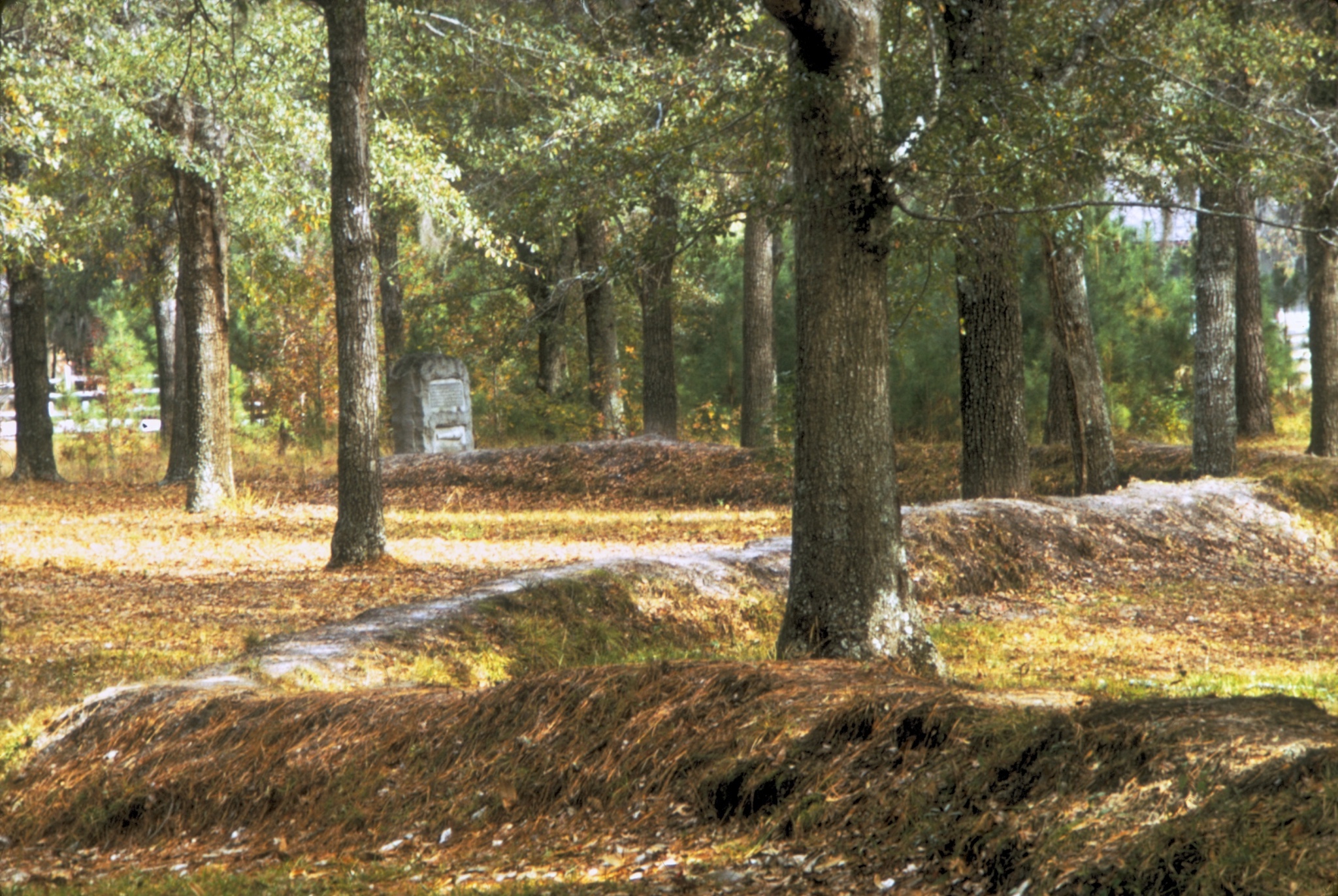
The bridge wasn’t the biggest one in the colony of North Carolina, nor was Moore’s Creek a large body of water. But for a moment in time on a cold February morning in 1776, Moore’s Creek Bridge in southeastern North Carolina was the site of a foundational event that was significant to our country’s birth and the Declaration of Independence.
Let’s go back. News of Patriot victories at the Battles of Lexington and Concord in the spring of 1775 and the fight against the British at Bunker Hill in Massachusetts had inflamed patriotic fervor throughout the colonies. In North Carolina, increasing pressure from the colonial assembly had forced Royal Governor Josiah Martin to flee the cozy protections of Tryon Palace in the colonial capital of New Bern, sending his family north to New York and escaping himself to Fort Johnston near the town of Brunswick on the Cape Fear River.
From there, Governor Martin arrived at a plan to crush the growing rebellion against the Crown. Who knew it would be decided at Moore’s Creek?
Background
Like other American colonies, the North Carolina colony had largely been left alone by the Crown throughout the mid-1700s, developing its own practices of self-government and becoming quite autonomous.
Then, with a new king — George III — taking the throne in 1760 and the end of the French and Indian War in 1763, the British turned their sights on the colonies to help pay war debts and reinstitute their royal authority. This led to the well-known Stamp Act of 1765, which was greatly detested in the colony and became a rallying point for future Patriots — especially in the lower Cape Fear area of North Carolina.
Other British taxes and fees, such as the taxes on tea and other goods, were implemented in the years leading up to 1776. They served only to irritate the independent North Carolina colonists. Mostly, North Carolina colonists simply wanted to be left alone.
Tensions grew as local government leaders in North Carolina’s counties joined together in Committees of Correspondence and learned through communications with people in other colonies — especially the firebrands in northern colonies like Massachusetts — about radical actions being discussed and taken against the Crown.
Representative bodies from counties were created to meet at “Provincial Congresses” to address the increasing tensions. There were five of these — the first two held in New Bern, followed by one at Hillsborough, and the last two at Halifax.
These meetings enabled the radical Patriot leaders of the province to build the framework for Revolution in North Carolina: sending representatives to the first and second Continental Congresses in Philadelphia, organizing trade boycotts with England, organizing the militia, enacting the first constitution of North Carolina, and — ultimately — forcing out Royal Governor Josiah Martin.
The plan
As Governor Martin quickly became a man without a colony, he started strategizing on how to fight back.
Martin convinced British generals that he could rally enough Loyalists — he estimated 10,000 soldiers — to combine with British regulars to create an overwhelming force. If that combined force successfully quashed the rebellion in North Carolina, it would cut the colonies in half and then turn its sights on South Carolina and Georgia, then the middle Atlantic colonies, ending the American uprising quickly.
The plan was to gather Scottish Highlander forces loyal to the British Crown living in the area around Cross Creek on the Cape Fear River (Fayetteville today) and have them march to the coast. There, they hoped to link up with a major combined British force — 7,000 British regulars — under the command of General Henry Clinton and Commodore Peter Parker that was sailing south to the coastal port of Wilmington.
That united force would then move through the colony, rallying other Loyalists to their cause, and crush the rebellion in North Carolina.
One problem arose: Patriot militia in the area found out about the plan. Forces under the leadership of Alexander Lillington, Richard Caswell, and James Moore quickly rallied to stop the advance of the Highland Scots.
As the Loyalist Tory Highlanders marched east to meet the British force, they engaged the gathering Patriot militia groups at Moore’s Creek Bridge in February 1776 and suffered a devastating loss. The Highlander force was decimated and scattered in defeat.
Aftermath and significance
Following the battle, Loyalist support — already overestimated by Gov. Martin — flagged in the colony even more, and Patriot support was emboldened.
In fact, news of the loss was devastating all around. When the British naval group heard of the defeat, they changed plans and kept sailing, ultimately attacking Charleston in South Carolina. Governor Martin, from his perch on the British ship HMS Cruizer at the mouth of the Cape Fear River, gave up on his plan and moved north. Tory forces who were hoping to back the King against the rebellion were not supplied with the ammunition and 10,000 muskets that General Henry Clinton was carrying on his ships and retreated into the backcountry or left the colony.
The victory at Moore’s Creek essentially ended British authority in North Carolina. It was one of the first Patriot victories of the Revolution.
When you consider the timing of the Moore’s Creek victory in early 1776, there’s a lot of what-ifs to consider.
What if the Tories had been successful instead of the Patriots? Would local North Carolina representatives have have had the encouragement to meet in Halifax in April 1776, declare their strong opposition to the Crown, and support “independency” in the Halifax Resolves? If not for the victory at Moore’s Creek Bridge and the strong influence of the Resolves, would the Patriot representatives to the Continental Congress have been as confident to commit to the Declaration of Independence in July 1776? That’s a big what-if.
The signers of the Declaration of Independence months later stated that “with a firm reliance on the protection of divine Providence, we mutually pledge to each other our Lives, our Fortunes and our sacred Honor.” They knew that if their support for rebellion failed, they risked death and suffering for their families.
The Patriot militia that armed up and won the Battle of Moore’s Creek Bridge had already faced up to that same fate in February 1776. For their commitment to rise up against the most powerful empire on Earth at that time, these men should be remembered for their place in American history.
The John Locke Foundation’s NC250 project is producing a film on the Battle of Moore’s Creek Bridge that is scheduled to be released before the 250th anniversary of the battle in February. We look forward to honoring these Patriots and their bravery with this film and hope you will help us promote it and other efforts to support and celebrate the 250th anniversary of the Declaration of Independence next year.
To learn more on the Battle of Moore’s Creek Bridge, be sure to watch or listen to Episode 4 of the “Revolutionary Roads” podcast.