Share this Story on Facebook, X, Text, LinkedIn, Gmail, Yahoo Mail, or Outlook
Key energy legislation poised to pass the 2026 General Assembly will increase your future electricity bills, not lower them. They will worsen price increases already caused by the Virginia Clean Economy Act, which passed the last time Virginia was under one party control.
As the Assembly crosses its first deadline, with each chamber now able to only consider bills approved by the other body, several of the proposals discussed below have passed on both sides. They likely will end up in front of Governor Abigail Spanberger (D) for final approval.
Many will raise future electricity costs for everyone. Others will have a more targeted impact, as the Assembly’s majority is creating or expanding programs that use ratepayer funds to pay for energy home improvements for the favored few. Why raise taxes when you can hide social spending programs on utility bills?
The demarcation line to identify those deserving the financial investment in their residences, as opposed to those who provide the cash, seems to be 200 percent of the official federal poverty measure. That is an income of $66,000 for a family of four in 2026.
That will be the new, higher eligibility cut-off for the existing Percentage of Income Payment Program (PIPP), first authorized in 2020, under House Bill 884. PIPP creates a monthly bill cap for its enrollees, and the pending bill also lowers that cap, which will further increase its reach. The cap now kicks in if the electricity bill (including heat) exceeds ten percent of the enrollee’s income, but under this bill the cap is lowered to five percent of income.
The utility gets the rest of its money from a special charge on all customers, including commercial and industrial customers. The PIPP fund is also helping the low-income families pay off old unpaid bills.
The largest bill impact will come from the expansion of the Virginia Clean Economy Act to mandate massive spending on utility scale batteries. The capital expense authorized by House Bill 895 and Senate Bill 448 will run into the tens of billions of dollars, but no real cost estimate was ever provided to legislators, or any estimate of how much individual bills will rise.
The Regional Greenhouse Gas Initiative’s carbon tax is coming back, as Governor Spanberger pledged in her campaign. House Bill 397 andSenate Bill 802 were accompanied by a fiscal impact statement predicting the tax will extract over $460 million annually from electric generating facilities using hydrocarbon fuels, but it skips the key point that the companies are then free to recover it in full from customers – and surely will.
The bills to create a utility-managed, ratepayer-funded home energy upgrade program for heating oil and propane users have crossed over. The beneficiaries of House Bill 2 and Senate Bill 72 will receive replacement heat pump-based heating systems, a home renovation likely to cost $10,000 per household or even substantially more.
Without question, many homes and businesses could lower their energy bills with some upfront spending on new appliances, insulation or other modern upgrades. These are investments that would pay off over time, but few people have the cash or want to apply for the necessary loan.
A concept called “pay as you save”, used in other states, has the utility loan the money for its customer to fund the upgrades, and then the utility adds the financing charge to pay it back right onto their bills. It might be a homeowner or an apartment landlord. That was the concept behind Senate Bill 337 as introduced, but the bill got changed before it passed the Senate.
Guess who will now pick up the tab for the upgrades under the substitute version? The costs of a pilot program spending on energy conservation, solar installation and battery installation will be covered using yet another rate adjustment clause buried on everybody’s electric bill, just like existing energy efficiency programs.
The concept of ratepayer-funded spending on private residential upgrades could explode to “whole home energy efficiency refits” that go well beyond electric bills, as envisioned by House Bill 3 andSenate Bill 5. At least they start with a study process directed to first make some cost estimates, sorely lacking on most of the other energy welfare proposals.
The Assembly had a perfect opportunity to remove an existing program where all customers pay for a home energy upgrade for just a few. The so-called “strategic undergrounding program” pays for buried residential tap lines in target neighborhoods, and this one has no income limit for beneficiaries. The program was set to expire in 2028, butSenate Bill 253 and House Bill 1393 extend it for another decade and another $3 billion (or more) will be extracted from all ratepayers.
That is not an exhaustive list by any means. Other bills that will cost ratepayers more over time which are still thriving at crossover include mandates for a “federal prevailing wage” on various energy construction projects, efforts to bury major transmission lines at a cost several times the cost of overhead power lines, and an opportunity for the utilities to get directly into electric vehicle charging as a retail operation, again using ratepayer funds.
And the effort to shift costs away from low-income households and onto those with more means is now extending into water and sewer services with House Bill 770 and Senate Bill 650. Again, the customers who get discounted rates will be those with incomes at or below 200 percent of federal poverty, with others picking up the difference and keeping the utilities whole.
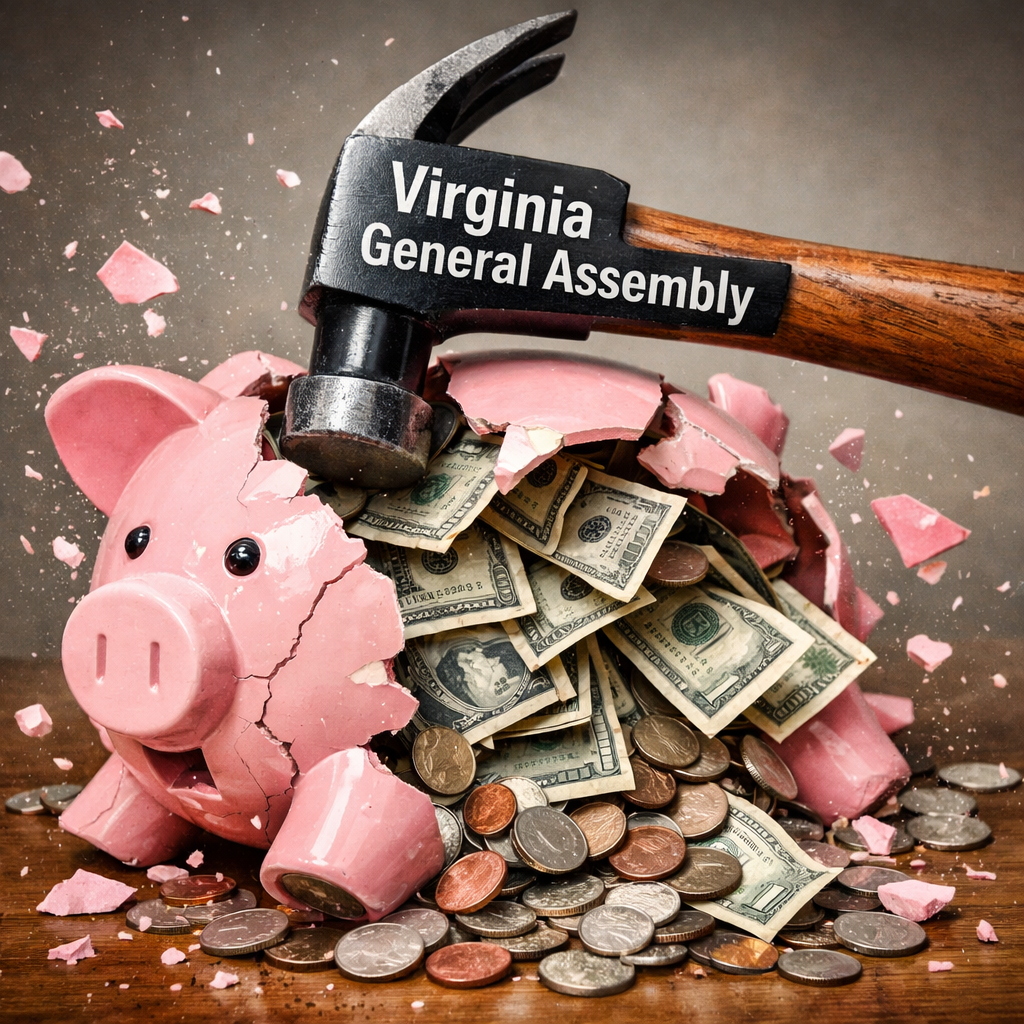
The abnormally high bills you are seeing in the wake of Winter Storm Fern and the electricity price increases driven by previous Assembly policy decisions may one day be a source of nostalgia. Your energy bill is the Assembly’s new favorite piggy bank.

Steve Haner is a Senior Fellow for Environment and Energy Policy. Steve Haner can be reached at Steve@thomasjeffersoninst.org
Share this Story on Facebook, X, Text, LinkedIn, Gmail, Yahoo Mail, or Outlook