By Randal O’Toole
Note: This post is a sequel to Metro’s Plan for Making Housing More Expensive
The average cost of “affordable” (meaning subsidized) housing in Portland is nearly $800 per square foot. The cost in the suburbs is a little lower but still around $600 to $700 per square foot. That’s two to three times the cost of housing in the private sector.
Metro and the city of Portland are supporting outrageously priced housing projects with tax dollars, resulting in higher cost of housing to everyone else. This does a disservice to taxpayers and to low-income people who would benefit from more homes that cost less.
After writing yesterday’s post, I needed an illustration of a subsidized housing project, so I picked one at random. Then I checked the numbers on that project and was stunned to learn that it cost $942 per square foot. Since the average cost of homes in Portland is under $300 per square foot, $942 is an incredible waste of taxpayer resources.
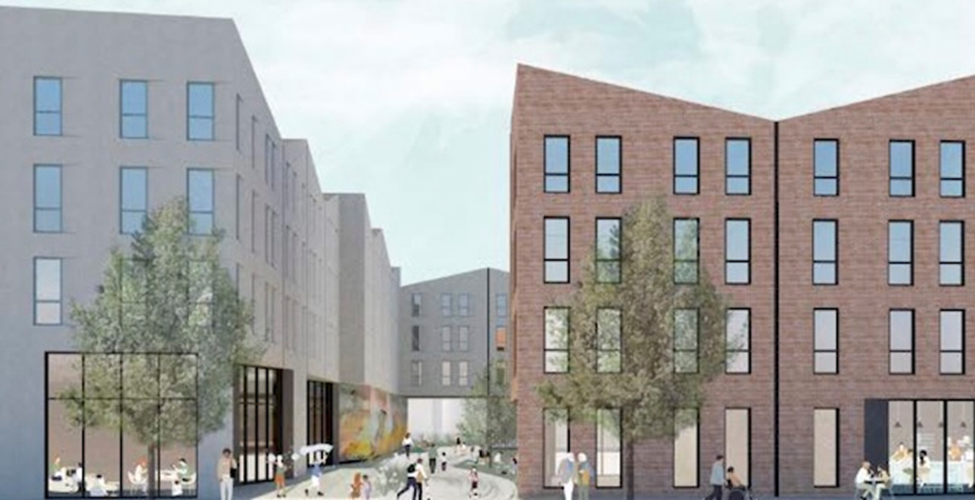
This project in the Portland suburb of Gresham cost $66 million and includes 224 housing units totaling 72,500 square feet for an average cost of $1,073 per square foot. Image provided by Metro.
To find out if this was typical, I went to Metro’s map of projects funded with its 2018 Affordable Housing Bond. For more than 40 projects, I was able to download information that told the cost of the project, the number of livable square feet in the project, and other information such as where it is located, how many stories tall, and who was the developer.
It turns out $942 per square foot is a little above average, but not a lot. The average cost of the 41 projects I found was $681. Projects in Portland suburbs tended to cost less than those in the city of Portland itself; the average cost in Portland was $787 per square foot.
Although $942 was on the high end, it wasn’t the most expensive project. While there are a few I haven’t yet tallied, the most expensive so far may be Glisan Landing, a $77.8 million project that provides 72,500 livable square feet, for an average cost of $1,073 per square foot. A few might be even more expensive, but Metro released the square footages of some projects only as ranges. One called Hattie Redmond is supposed to be 315 to 355 square feet per unit; even at 355 square feet, it would average more than $1,100 per square foot.
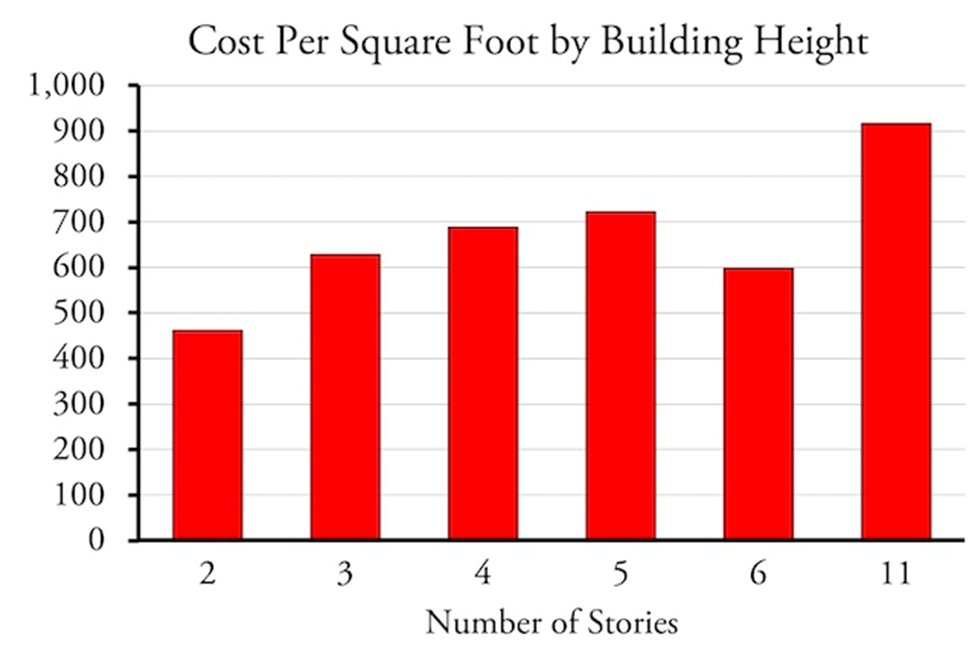
One reason for the high cost is that Metro is intent on subsidizing as many mid-rise apartment buildings as it can. As the chart above shows, each added story increased average costs except between five and six stories. Many of the six-story projects were in Portland suburbs, which may be why they cost a little less than the average five-story projects; one of the six-story projects in Portland was over $1,000 a square foot.
Another reason for high costs is that Metro awarded all its housing grants to non-profit housing developers. It seems like non-profits would save money, but in fact it just adds another layer of bureaucracy taking its share of the funds. On average, non-profits keep 12 percent of project funds in “developer fees.” In many cases, they use these fees to pay executives well over $100,000 a year.
But most non-profits don’t actually build the projects; instead, they contract construction out to for-profit construction companies that take a share of profits for themselves. Studies have found that low-income housing projects built by non-profit groups cost 20 percent more per square foot than those built by for-profit companies.
Metro grants covered just a small share of the cost of these projects. Most of the rest was covered by low-income housing tax credits and other federal, state, and local housing subsidies. On average, developers of these projects use their own money to cover only about 10 to 20 percent of the total costs. Many projects funded by Metro also received subsidies from the city of Portland funded out of a one percent tax on new home construction, thus making market-rate housing even less affordable.
The projects funded by Metro that I’ve been able to find cost more than $2 billion in total. Well over a billion of that was wasted on mid-rise housing, filling non-profit coffers, and other inefficiencies.
If Metro were truly interested in making housing more affordable, it wouldn’t fund its affordable housing programs with a tax on housing. If Metro were truly interested in providing affordable housing to low-income people, it wouldn’t allow developers to spend $700 to $800 per square foot building homes that ought to cost about $150 to $250 per square foot.
But Metro doesn’t care about either of these things. Instead, its single-minded desire is to increase Portland’s population density, even though it knows that doing so will make housing less affordable. This is typical of government planners: instead of planning comprehensively, as they claim, they too often become slaves to one interest. This is just one more reason why I am an antiplanner.
Visit Randal O’Toole’s Antiplanner blog
Note: This post is a sequel to Metro’s Plan for Making Housing More Expensive
Randal O’Toole is an Adjunct Scholar at Cascade Policy Institute, Oregon’s free market public policy research organization. He is a transportation and land-use policy analyst and the author of several books, including American Nightmare: How Government Undermines the Dream of Homeownership and Romance of the Rails: Why the Passenger Trains We Love Are Not the Transportation We Need. He writes from Central Oregon.