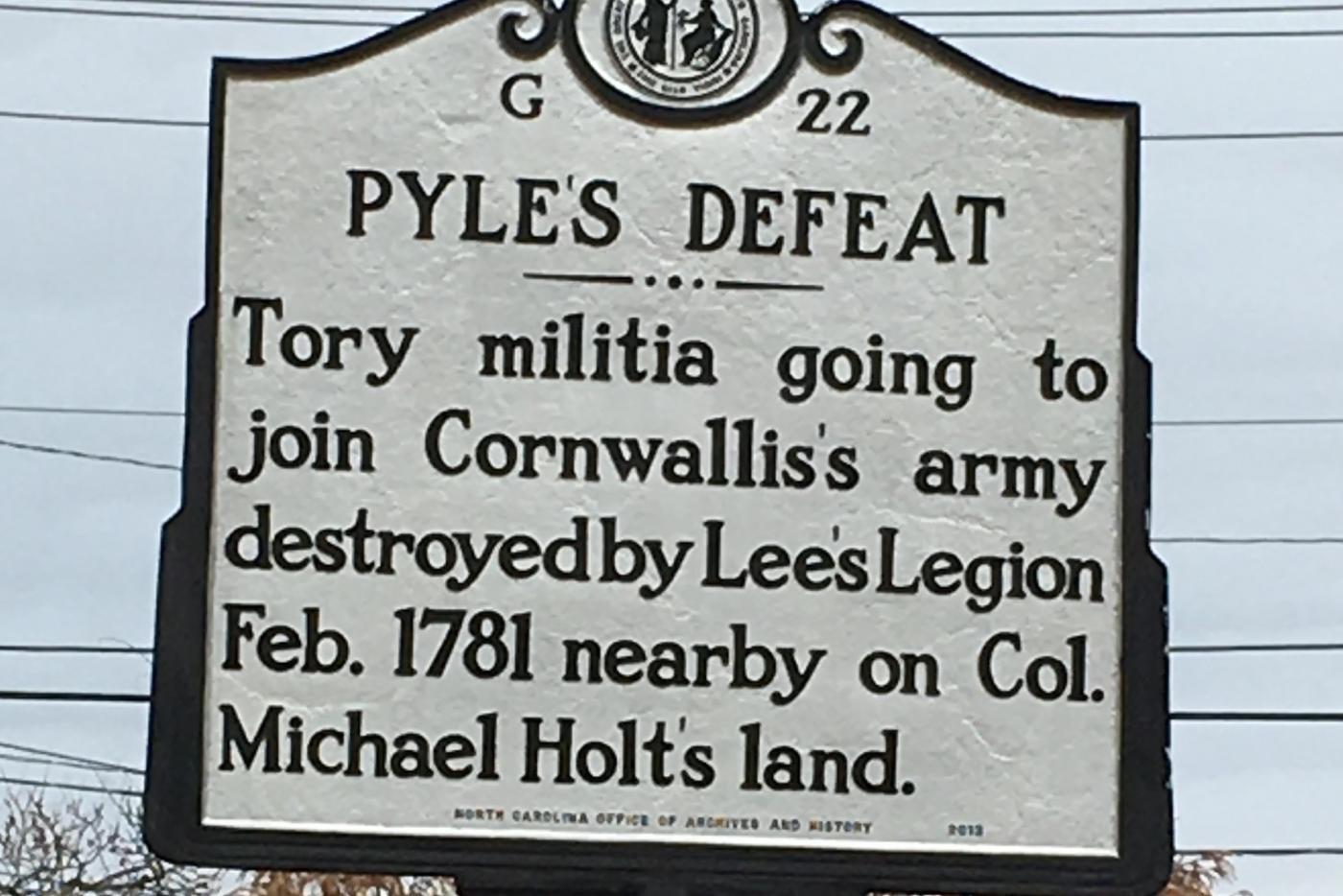
In addition to the celebration of the 250th anniversary of the Battle of Moores Creek Bridge and commemoration of the Battle of Guilford Courthouse that occurred in the last few weeks was the 245th anniversary of Pyle’s Defeat — a battle that occurred on Feb. 25, 1781.
I had never heard of that battle until I began working on the John Locke Foundation’s NC250 project. The more I’ve learned, however, I’ve realized that both the Battle of Moores Creek Bridge and Pyle’s Defeat — although small in scale — were defeats over North Carolina Loyalists that were immensely significant to the Patriots’ ultimate victory over the British.
The British attempt to stop Patriot momentum
Pyle’s Defeat occurred in 1781 near the end of the war, five years after the Battle of Moores Creek Bridge. After losses in South Carolina to the British, who were led by Gen. Charles Lord Cornwallis, Patriot troops had rallied for victories at Cowpens and Kings Mountain. Cornwallis was determined to stop the Patriots’ momentum and gave chase. Gen. Nathanael Greene had been sent by Gen. George Washington to take over the Patriot army in the South and assumed command in Dec. 1780 in Charlottetown.
With strong leadership and a keen strategic mind, Greene proceeded to outwit the British. Crossing swollen rivers and swamps with Cornwallis pursuing him, Greene led his army of Patriot regulars and militiamen north through North Carolina during the rainy and icy winter of 1781 — even throwing out his supplies to move his wagons faster. Greene’s mad dash to cross the Dan River (now known as the Yadkin River) near the border of Virginia and North Carolina to rest his troops from the British pursuit was called the “Race to the Dan.” Along the way, Greene had secured boats to transport his men across the largest rivers, stranding the British and forcing them to lose time finding alternative fords downstream.
A little-known rout with outsized consequences
A frustrated Cornwallis ended up taking his army to Hillsborough and preparing for a battle that both he and Greene knew was bound to happen. Cornwallis sent out scouts and small bands to look for signs of Greene’s forces. He dispatched Col. Banastre Tarleton, a ruthless cavalry leader feared by Patriots throughout the colony, to explore the area around Alamance County and the Haw River with his well-known force of dragoons. At the same time, Gen. Greene had ordered Gen. Andrew Pickens and Lt. Col. Henry “Light Horse Harry” Lee to disrupt British troop movements and Loyalist recruitment where possible with their combined force of around 600 men.
In the meantime, Gen. Cornwallis had called for Loyalist militia to come and join him against the rebels. A group of around 400 men heeded the call. Under the leadership of Col. John Pyle, a dentist from Alamance County, the Loyalists made their way to join Cornwallis. On the way, they were approached by green-coated troops on horseback. Thinking these were Tarleton’s dragoons also headed to join Cornwallis, Pyle’s men let them pass. Looking for all the world like Tarleton’s men, the cavalry troops rode jovially past with their plumed hats waving in the breeze. Unfortunately for the Loyalists, the cavalry was actually Lee’s Legion.
Reaching the front of the column, Col. Lee realized that Pyle’s troops believed them to be Tarleton’s dragoons and extended pleasantries to Pyle. What happened next is different in every account I’ve read. Someone apparently shouted, “Who do you stand with?” The response of “His Majesty” set off an immediate, amazingly quick, and bloody firefight. Lee’s men primarily used the chosen weapon of horse cavalry — their sabers — to cut down Pyle’s men. Pickens’s infantry forces joined in as well, the rout was on, and over 90 Loyalists were killed while others fled. One Patriot soldier was wounded.
The significance of Pyle’s Defeat
There is some disagreement over how the battle unfolded, who actually started it, and whether Lee intended for what the British called a massacre to unfold. Regardless, Pickens and Lee’s mission to “capture and disarm” the enemy had at least been partially successful. They stopped a Loyalist band, but Lee certainly would rather have surprised Tarleton’s raiders than a band of militia.
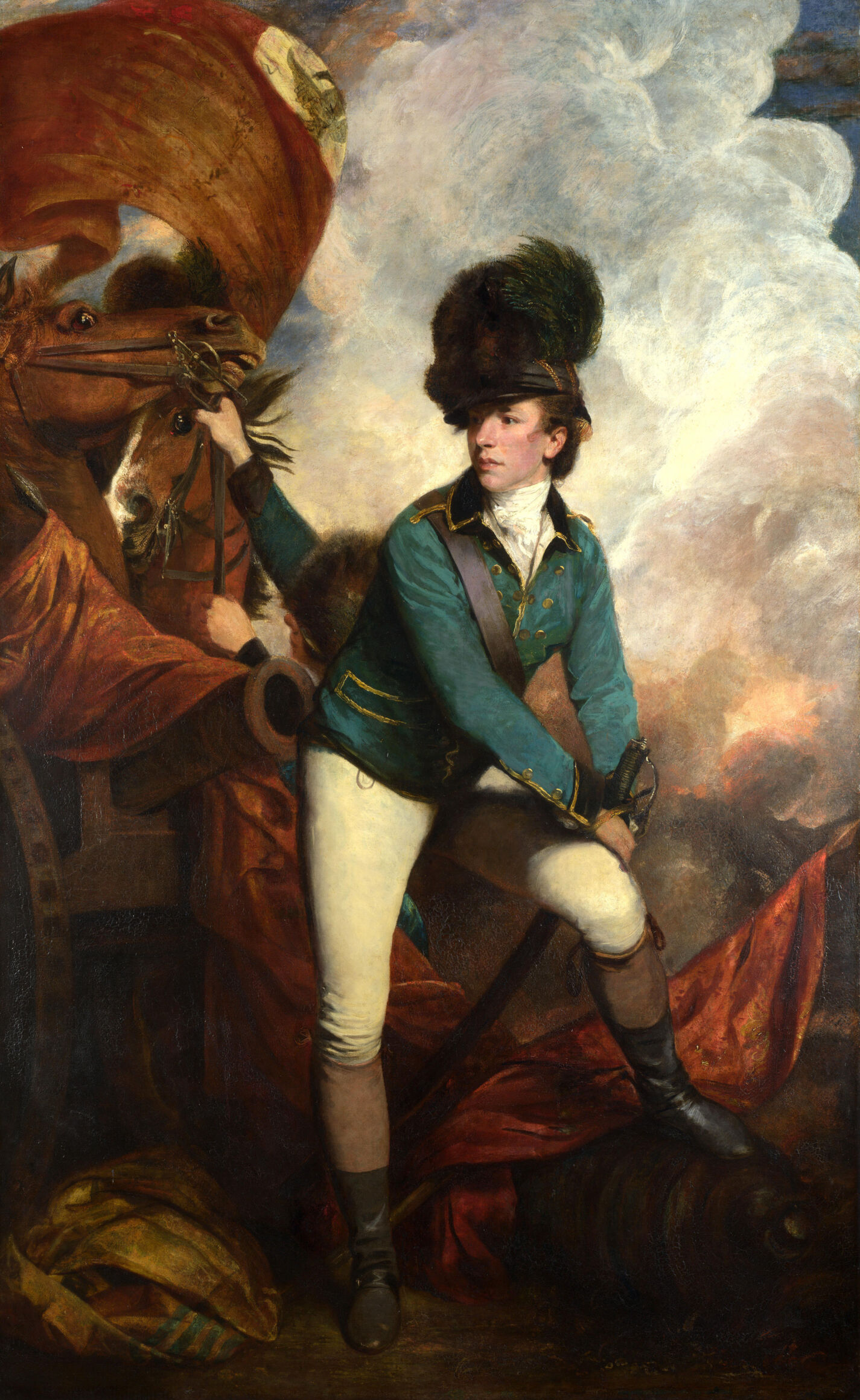
Some surmise that the reason for the bloody nature of the conflict was that as Tarleton was rampaging through South Carolina the year before, he came upon a force of 350 to 380 Virginia Continentals led by Abraham Buford. Buford apparently kept marching in spite of Tarleton’s invitation to surrender, so on May 29, 1780, Tarleton delivered a savage victory for the British. In the end, 113 of Buford’s soldiers were killed, more than 200 were captured, and more than 100 were severely wounded. The British lost just five. The savagery of the fighting (though there appears to be no real evidence of killing prisoners) led to the phrase “Tarleton’s quarter,” which meant shooting after surrender.
Regardless of the legends, Pyle’s Defeat was another savage blow to British prospects leading up to the Battle of Guilford Courthouse only a few weeks later.
Most importantly, following Pyle’s Defeat, Cornwallis’s hopes of generating a mass Loyalist uprising against the Patriot cause — much like Gov. Josiah Martin had dreamed before the Battle of Moores Creek Bridge — were crushed. It is said that Gen. Andrew Pickens commented on the impact the battle had on Loyalist support in North Carolina by saying, “It has knocked up Toryism altogether in this part.”
A historical marker near I-85 off Exit 145 in Alamance County commemorates the battle.