In 2024, then-governor Jay Inslee warned that “We have this epidemic of asthma in our state,” saying that funding from the state’s CO2 tax would help fund projects to reduce air pollution. The next year, the Department of Ecology distributed $8.5 million in grants to improve air quality in “overburdened communities” and improve “health disparities.”
An examination of the 21 projects they funded shows that only one is likely to reduce air pollution. Most of the funding went to community outreach and political advocacy for groups like the Somali Independent Business Alliance and the Urban League of Seattle.
Rather than funding projects that reduced air pollution, funding from the “Washington State Air Quality in Overburdened Communities Grant” was spent on:
- “Policy advocacy” to “groups to push for environmental justice legislation, such as the HEAL Act…”
- Paying $2,000 each to members of a “community advisory board” on air pollution
- Giving away 50 refurbished bicycles and providing middle school students “with the skills to maintain their bikes”
- Subsidizing the purchase of electric bicycles, which has not shown to reduce air pollution
Even some theoretically good projects fell far short. For example, one project to replace wood-burning stoves – a significant source of particulate matter air pollution – intended to replace 20 stoves but ended up replacing none because homeowners didn’t want to get rid of them.
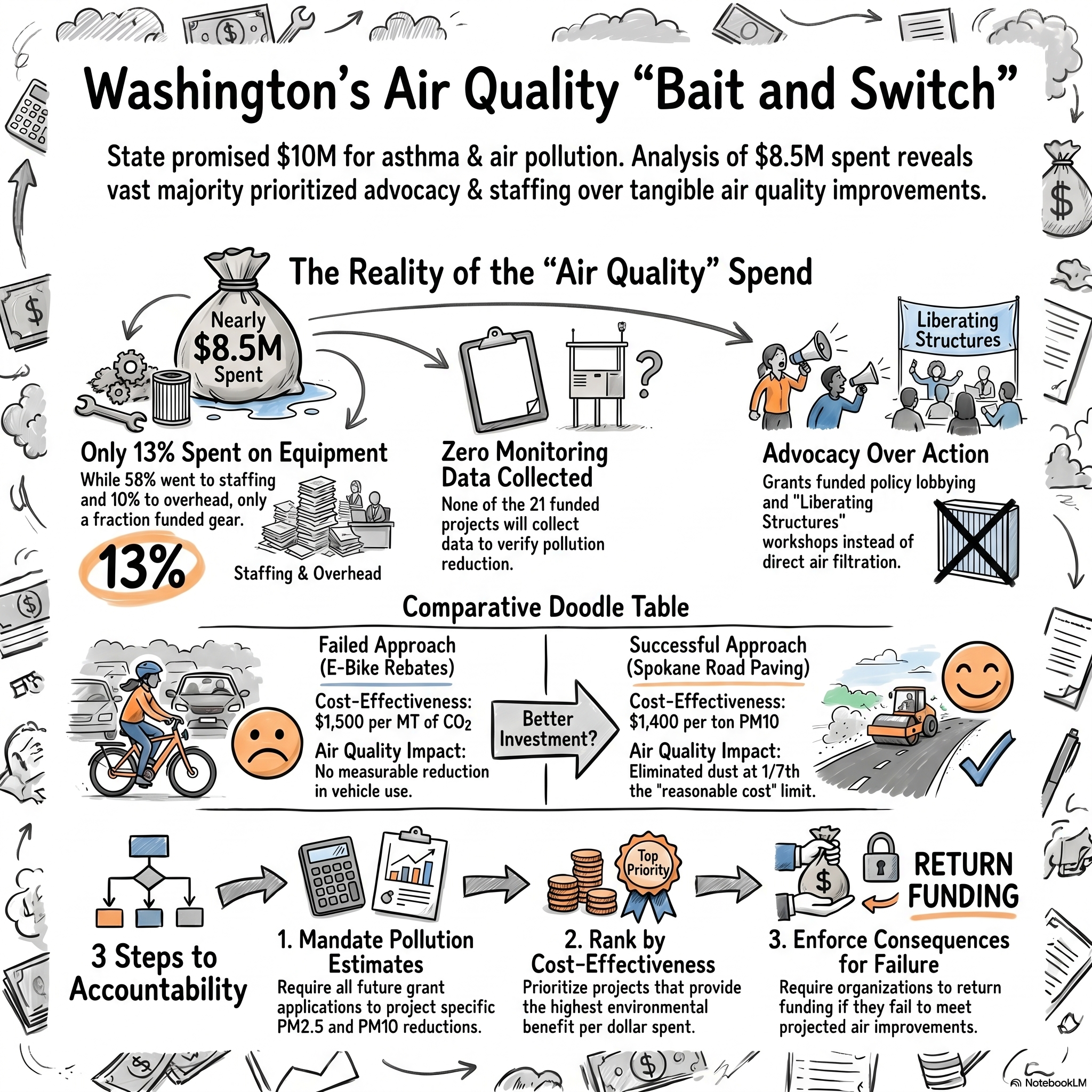
The only project that meaningfully addressed air pollution in a cost-effective way was a Spokane project that reduced dust from an unpaved road. This grant did two things that none of the others did: it provided an actual projection of the pollution reduced by the project and estimated the cost-effectiveness of the program by comparing it to standard metrics.
Ironically, the legislature voted to cut funding for these kinds of programs in the future. Rep. Joe Fitzgibbon’s legislation reduced future funding for these projects by half. That is despite telling the Seattle Times editorial board in 2024 that the CO2 tax was needed because “it’s important for addressing health disparities.”
The state should do four things to ensure that future projects yield actual environmental benefits.
- Require all grants to provide an estimate of the amount of PM2.5 and PM10 that will be reduced.
- Rank projects based on cost-effectiveness. The more environmental benefits the projects provide per dollar, the higher the project should be ranked.
- No more funding for “community outreach.”
- Organizations that fall short of achieving the projected air quality improvements should face accountability, including returning a portion of the funding based on the shortfall and should be banned from receiving future CCA grants.
There are projects that can tangibly reduce air pollution but the current program has no standards of effectiveness or accountability. Until it does, people across the state will continue to breathe particulate matter and be burdened by air pollution.