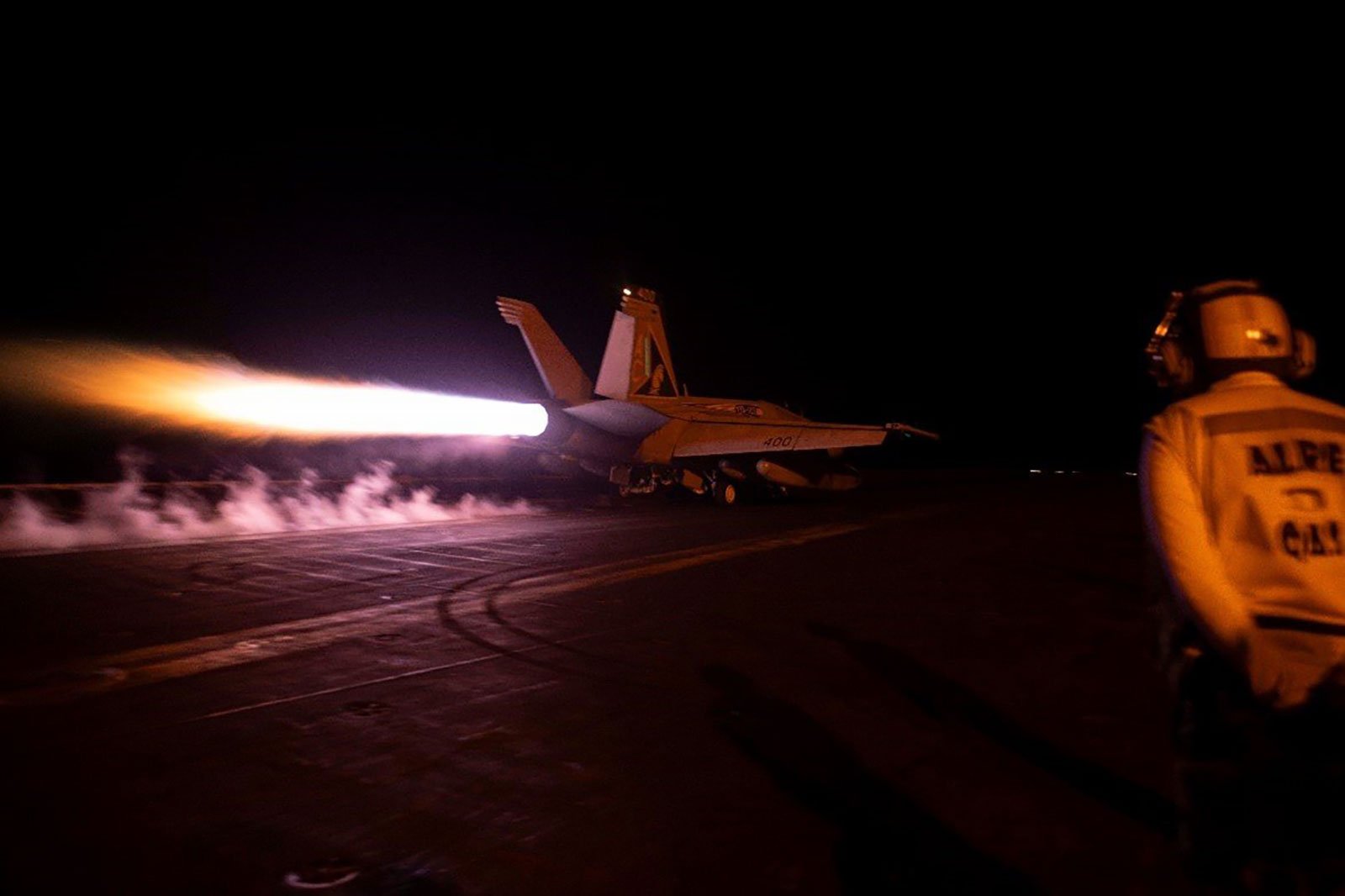
Gulf of Oman — In a bold enforcement of the U.S. naval blockade on Iran, a Navy F/A-18 Super Hornet fighter jet disabled the rudder of an Iranian-flagged oil tanker Wednesday morning, halting its attempt to reach an Iranian port in the Gulf of Oman.
U.S. Central Command (CENTCOM) confirmed that the tanker, identified as the M/T Hasna, ignored multiple warnings before the aircraft, launched from the USS Abraham Lincoln, fired several 20mm cannon rounds into the vessel’s steering mechanism. The Hasna, a large crude oil carrier measuring over 330 meters in length, was unladen at the time of the incident and operating in international waters.
“No injuries were reported among the crew, and the vessel is no longer transiting toward Iran,” CENTCOM stated. The action underscores Washington’s determination to maintain pressure on Tehran amid stalled nuclear negotiations and ongoing tensions in the region.
Precision Operation in Tense Waters
According to military officials, the Hasna was tracked as it approached restricted waters. U.S. forces issued repeated radio and visual warnings to the crew, directing the tanker to alter course and cease its violation of the blockade. When those went unheeded, the Super Hornet executed a surgical strike targeting only the rudder, a tactic designed to immobilize the ship without causing sinking, fires, or environmental damage from oil spills.
The USS Abraham Lincoln, one of two U.S. aircraft carriers supporting blockade operations in the CENTCOM area of responsibility, provided the launch platform for the mission. The carrier strike group has been instrumental in interdicting vessels attempting to circumvent sanctions and support Iran’s economy.
Maritime tracking data showed the Hasna had recently passed through the Laccadive Sea near the Maldives before entering the Arabian Sea en route to the Gulf of Oman.
Broader Context of the Blockade
The incident comes as the Trump administration’s maritime enforcement has dramatically reduced Iran’s seaborne oil exports. Officials estimate the blockade has slashed Tehran’s maritime trade by nearly 90 percent since its implementation earlier this year. Indirect talks between U.S. and Iranian representatives have shown tentative progress, but violations like the Hasna’s continue to test American resolve.
Pentagon spokesmen emphasized that the operation was conducted with minimal force. “This was not an act of aggression but a measured response to enforce international norms and U.S. policy,” one official said on condition of anonymity.Iranian state media has not yet issued a detailed response, though past incidents have prompted accusations of “piracy” from Tehran. The Hasna remains adrift under observation, with U.S. forces monitoring the situation to prevent any escalation or attempts at towing by Iranian vessels.
This marks a rare direct kinetic engagement by U.S. naval aviation against a commercial vessel in recent memory, highlighting the effectiveness of precision munitions in modern maritime interdiction. Analysts say such actions deter blockade runners while avoiding the broader conflict many fear in the strategically vital Strait of Hormuz.
Conservative Daily News will continue to monitor developments in the Gulf as diplomatic efforts unfold.