When Sound Transit first announced their “enterprise initiative” to address the agency’s $34.5 billion budget gap they said it would consider a wide range of alternatives. But it has now become clear they have done no such thing. The whole exercise has been structured as a tug-of-war among the subareas over which light rail extensions would be built and which would be deferred or canceled.
No serious consideration has been given to more cost-effective transit technologies, such as Bus Rapid Transit, automated rubber-tired shuttles, or even upgrading existing Sounder commuter rail service. The question of whether the proposed light rail extensions still make sense given the very high cost, low ridership, neighborhood impacts, and huge carbon footprint, hasn’t even been part of the discussion.
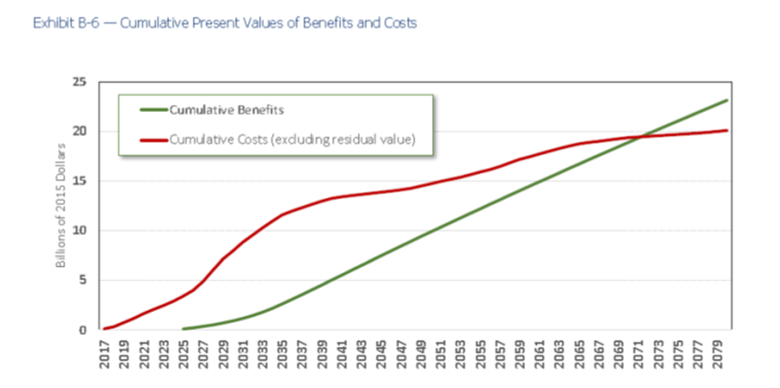
As shown in the graph copied below, Sound Transit’s own analysis in 2016 showed costs of the ST3 plan would far exceed expected benefits all the way out to year 2071. Since then costs have risen by tens of billions of dollars and ridership forecasts have been scaled back. Using updated inputs the ST3 plan doesn’t come close to passing a benefit-cost test. That is the fundamental issue the Sound Transit board should be considering, but the “enterprise initiative” doesn’t address the question.
Sound Transit likes to frame their “mandate” as building light rail lines, but they ignore their commitments to a timeline (ST3 was a 25-year plan), or to a budget ($54 billion was the price tag presented to voters), or to any meaningful performance measures (ridership, transit mode share, etc). Sound Transit is intent on building light rail, but the scenarios under consideration all break commitments to voters about the costs, the timeline, and the usefulness of the system. Sound Transit’s commitment to subarea equity, which they’ve been treating rather loosely, is also very much in doubt.
The proposed changes aren’t minor details. For example, the revised plan would stretch the timeline for implementation out to 2050 and issue billions of dollars in bonds that commit Sound Transit to debt repayment that may extend to the end of the century. That is very different than the commitment Sound Transit made to voters. Several years ago Sound Transit testified under oath the ST2 taxes would be rolled back in 2038, but now it looks like the taxes won’t be rolled back in our lifetime, if ever. If keeping faith with voters is a goal of the “enterprise initiative” it is curious the effort fails to discuss how the revised plan falls very far short of the agency’s prior commitments.
Sound Transit has tried to make it sound like the pandemic and inflation are to blame for their budget problems, but in reality every phase of the Sound Transit program has been billions of dollars over budget and years behind schedule. The original Sound Move plan was for ten years, but after thirteen years it had gone far over budget and still wasn’t fully implemented. In 2008 voters approved the ST2 plan, but within months of the vote the Sound Transit board revealed significant budget problems, projects were deferred and years were added to the implementation timeline. As recently as 2020 Sound Transit undertook yet another “realignment” to bring the ST3 plan within budget. Just five years later they revealed a $34.5 billion budget gap. Sound Transit has consistently made unrealistic assumptions and frequently misrepresented costs, risks, and future ridership. Instead of keeping faith with voters they have simply moved the goal posts.
An ongoing obstacle to sensible decision-making has been the filtering of information that is presented to the board. For instance, none of the questions asked in Sound Transit’s recent on-line survey offer the possibility of substituting other transit improvements for light rail or mention the reduced ridership forecasts for the proposed extensions. The survey is more like a push-poll than an unbiased assessment of public preferences.
Sound Transit does public outreach, but the events seem designed to reinforce the staff-preferred options rather than open dialogue about alternatives. For example, the Sound Transit website highlights recent public meetings co-hosted by the Transportation Choices Coalition, but the website fails to mention that Sound Transit helps fund that organization, which makes it less surprising the meetings were more like cheerleading sessions. There are neighborhood groups and other organizations opposed to the light rail extensions, but their concerns and suggestions, which can be viewed on their websites, https://rethinkthelink.org/fact-sheet https://smartertransit.org/home/, are not acknowledged by Sound Transit.
Over the next two months the Sound Transit Board is expected to take action on the carefully massaged “enterprise initiative” recommendations. If the Board is truly interested in “affordability” and “transparency” as the website says, then their deliberations should consider a few relevant facts that somehow have been omitted from the “enterprise initiative” presentations:
- Despite spending over twenty billion dollars on light rail, total transit ridership in the Puget Sound region is lower today than it was ten years ago. This ought to cause the Sound Transit board to ask whether light rail is the answer to the region’s mobility needs.
- Light rail currently carries less than one percent of the daily person trips in the region. According to PSRC projections at full build-out ridership will still be in low single digits. That is an extremely poor return on a $150 billion investment. Because of the meager light rail ridership, most of whom are former bus riders, the light rail extensions will have no measurable impact on congestion.
- The average household in the Sound Transit district pays over $1,700 per year in highly regressive taxes that go to Sound Transit. The vast majority of those households gain no benefit from light rail. In the “enterprise initiative” Sound Transit has emphasized affordability, but they only mean that in relation to the agency’s ability to spend. All the scenarios developed for the “enterprise initiative” are much less affordable for taxpayers.
- Building light rail lines, especially involving tunneling, has such a huge carbon footprint that the ST3 projects will increase total GHG emissions. This is clearly inconsistent with state environmental policy.
Sometimes the real story isn’t what’s included in the Board’s meeting materials. The important questions are what they don’t want to talk about.