Nearly one year ago, Texas Governor Greg Abbott signed into law Senate Bill 14 in an effort to “slash regulations, put stricter standards on new regulations that could be costly to businesses, and put a check on the growth of the administrative state.” All worthy goals too considering the Lone Star State’s cumbersome regulatory environment, which recently ranked “as the fifth most-regulated…in the nation, after California, New York, Illinois, and New Jersey,” according to StateReg Data.
Fast forward to today and Texans are beginning to reap the fruits of the new law.
As part of SB 14’s implementation, the Texas Regulatory Efficiency Office (TREO)—or Texas DOGE—was established in the office of the Governor and tasked to cut red tape in 3 ways: work with state agencies to identify bureaucratic bloat; make administrative and legislative recommendations to improve operations and experience; and help educate the public on how to navigate complex rules and systems.
And based on TREO’s new AI-driven interactive website, the office has made great progress on all 3 goals.
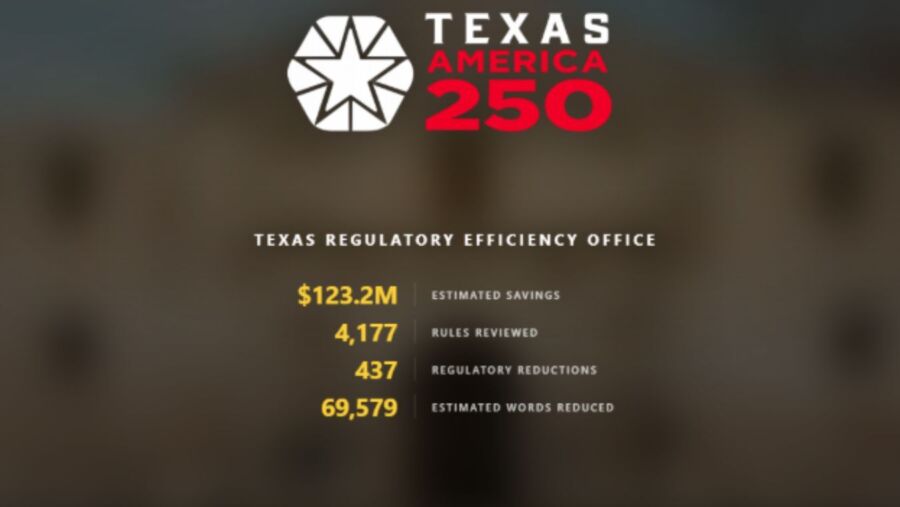
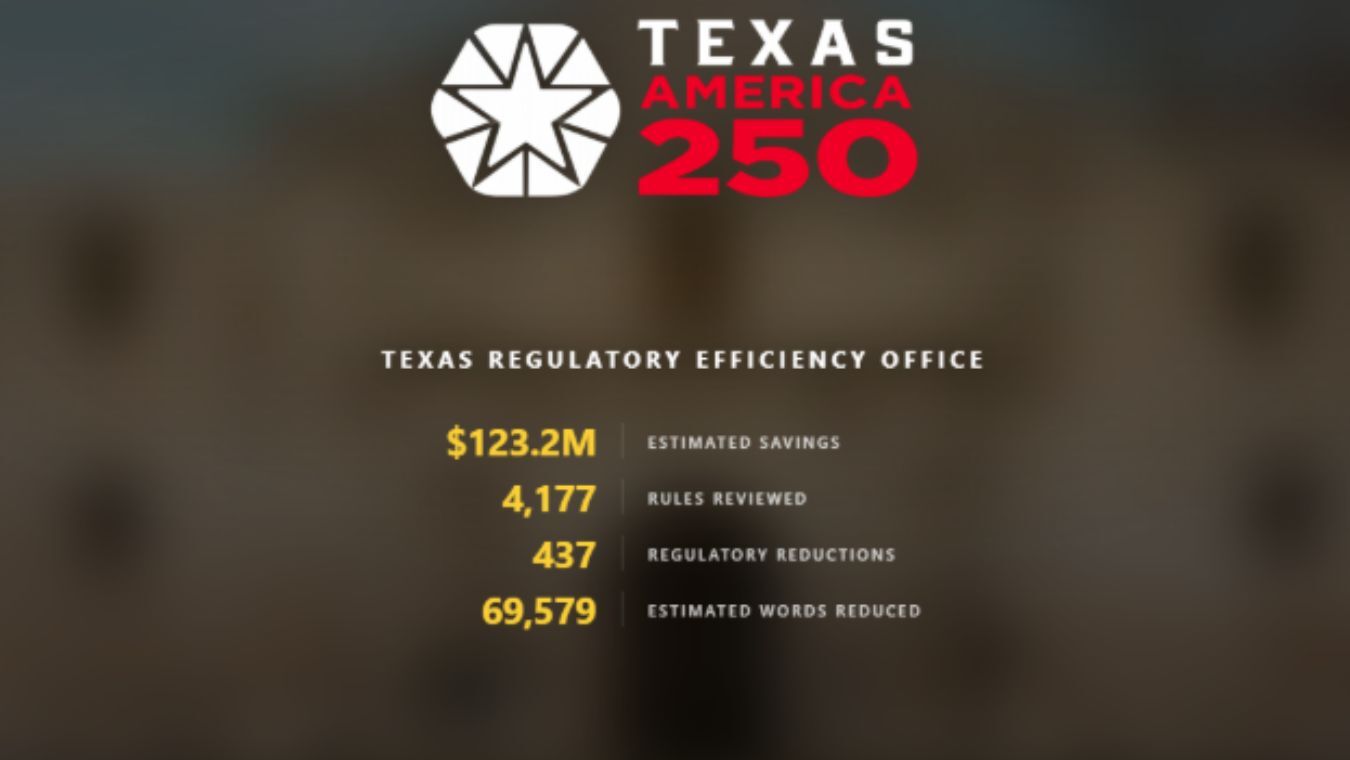
As may be viewed on its new website, TREO’s early activities have already identified “more than 435 regulations for amendment or repeal across 11 state agencies. TREO estimates these initial recommendations can reduce 69,000 words from the Texas Administrative Code and save Texas taxpayers an estimated $123 million so far.” The initial round of state agency reviews included: the Texas Optometry Board, the Racing Commission, the Texas Board of Dental Examiners, the Texas Animal Health Commission, the Texas State Library and Archives Commission, the Texas Department of Motor Vehicles, the Texas Alcoholic Beverage Commission, the Finance Commission, Texas Parks and Wildlife, Texas Department of Transportation (TxDOT), and the Texas Board of Veterinary Medical Examiners. The greatest possible savings were located within: TxDOT ($36.2 M), the Texas Board of Dental Examiners ($29.6 M), and the Texas Board of Veterinary Medical Examiners ($16.7 M).
Looking ahead, 9 state agencies are scheduled for future review, including: the Texas Commission on Environmental Quality, the Texas Department of Public Safety, the Texas Department of Housing and Community Affairs, the Texas Higher Education Coordinating Board, the Texas Board of Pardons and Paroles, the Texas Department of Banking, the Texas Department of Licensing and Regulation, the Texas Real Estate Commission, and the Department Information Resources. Considering the size and scope of these 9 state agencies, it is likely that a substantial amount more regulatory excess and savings will soon be found.
For Texans interested in offering up their own cost-saving ideas, TREO’s website also includes an “Evaluation Portal” to submit recommendations related to most state authorities, including the Legislature.
Of course, what makes TREO’s early work particularly exciting is its interactive online element, which takes the form of an AI chatbot named SAM. With SAM’s help, users can learn how to successfully maneuver through various permitting, licensing, and regulatory environments to achieve their goals, whatever they may be. Already, I’ve been directed on how to form an LLC and what it might cost; how to obtain an air conditioning and refrigeration contractor’s license; what it would take to obtain a law enforcement certification; and much more. Indeed, SAM provides a level of inquiry and interplay that really doesn’t exist other state and local governmental entities—though perhaps that will change at some point in the near future.
Overall, TREO has shown impressive potential to cut red tape, streamline government, and ensure regulations serve Texans, not bureaucracies. Even more, it proves that the DOGE spirit is alive-and-well in the Lone Star State.