Rhode Island’s symbol may be the Anchor of Hope, but Ocean State students cannot hope for a bright tomorrow without a great education today!
As Rhode Island legislators debate whether or how severely to halt meaningful education reforms, our students cannot afford to wait. They also cannot afford for our governor to deny them access to educational funds that would not cost the state a dime.
Rhode Island families should not be left behind. Imagine a program that would:
- Empower working- and middle-class families to choose the best education for their child, independent of zip code or district boundaries
- Strengthen student outcomes without harming public schools
- Fill gaps in Rhode Island’s current system, by augmenting existing education parental choice options
- Deliver real impact for Ocean State students, based on past education scholarship results
The federal Education Freedom Tax Credit (EFTC) can provide exactly this proven, privately funded pathway to better educational outcomes for thousands of Ocean State families at no cost to Rhode Island taxpayers or public schools. And it can be approved today!
Any governor is authorized to opt-in at any time to this federal program, avoiding General Assembly politics and state bureaucracy, simply by submitting a required list of scholarship granting organizations (SGOs).
This common-sense action would ensure all eligible Rhode Island families can choose the K–12 education or educational aid that best meets their children’s needs. On the other hand, denying access to these life-changing scholarships would leave children and young adults in our state even further behind in a competitive world.
For more information, visit the American Federation for Children’s pages for its Scholarship Fund and EFTC advocacy.
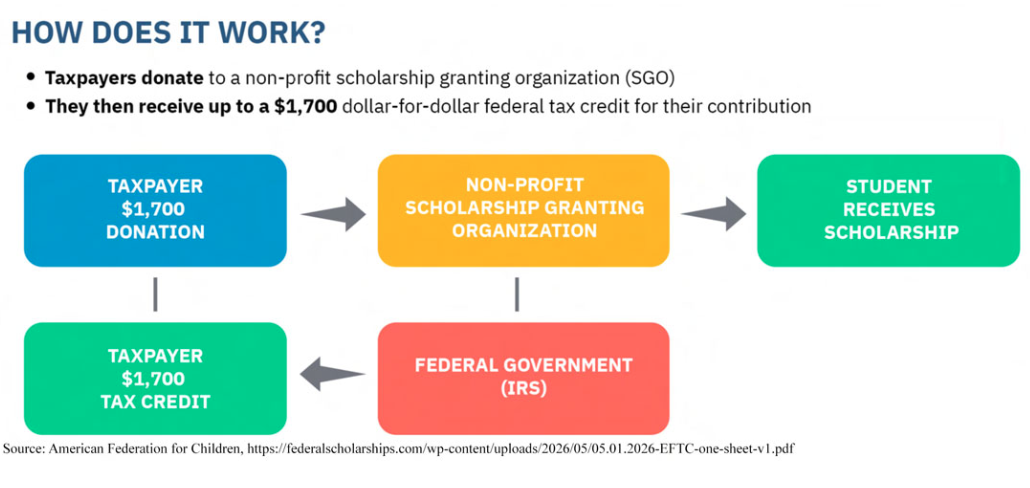
Program Overview: The EFTC, enacted as part of H.R. 1, the One Big Beautiful Bill Act (OBBBA), and signed into law in 2025, creates the nation’s first permanent, uncapped federal tax credit for K–12 school choice. Starting January 1, 2027, Rhode Island taxpayers who donate up to $1,700 to qualified nonprofit SGOs would receive dollar-for-dollar federal tax credits. These privately funded scholarships would then support eligible K–12 students statewide.
National estimates suggest 90% of families would be eligible (as households up to 300% of area median income), but Rhode Island’s income distribution likely pushes this number to about 95%. In addition to eligibility, federal rules prevent earmarking of donations for specific students and single-school SGOs. Beyond those restrictions, each organization would determine its own scholarship requirements and structure. Rhode Island has not yet opted in or out of the program. By submitting a list of eligible SGOs, our current or future Governor could unlock new resources for education in Rhode Island at zero cost to state or local budgets. Not only would the scholarships represent increased education funding, but to the extent scholarships cover tuition only partially, families and other sources would add even more to the Ocean State’s total investment in our students.
When the Rhode Island Center for Freedom & Prosperity studied the effects of a school choice proposal in 2015, we found a modest scholarship program would attract more than $17 million in additional discretionary funds to capture the value of the scholarships.
Rhode Island’s Need: Rhode Island’s K–12 students face persistent achievement challenges. Only about 31% are proficient in math and 34% in English/language arts on recent state assessments, and parental should be a powerful part of any plan for improvement. According to Stanford University’s Center for Research on Education Outcomes, 55% of Rhode Island’s charter schools outperform comparable district schools in reading, while 41% are equivalent. The RI Center has found that students at relatively low-cost private religious schools in Rhode Island outperformed their public-school peers substantially on the Scholastic Aptitude Test (SAT).
Denying families access to life-changing scholarships would leave thousands of students trapped in underperforming schools, perpetuating inequities today and limiting opportunities for tomorrow. If Rhode Island acts now to opt in, rapid implementation and empowering Rhode Island families could begin as soon as January 2027.
Rhode Island’s Student Achievement Challenges: Despite the tenth-highest per-student spending in the nation, National Assessment of Educational Progress (NAEP) results for 2024 find Rhode Island “not significantly different” than the national average, except when it comes to 8 th grade math, on which the Ocean State is “significantly lower.” These mediocre results mask significant gaps, especially in urban districts and for low-income and minority students.
Limited educational freedom options are available for Rhode Island families: charter schools, a small corporate tax-credit scholarship, and limited public school open enrollment, which are insufficient to serve the thousands of families seeking better fits based on learning style, values, or special needs. If they were a school district, non-district schools, including charters, would be the only public system experiencing increases in enrollment. This century, they have seen 1,420% growth, from 1,078 in 2000 to 15,307 in 2025. Even this does not meet the demand; the RI Senate Fiscal Office found in 2021 that charter schools received more than five applications for every open seat.
Defining the Federal Education Freedom Tax Credit
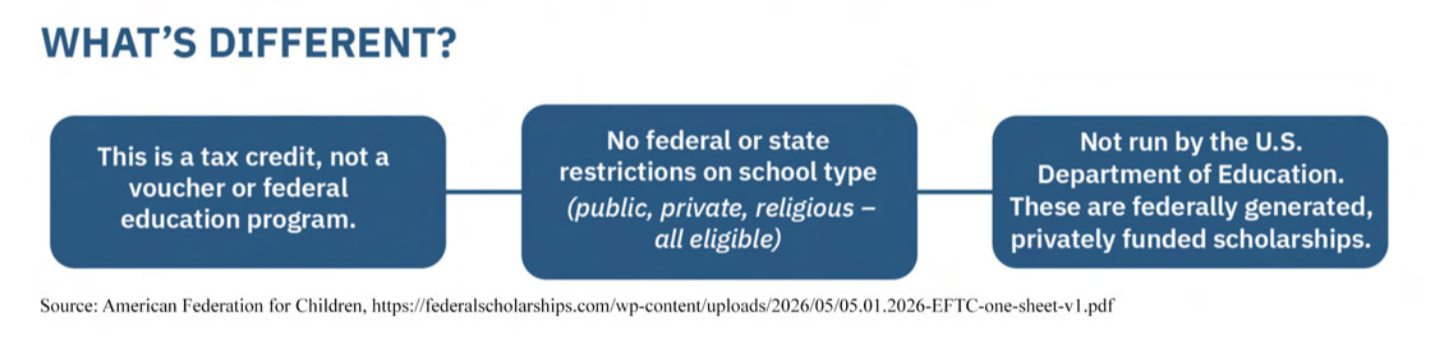
The EFTC is the most ambitious federal school choice initiative in U.S. history. It functions as a tax credit, not a voucher or new federal spending program:
- Taxpayers make cash donations (up to $1,700 per donor) to qualified 501(c)(3) SGOs.
- Donors receive a 100% non-refundable, dollar-for-dollar federal tax credit.
- SGOs award scholarships for tuition, fees, tutoring, special needs services, materials, transportation, and technology. States do not have discretion to set rules governing scholarship granting organizations or limiting their use of the funds.(1)
- Scholarships are usable at any school type — public, private, charter, religious, homeschool, or virtual— with no federal or state restrictions.
- The program is permanent and uncapped, with no sunset or donation limits.
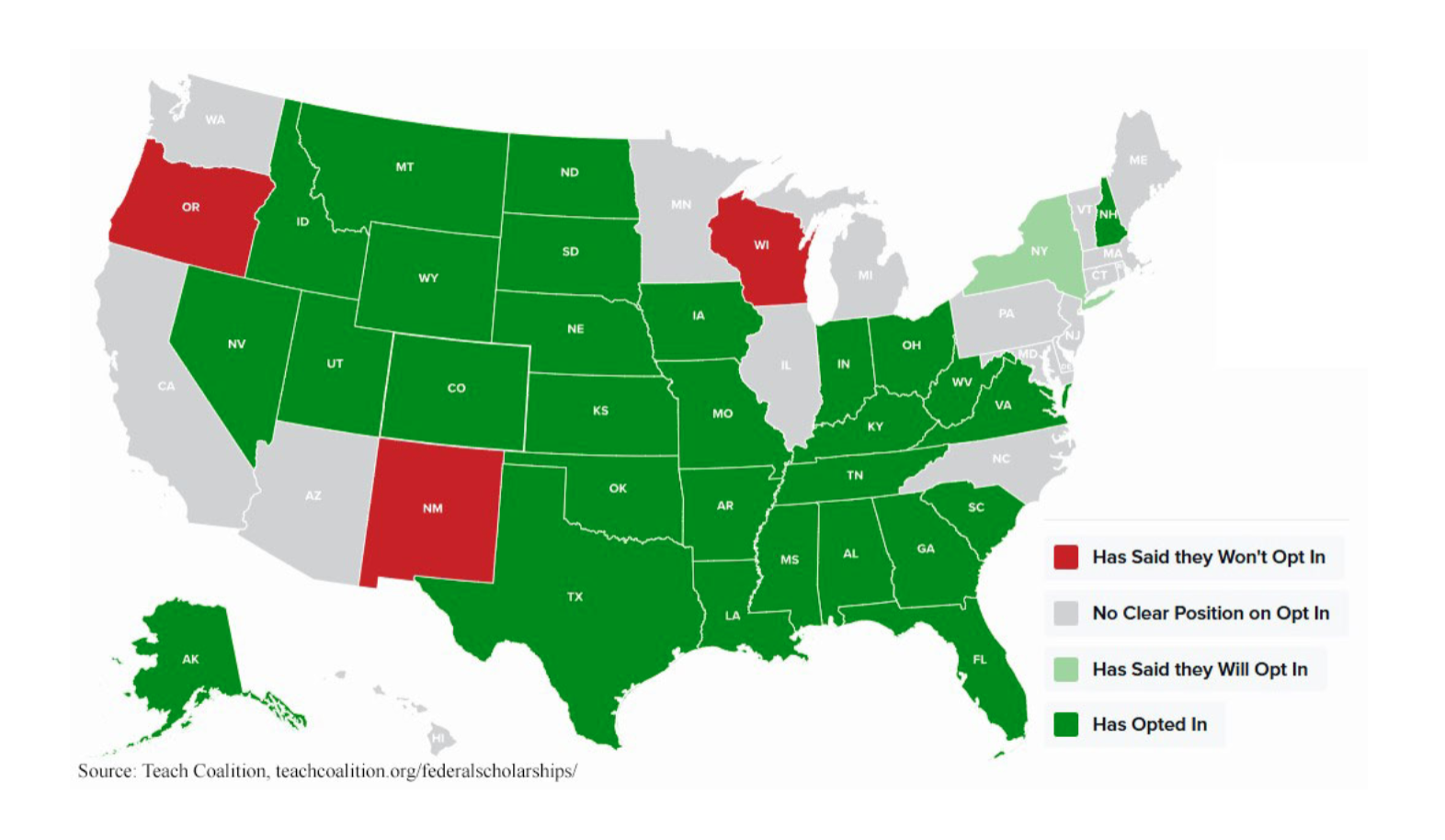
- States opt-in annually by having the governor (or designated official) submit a list of qualifying SGOs to the U.S. Secretary of the Treasury.
Local organizations, whether newly formed or existing SGOs already participating in Rhode Island’s existing corporate scholarship program, or national organizations, like the AFC Scholarship Fund, can readily administer scholarships in the Ocean State. The scholarships are entirely privately funded through federal taxpayer incentives and have no direct effect on state budgets or public-school funding formulas.
If our governor opts-out, Rhode Island would be forgoing millions in potential scholarship dollars that could flow directly to Rhode Island students, from out-of-state and in-state donors alike. Only our students would suffer, as taxpayers participating in the credit program would donate to federal SGOs or those in other states.
This is a “don’t leave the money on the table” moment for the Ocean State.
Implementation and Next Steps for Rhode Island
- For State Leaders: The governor (or designated official) should solicit requests for participation from SGOs and submit the resulting list of eligible organizations to the U.S. Secretary of Treasury to allow Rhode Island’s full participation for the next calendar year, preparing now for January 2027. This simple opt-in requires no new state spending or legislation. The resulting tax credit funds could be called BRIGHT TODAY SCHOLARSHIPS because RI students cannot hope for a bright tomorrow without a great education today!
- For Donors: Rhode Island taxpayers can begin contributing up to $1,700 to qualifying SGOs (including national partners like the AFC Scholarship Fund) and claim the full federal tax credit even if Rhode Island’s governor does not opt in.
- For Families: Eligible students can apply directly through participating SGOs for scholarships covering a wide range of educational expenses.
- For Advocates: Urge state officials to opt-in swiftly and support SGO capacity-building to ensure scholarships reach Rhode Island families as quickly as possible.