Before the Edenton Tea Party’s 1774 protest against the tax on tea, before the Mecklenburg Declaration of Independence on May 20, 1775 (it’s on the North Carolina flag!), and before the Halifax Resolves on April 12, 1776 (also on the flag!), there was the Stamp Act Crisis in 1765 and 1766.
The 250th anniversary of the Declaration of Independence is only a few short weeks away. We have tried to give you a picture of North Carolina’s Patriot experience, who its leaders were, and the role our state played in making that document possible as it has become a symbol for freedom-loving individuals around the world.
The story of North Carolina’s role in fighting the Stamp Act reads like a movie script.
Background for the Stamp Act crisis
Why did the Stamp Act serve as a lightning rod for Patriot opposition in 1765? The Stamp Act became effective Nov. 1, 1765, and was the first direct tax levied by the Crown. It was a tax on newspapers, pamphlets, insurance policies, licenses, ship’s papers, playing cards, dice, and legal documents.
Before this time, there had been indirect taxes, like customs duties, that were more like user fees. A direct tax was levied to raise revenue, and it affected many more people. The Stamp Act was passed by Parliament for three reasons: to help pay for protection of the American colonial frontier, to tighten British control over the colonies further, and to force the colonies to contribute to their own administration.
Parliament did not expect the Stamp Act to cause any problems. Only a few members spoke against it. One of them, Isaac Barre, spoke in a speech about the burden the new tax would put on the colonial “Sons of Liberty” and foresaw that the colonists would oppose the Stamp Act. He reasoned that the colonists would see this as violating their rights as Englishmen, and he was proved correct as representative assemblies in several American colonies rose up in protest against the Stamp Act, objecting primarily that colonial taxation should be initiated only by colonial assemblies. The leaders in the Stamp Act protests became known as the “Sons of Liberty” — named after Barre’s reference.
Reactions to the Stamp Act in North Carolina
News of the Stamp Act’s passage arrived in in North Carolina in June 1765 and aroused opposition all over the colony, primarily in the Tidewater area. Residents in the Cape Fear area around Wilmington were the most agitated, forming a Sons of Liberty contingent and organizing against the new tax. The arguments against the Stamp Act articulated what most of us learned in school as the principle of “no taxation without representation.”
This argument was best stated by Maurice Moore, a superior court judge, who in the summer of 1765 published a pamphlet entitled “Justice and Policy of Taxing the American Colonies in Great Britain Considered.” He directly attacked the way in which colonists were taxed, saying, “If the British parliament will insist on taxing the Colonists, as their virtual representatives, then are they stripped of that constitutional right on which their liberty and property depends, and reduced to the most abject state of slavery.”
Moore also expressed his concern for the impact the tax would have on shipping and commerce in his native Cape Fear area: “The Stamp Duty is itself a burthen too great for the circumstances of the Colonies to bear, considering the many restrictions that have been put upon their trade.”
For his role in framing the ideological argument in North Carolina, Maurice Moore was later described by Royal Gov. Josiah Martin as “a whimsical visionary in politicks … strongly tinctured with republicanism.” Definitely not someone approved of by the Crown.
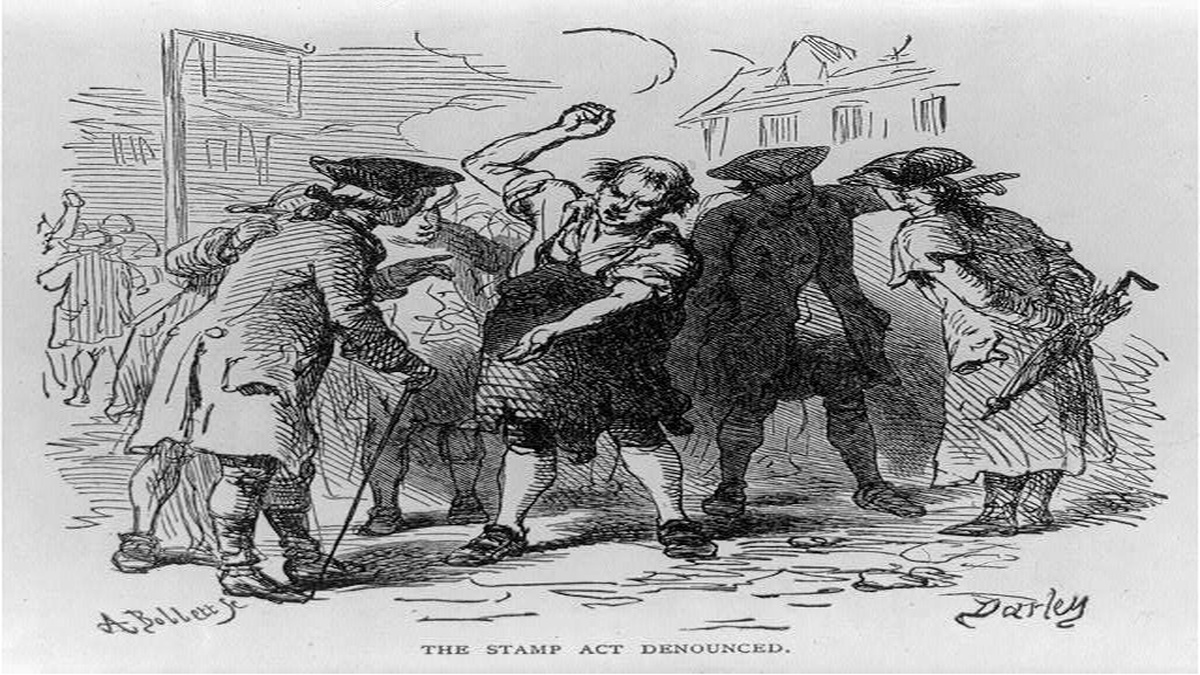
Protests against the Stamp Act soon spread sporadically around the colony. Public meetings were held in Edenton to protest the duties. In New Bern, Dr. William Houston, the stamp agent, was burned in effigy during the sitting of the superior court. Houston’s response was that he did not solicit the office and that it made him odious and abhorred. Houston was also burned in effigy in the town of Cross Creek (now Fayetteville) and in Duplin County. In Tarboro, the stamp master was forced to take an oath at the courthouse not to have anything to do with stamps, and a Sons of Liberty chapter was formed.
The most heated protests took place in the lower Cape Fear area around Wilmington. There, on Oct. 19, 1765, Cornelius Harnett, an outspoken member of the Assembly, led a band of nearly 500 local Patriots against the Stamp Act. They gathered in Wilmington near the courthouse around a huge bonfire of tar barrels and hanged an effigy of Lord Bute before burning it. According to the North Carolina Gazette, the crowd then went to every house in town and “bro’t all the Gentlemen to the Bonfire, and insisted upon their drinking, LIBERTY, PROPERTY, and no STAMP-DUTY.” The toasts went on until midnight when the crowd dispersed without incident.
The Gazette went on to report that on Oct. 31, 1765 (the last night before the Stamp Act was to go into effect), another protest occurred. This group also assembled in the evening. They produced:
[A]n Effigy of Liberty, which they put into a Coffin, and marched in solemn Procession with it to the Church-Yard, a Drum in Mourning beating before them, and the Town Bell, muffled, ringing a doleful Knell at the same Time:—But before they committed the Body to the Ground, they thought it adviseable to feel its Pulse; and when finding some Remains of Life, they returned back to a Bonfire ready prepared, placed the Effigy before it in a large Two-arm’d Chair, and concluded the Evening with great Rejoicings, on finding that LIBERTY had still an Existence in the Colonies.
What a scene this must have been. The Gazette’s report makes it sound like the whole presentation was carefully choreographed for the most dramatic impact, most likely the work of the local Sons of Liberty.
The Patriots’ work, however, was not done. After Nov. 1, the stamp duty was supposed to be in force, but there were no stamps. As a result, commerce came to a standstill since ships could not clear customs. Legal documents could not be executed nor newspapers printed and distributed. The stamp agent for the district, Dr. William Houston, finally arrived on Nov. 16, but still there were no stamps. In an effort to intimidate him, Houston was met shortly thereafter by a crowd of “three or four Hundred People … with Drums beating and Colours flying.” The mob went to Houston’s house and demanded whether he “intended to execute his said Office, or not.”
Houston responded that “[h]e should be very sorry to execute any Office disagreeable to the People of the Province.” Not content with the spoken word, the crowd marched Houston to the courthouse and made him sign “a Resignation satisfactory to the Whole.”
Having done what the crowd desired, Houston was then placed in “an Arm-chair” and carried around the courthouse and town squares amid great celebration. The procession ended at Houston’s house, where the crowd trooped inside and enjoyed the finest of Houston’s liquors. Later that evening, another huge bonfire was built, liquor flowed and “no person appeared in the Streets without having LIBERTY, in large Capital Letters, in his Hat.”
The Patriot cause was on the rise.
Royal Gov. William Tryon couldn’t help but take notice of this protest and organized a dinner meeting on Nov. 18 with around 50 of the most prestigious men of New Hanover, Brunswick, and Bladen counties and promised to relieve their grievances. The next day the provincial leaders rejected Tryon’s offer and condemned the Stamp Act as a threat to the liberty of British subjects, stating that “submission to any part of so oppressive and … so unconstitutional attempts, is opening a direct inlet for Slavery, which all Mankind will endeavor to avoid.”
When stamps finally arrived on Nov. 28, 1765, aboard the sloop Diligence, there was no stamp agent to accept them. Local Patriots Hugh Waddell and John Ashe led an armed band of men to stop the landing of the stamps, and since the Sons of Liberty had intimidated anybody from taking the stamp receiver job, the stamps stayed on the ship. As a result, ship movement in the area was paralyzed for months, and any other transaction requiring stamps was delayed, including marriages, lawsuits, debt collection, franchises, and contracts. Ministers had their salaries held up and letters delayed.
On Feb. 18, 1766, the Sons of Liberty joined together in an association united “in preventing entirely the operation of the Stamp Act.” They took an oath to resist the stamp tax to the death:
We … detesting Rebellion yet preferring Death to Slavery, Do with all Loyalty to Our most Gracious Sovereign, with All deference to the Just Laws of Our Country, … hereby mutually and Solemnly plight Our Faith and Honour that We Will at any Risque whatever, and whenever called upon[,] Unite, and truly and Faithfully Assist each other, … in Preventing entirely the Operation of the Stamp Act.
The next day, the Sons of Liberty armed themselves and marched 1,000 strong to Brunswick Town, home of the governor’s Castle Tryon. Their leaders, George Moore and Cornelius Harnett, knocked on Gov. Tryon’s door and delivered a message signed by Speaker of the Assembly John Ashe which guaranteed the governor’s safety, saying the men only had dealings with naval personnel hiding at the governor’s house (referring to Captain Jacob Lobb, who had captained a British ship that had seized two merchant ships entering the Cape Fear River headed for Brunswick Town earlier in the year without the appropriate stamps).
Tryon was infuriated by the sight of the armed band surrounding his house and dared the men to break into his house. Before violence erupted, word came that Lobb was not in the house but on his ship. The men departed. They moved to seize the customs house and control of Fort Johnston, a poorly defended fort on the river. Tryon’s men spiked the guns in the fort to keep the Sons of Liberty from seizing them.
Next, Harnett and his band forced assurances out of the customs men that they wouldn’t enforce the stamp duties. They met with tax collector William Dry and Captain Lobb and were able to get the ships released. They also wanted commitments from William Pennington, the comptroller of customs for Brunswick, who had hidden at Tryon’s house the night before in fear. More than 400 men went back to the governor’s house early the next morning and requested to speak with Pennington, by force if necessary. Pennington decided to go with them, but Tryon made him resign to save the Crown embarrassment. Harnett took Pennington and Dry and made them promise never to execute the Stamp Act until it was accepted by the American colonies. Then the armed citizens disbanded.
Conclusion
The opponents of the Stamp Act had accomplished all their goals. They had freed the impounded ships, opened the ports, and made sure that stamps were not in use. The two sides remained in a virtual stalemate until Parliament reconsidered and rescinded the Stamp Act later in March 1766. If one catalyst can be isolated that spawned the aggressive action by the Wilmington radicals, it would be the Crown’s seizure of ships carrying valuable cargo and the threat of dispatch to far-away vice admiralty courts in Halifax, Nova Scotia.
The impact of the Stamp Act crisis in North Carolina was noted throughout the colonies. James Murray, later a Loyalist, had moved from Boston to North Carolina during the Stamp Act upheaval and reported that southern colonies were more aggressive toward the act than the northern colonies. On Jan. 14, a newspaper reported that several gentlemen had arrived in Wilmington from the north, saying that the Stamp Act had had little effect there and that it was business as usual except at Cape Fear — “the only spot on the Continent where seizures of that sort happen.”
The Stamp Act conflict was as close as Patriot radicals came to armed conflict prior to 1775. Considering the fact that all sides were armed and prepared for bloodshed, it is remarkable that no blood was spilled.
One of the strangest turn of events that occurred after the Stamp Act was repealed in 1766 was that the colonial Assembly, in gratitude for Tryon’s role in airing their grievances to the Crown, financed 15,000 pounds for the building of a new house for Gov. Tryon. Today, we know it as Tryon’s Palace.
The Stamp Act struggle clearly laid the groundwork for later rebellion. Leaders were identified. Tactics defined. Messages articulated. The clear rallying cry of “no taxation without representation” was hammered home as a touchstone for rebellion. The rebellious spirit of freedom-loving Patriots had taken form, to be tapped into again 10 years later against the authority of the most powerful force in the world at that time: King George III and the British Empire.