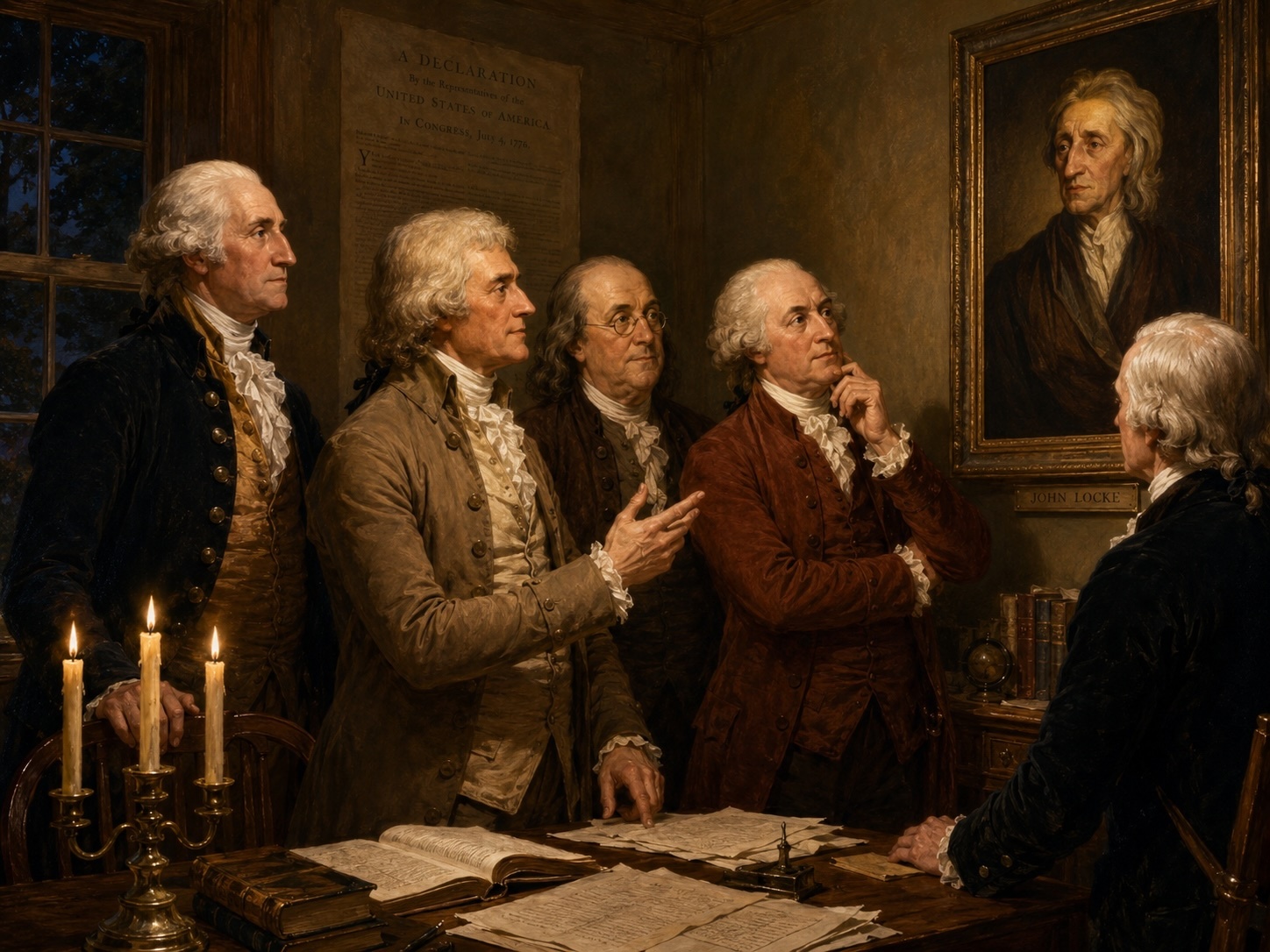
As we get closer to the 250th celebration of the Declaration of Independence on July 4, it’s important to go back and explore the roots of the document. Much of the Declaration’s language of freedom that flowed from the pen of Thomas Jefferson and the minds of his fellow patriots can be attributed to the great philosopher John Locke.
The doctrine that governments need the consent of the governed is clearly espoused by Locke. This idea that became flesh in the American Revolution changed the world from a place where kings and queens ruled the world to one where individual freedom was possible.
John Locke is remembered for many reasons. He was a physician, but he is better known as a government employee who worked for the Lords Proprietor appointed by King Charles I over the colony of Carolina. In that role, Locke performed many other jobs that utilized his fertile mind and shaped his view of the world.
Locke is perhaps best known as a philosopher who wrote several papers that provided the ideological basis for our understanding of natural rights and individual freedom.
John Locke believed that our rights do not come from government; they exist by nature and therefore precede government. He believed that governments derive their just powers from the consent of the governed and remain legitimate only so long as they protect those rights.
In Locke’s mind, true freedom was the absence of coercion, and every person’s life, liberty, and property should be protected from invasion by others. This was not a “right” to economic goods or “freedom from want” but the right to pursue one’s own path without interference.
One thing I find is that when we remember historical figures like Locke, we often think only of actions that took place during a narrow time frame in a lifetime of varied experiences. Locke is one of those amazing characters in history. The writings on philosophy that we often remember from Locke were written in the 1680s during a turbulent period in the reign of England’s King Charles II. His ideas grew and developed when he went into exile in Holland for five years with his patron and employer for many years, Lord Anthony Ashley Cooper, the First Earl of Shaftesbury.
Was John Locke just some really smart guy who sat up in an ivory tower all the time thinking of brilliant things to say to the world? I don’t think so. Consider John Locke’s world in the 12-year period from 1666 to 1688.
From October 1666, Locke served as the Earl of Shaftesbury’s secretary — what we might today consider his Chief of Staff — and in that capacity he was around all kinds of political intrigue.
Shaftesbury is a story unto his own. He had opposed the beheading of King Charles I, then was supportive of the republican government that replaced him under Oliver Cromwell. Shaftesbury opposed Cromwell when he began thinking Cromwell was a tyrant, and then he became part of the group that sought to bring Charles I’s son back to the throne in what was known as the Restoration.
Whew! That’s a lot of dips and turns. The main issue of the day was royal succession — whether the Crown should be Catholic or Protestant. Money, power, and greed all flourished as they do today.
As the Earl of Shaftesbury’s secretary, John Locke was right there in the thick of things. Shaftesbury became a favorite in Charles II’s court and served in high positions — among them Lord Chancellor of England. He seemed to be one who sniffed out tyranny and spoke his mind.
In the summer of 1675, Shaftesbury wrote a 15,000-word pamphlet entitled “A Letter from a Person of Quality to his Friend in the Country” denouncing a “bill of test,” which leaders were required to sign in support of the government’s leadership. The pamphlet spoke of the government becoming “absolute and arbitrary.” In his role as Shaftesbury’s advisor, Locke undoubtedly helped in drafting the letter, and for a time it was attributed to Locke. When the House of Lords reacted by ordering it to be burned and set up a committee to uncover who printed it, Locke moved one step closer to the philosophical positions he ultimately articulated a few years later.
Over the next few years, Shaftesbury — and Locke with him — fell more and more out of favor with the Crown. They associated with other voices who disagreed with absolute royal power, and associations were formed that led to numerous plots and discussions of assassination, uprising, and insurrection.
How serious was politics in late 1600s England? One of John Locke’s contemporaries, Algernon Sidney, was a devout spokesman in opposition to royal tyranny. Sidney wrote “Discourses Concerning Government,” which along with Locke’s “Two Treatises of Government” are recognized as critical works in the founding of our country, as they were favorites of Thomas Jefferson and John Adams.
Sidney’s “Discourses,” written in the early 1680s, was a discussion of popular government in which he rejected theories in support of royal absolutism and the historical divine right of kings. Treated almost as a religious tenet, this belief held that the king was not only a civil power but also acted as God’s hand on earth. Sidney’s writing forcefully countered that the right to rule a body of people should be based on merit rather than birth.
Here’s where it gets real. Algernon Sidney was beheaded in 1683 for his role in the Rye House Plot to assassinate King Charles II and his brother James, Duke of York. John Locke and many other alleged co-conspirators, including the Earl of Shaftesbury, fearing retribution as well, fled to the Dutch Republic in Holland. How ironic that only five years later, William of Orange along with his queen, Mary, were welcomed to reign as monarchs in what became known as the Glorious Revolution. The event is referred to as “glorious” because of how relatively bloodless and peaceful it was compared with most transitions of power.
After Locke came back to England following the coronation of the new royal leaders, he gradually emerged as the older and thoughtful philosopher we know of today (Shaftesbury died soon after reaching Holland). Locke was known throughout his life as a scholar and a seeker of truth, especially during his 15 years or so at Oxford. He took an interest in a wide array of fields, such as the arts, biology, medicine, science, and philosophy, and he counted leaders in all those fields as his friends.
Public knowledge of Locke’s primary writings grew. “An Essay on Human Understanding” examined the self and led to his strong feelings of natural law and how it played into self-government and individual freedom. His “Two Treatises of Government” not only became the model for Jefferson and the Declaration of Independence but are still studied around the world as a foundational piece for the continuous fight between personal freedom and a coercive government.
John Locke clearly was not just a philosopher in an ivory tower. He was a passionate thinker and seeker of truth, and for his significant contribution to the cause of freedom, we are proud to be associated with him during this 250th celebration of our country’s birth.