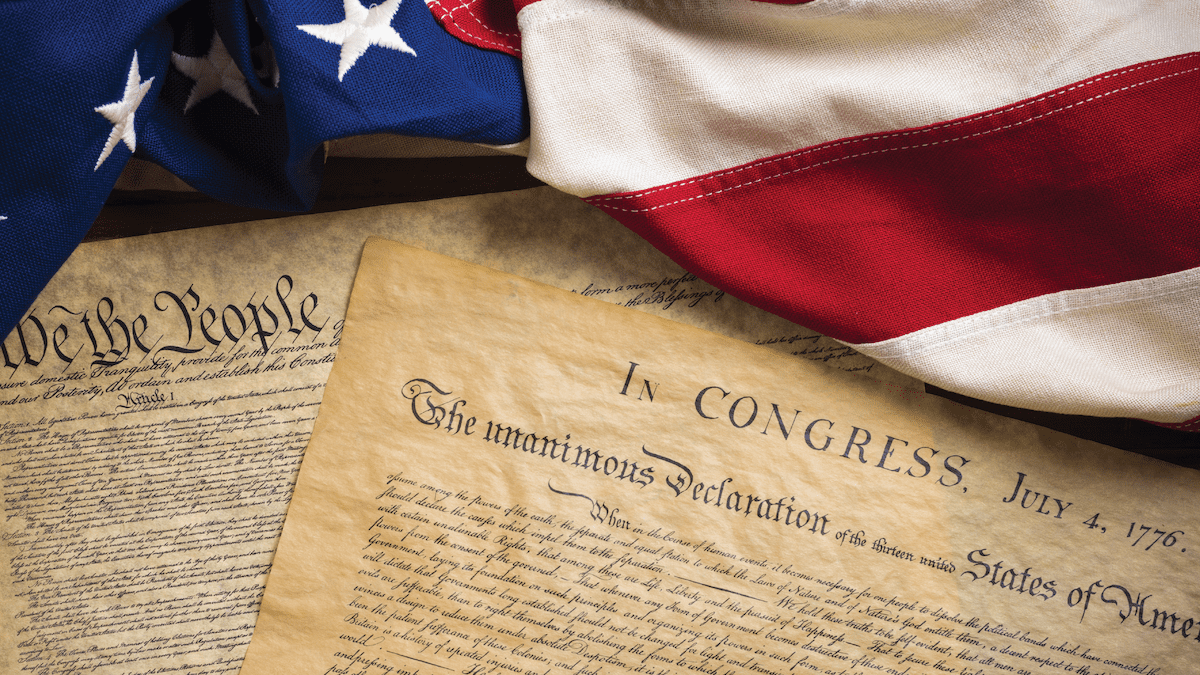

The historian Pauline Maier has noted that John Adams assumed that American independence would be commemorated on July 2 since that was the day in 1776 the Second Continental Congress adopted a resolution: “That these United Colonies are, and of right ought to be, free and independent States, that they are absolved from all allegiance to the British Crown, and that all political connection between them and the State of Great Britain is, and ought to be, totally dissolved.”
Eventually, Independence Day would be observed on the Fourth because that was the day Congress adopted the Declaration of Independence. Linking our official independence with the adoption of the Declaration is entirely fitting. The Declaration did much more than merely announce a political separation; it established an aspiration that shaped the new nation, and continues to shape us today. As Maier observed:
“In announcing their separate nationhood, Americans had to do more than demonstrate that the British Crown had forced them to the measure. They needed to overcome fear and the sense of loss, to link their cause with a purpose beyond survival alone, to raise the vision of a better future so compelling that in its name men would sacrifice even life itself.”
Abraham Lincoln had this sense of the Declaration’s purpose. With its adoption, he said, the “new nation” had been “conceived in liberty, and dedicated to the proposition that all men are created equal.” The preservation of this dedicated nation was the cause for which the brave men Lincoln commemorated gave “the last full measure of devotion.”
That sacrifice, in turn, facilitated a tangible advance toward the goals of securing equal human dignity and the enjoyment of God-given unalienable rights. In the wake of the Civil War, “members of Lincoln’s party tried to write [the Declaration’s] principles into the Constitution by enacting the Thirteenth, Fourteenth, and Fifteenth Amendments.”
Of course, the “promissory note” embodied in the Declaration has yet to be entirely fulfilled. Professor Maier wrote that the Declaration’s “power comes from its capacity to inspire and move the hearts of living Americans.” She points out that it has been “a cause of controversy” but also a “unifying national icon.”
This latter function seems to be our most pressing need now.
Thomas Jefferson, the Declaration’s primary drafter, and John Adams, “who did more to win Congress’s consent to independence than any other delegate,” became friends through their joint effort. Each made critical contributions to the new nation, but their friendship became severely strained because of political disagreements, and for a long period, they did not interact. The Philadelphia doctor Benjamin Rush, a signer of the Declaration, and a friend of both Jefferson and Adams, was distressed by their estrangement and worked to reconcile them.
Rush was successful, and Jefferson and Adams began corresponding again in 1812, a correspondence that continued to the end of their lives. Providentially, that end came for both of them on the same day in 1826, the Fourth of July – 50 years from the adoption of the Declaration and 200 years ago this coming Saturday.
The Fourth of July has been a tremendous symbol of patriotism, sacrifice, and freedom. It would be fitting that it also be a symbol of reconciliation and unity.