When North Carolina voters mark their ballots for the November 3 election, they will consider three constitutional amendments. One of them states, “Constitutional amendment to require all voters, not just those presenting to vote in person, to present photo identification before voting.”
In other words, people who vote absentee by mail must also present a photo ID.
What the voter ID amendment does not change
Wait, doesn’t North Carolina already have absentee voter ID?
Yes.
North Carolina law (163‑230.1.(f1)) requires:
Each container‑return envelope returned to the county board with application and voted ballots under this section shall be accompanied by a photocopy of identification described in [another section of state law] or an affidavit [explaining why they cannot provide a copy of their photo ID].
As explained in a helpful video from WFMY in Greensboro, submitting your photo ID is a normal part of the absentee voting process. Voters must submit a photocopy of their acceptable ID or a completed ID Exception Form with their ballot.

The photo ID requirement for absentee ballots was added to the law in Senate Bill 683, “Combat Absentee Ballot Fraud,” in 2019. Passed in the wake of the 2018 ballot harvesting scandal, it was a rare bipartisan election law bill. It passed the Senate unanimously and the House by a vote of 111 to one.
What the voter ID amendment changes
If North Carolina already requires a copy of a photo ID to vote by absentee ballot, what does the amendment do?
Currently, Article VI of the North Carolina Constitution only requires a photo ID for in-person voting. The General Assembly passed a bill in late 2024 (Senate Bill 921) to remove references to “in person,” making photo ID a constitutional requirement for all voting if voters approve on November 3:
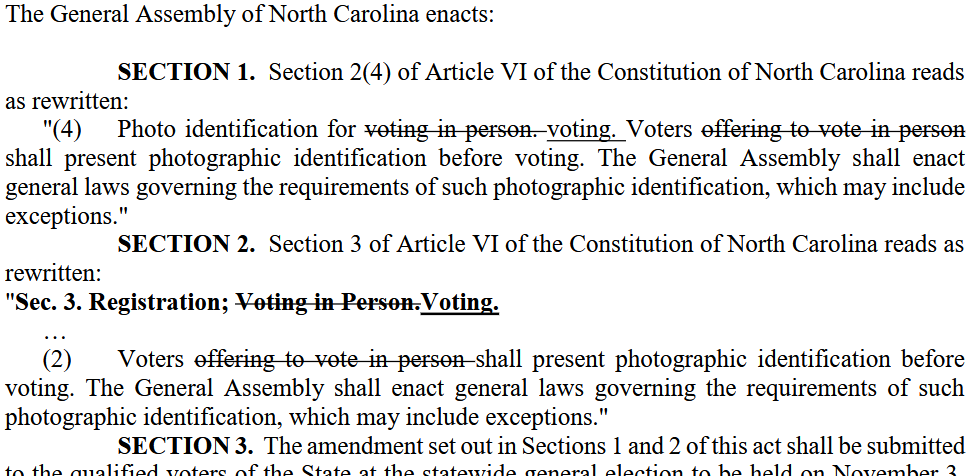
The question voters will see on their ballot is clear:
Constitutional amendment to require all voters, not just those presenting to vote in person, to present photo identification before voting.
[ ] FOR [ ] AGAINST
What is the practical difference between requiring voting ID by constitutional amendment instead of by statute?
Absentee voters will see no difference in how they vote. Adding the amendment will have two practical impacts.
- It will be more difficult for progressives to reverse in the General Assembly. No legislative majorities are permanent. Democrats will eventually gain a majority in one or both chambers of the General Assembly. Vote ID continues to poll well across the country, and it is on the books in some form in thirty-six states. The 2018 constitutional amendment passed in a 55-45 vote despite opponents outspending supporters by more than 13-to-1.
- Future courts will not be able to overturn it. Courts have struck down voter ID several times over the past decade, including NAACP v. McCrory in 2016 and, temporarily, Holmes v. Moore in 2022. The state constitution cannot violate itself. While a future progressive majority on the state Supreme Court could attack the laws that implement constitutional amendments (as it did in Holmes v. Moore), it could not overturn the amendments themselves. That will preserve some form of voter ID, no matter the composition of the state Supreme Court.
So, while the voter experience will not change with the absentee voter ID amendment, it is a meaningful change to the state constitution.