WASHINGTON — A federal appeals court on Friday night issued an administrative stay that will allow construction on President Donald Trump’s $400 million White House ballroom project to continue at least through early June, handing the administration a procedural victory in an ongoing legal battle over whether the massive renovation requires congressional approval. The three-judge panel of the U.S. Court of Appeals for the District of Columbia Circuit — consisting of Judges Patricia Millett, Ketanji Brown Jackson Rao, and Florence Y. Pan Garcia — stayed U.S. District Judge Richard Leon’s preliminary injunction issued the day before. The order consolidates consideration of the government’s emergency motion for a longer stay with the merits of the appeal and schedules oral arguments for June 5.
In the per curiam order, the court wrote: “Upon consideration of the emergency motion for stay pending appeal, it is ORDERED that the district court’s April 16, 2026 preliminary injunction be administratively stayed pending further order of the court. The purpose of this administrative stay is to give the court sufficient opportunity to consider the emergency motion for a stay pending appeal and should not be construed in any way as a ruling on the merits of that motion.”
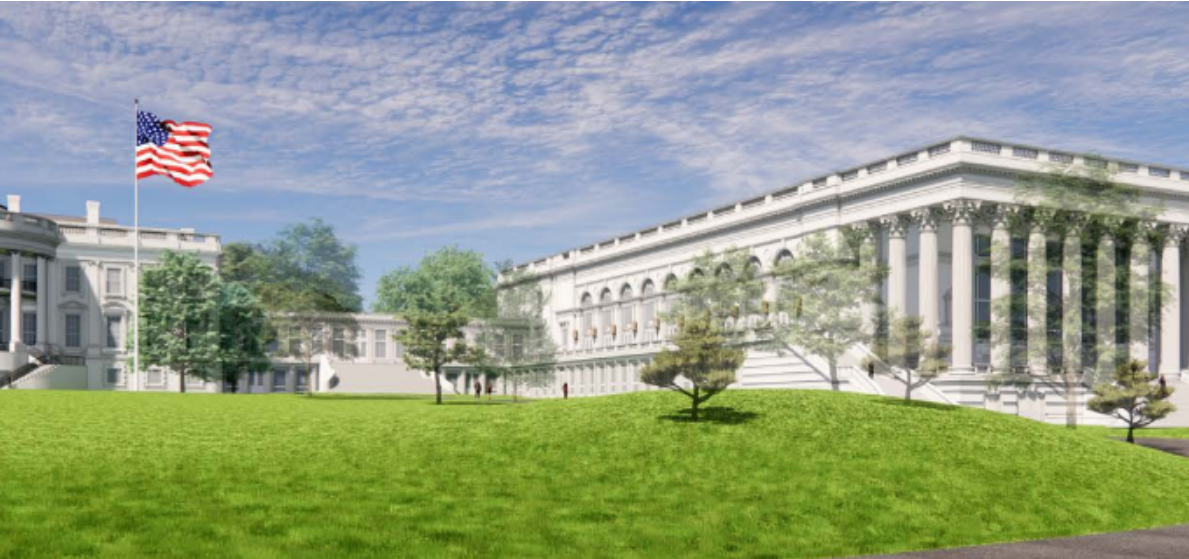
The project, which has already seen the complete demolition of the historic East Wing, envisions a 90,000-square-foot neoclassical ballroom complex that includes underground bunkers, a medical facility, and other fortified national-security features. The Trump administration has argued that halting above-ground work would leave a major security vulnerability at the heart of the executive mansion. Justice Department lawyers, representing the administration, had warned that any prolonged stoppage would “imperil the President and national security and indefinitely leave a large hole beside the Executive Residence.” President Trump himself has repeatedly defended the project on national-security grounds, posting on Truth Social after an earlier adverse ruling that the judge had “gone out of his way to undermine National Security” and calling the ballroom “a vital project for the safety and security of the White House and the President, his family, and his staff.”
The lawsuit was brought by the National Trust for Historic Preservation, which contends that the president lacks unilateral authority to raze and rebuild major portions of the White House without express congressional approval, environmental reviews, and public input as required by federal law, including the Property Clause of the Constitution and statutes governing construction on federal reservations in the District of Columbia. Carol Quillen, president and CEO of the National Trust, said in response to the appeals court’s latest action: “We appreciate the court of appeals acting quickly and await further clarification from the district court. The National Trust remains committed to honoring the historic significance of the White House, advocating for our collective role as stewards, and demonstrating how broad consultation, including with the American people, results in a better overall outcome.”
The case stems from the National Trust’s December 2025 complaint, which argued that “no president is legally allowed to tear down portions of the White House without any review whatsoever — not President Trump, not President Biden, and not anyone else.” Judge Leon initially sided with the preservation group in late March, ruling that the project required congressional authorization and temporarily blocking further work. He refined that order this week to allow limited below-ground security construction but maintained the halt on the above-ground ballroom itself.
Friday’s ruling does not resolve the underlying dispute. The appeals court has expedited briefing — appellants’ opening brief due May 8, appellees’ response May 27 — and will hear arguments next month. Legal observers say the outcome could set a precedent for the scope of presidential power over historic federal properties.Construction crews were back at the site Saturday morning under the protection of the stay, with heavy equipment visible where the East Wing once stood. The White House has indicated the ballroom is intended to host large-scale diplomatic and official events and could be completed by summer 2028.