
“By exercising restraint, the MTSC upheld the rule of law and the separation of powers, core principles of truly limited government.”
The following has been adapted from an excerpt of the Frontier Weekly Newsletter written by Kendall Cotton for the July 16th edition.
The Montana Supreme Court has been rightfully critiqued for improper judicial activism over the years. However, this week I want to highlight the Court’s very recent and consequential decision in Treasure County v. Edlund as an excellent example of the type of judicial restraint that we have been calling for.
In the June 23rd Edlund decision, the MTSC unanimously upheld a district court ruling that a proposed citizen initiative for a countywide wind energy ordinance in Treasure County was invalid. The proposal sought to establish a new permitting and approval system for wind energy projects, establishing regulations like setbacks, noise limits etc. while granting the county commissioners broad discretion to approve or deny permits.
Treasure County challenged it, a district court sided with the County, and the case eventually went to the MTSC
The MTSC ruled unanimously that the initiative could not proceed because it attempted to create a comprehensive land-use regulatory and permitting regime using only the County’s general powers. Montana law specifically governs how counties may regulate land use and zoning (Title 76, Chapter 2). When the Legislature has established a detailed statutory framework for a subject, that framework controls, even for citizen initiatives. The proposal’s key provisions (including who issues permits and what penalties apply) conflicted with those specific statutes.
Here’s a key passage:
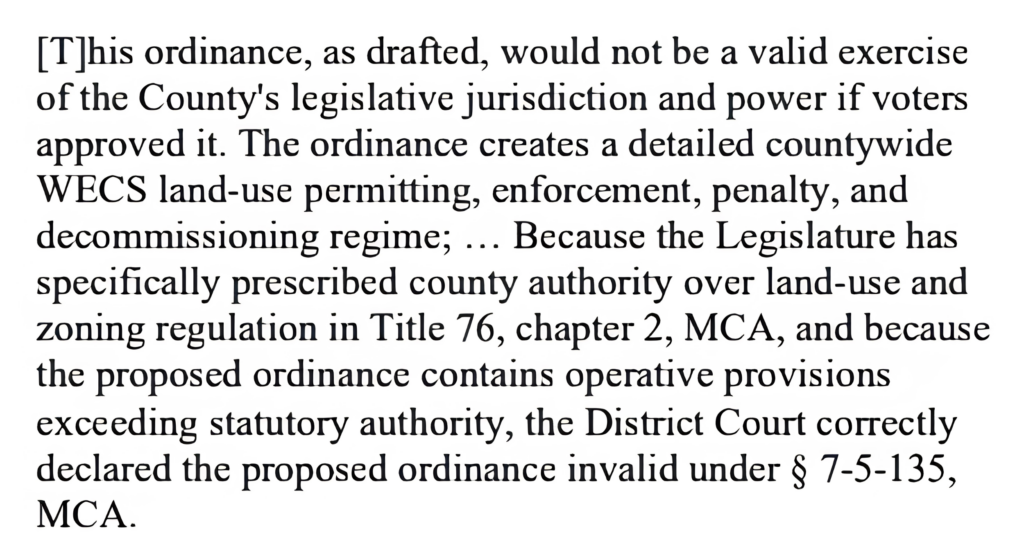
Critically, the Court issued a narrow holding: it did not declare that citizen initiatives can never address land use. It held only that this ordinance, as drafted, could not proceed because it failed to rest on valid statutory authority. It also declined to reach constitutional questions once statutory invalidity resolved the case.
This decision has numerous markers of proper judicial restraint. The Court:
- Respected the Legislature’s deliberate design for land-use regulation to balance interests.
- Applied existing law instead of expanding its own role or deciding the policy merits of wind energy development.
- Enforced structural limits on government authority (including authority via citizen initiative)
- Resolved the case on narrow, text-based statutory grounds rather than broad constitutional pronouncements.
- Issued a narrow holding that preserves properly structured citizen-initiated land-use measures rather than issuing an advisory or categorical opinion.
By exercising restraint, the MTSC upheld the rule of law and the separation of powers, core principles of truly limited government. They protected our founding principle that the government must act within enumerated limits, including when acting via citizen initiative.
Hopefully, Montana sees more of these types of decisions from the state supreme court in the future.
Be sure to check out our full report: Montana Supreme Court: An Institution in Need of Reform to learn more about the Montana Supreme Court’s record.