With the passage into law of House Bill 1300, voters this fall will have the opportunity to cap their local school district budget increases and administration spending. How would this work?
Josiah Bartlett Center President Andrew Cline wrote in NH Journal in May about the strange fact that Massachusetts has a statewide property tax cap, but New Hampshire does not. The compromise version of House Bill 1300 contains a tax cap and a limitation on school administration. The tax cap portion bears notable similarities to the one that Massachusetts adopted in 1980.
Opponents of tax caps claim that they starve local government budgets of needed funding. In practice, they tend to merely slow the rate at which local tax collections grow. That’s how it’s worked in Massachusetts.
A Tax Foundation analysis of Massachusetts’ Proposition 2 1/2 cap found that tax revenues more than doubled from 1984-2024, after adjusting for inflation and population growth. So local budgets weren’t strangled to death. If local tax revenue were a meal, municipalities wound up with portions twice as large in 2023 as they enjoyed in 1984.
How?
Massachusetts limits the growth of property tax levies in this way: Local revenue is capped at the prior year’s tax base + 2.5% + the value of new taxable property.
That’s how HB 1300 works too, though the middle number is different.
HB 1300 would limit school district budget increases to last year’s base + the rate of inflation + the value of new taxable property.
This allows school district revenue to grow faster than the rate of inflation.
Though this type of tax cap allows for higher revenue growth vs. a cap tied to inflation alone, it remains a real restraint.
In a new study for the Fiscal Alliance Foundation, economist Jared Walcząk found that Massachusetts’ cap helped to cut the state’s effective property tax rate by two-thirds.
“The property tax bill for the median Massachusetts single-family home is $6,896,” Walczak wrote. If taxed at pre-Proposition 2½ rates, tax liability would be an eyewatering $24,613.”
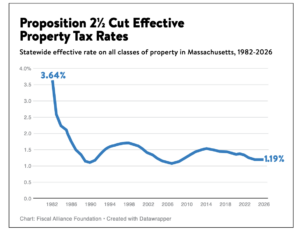
It’s important to note that cutting the property tax rate did not shrink property tax revenues. As the tax rate fell by 2/3, property tax revenues more than doubled, adjusted for inflation and population growth.
The cap didn’t shrink local governments. It let their revenues grow, but not above 2.5% plus the value of new taxable property.
The Massachusetts law has two separate caps, a levy limit and a rate cap. HB 1300 has only the levy limit, which functions the same way as the limit in Proposition 2 1/2.
HB 1300 uses the inflation rate, not a fixed percentage, so there’s never a year in which school district spending would be capped below the rate of inflation, as can happen in Massachusetts.
And HB 1300 applies only to school districts, not entire municipalities.
So the proposed school district tax cap in HB 1300 is weaker than the tax cap that Massachusetts has had for 46 years. And it’s voluntary, not mandatory.
Why cap school district revenue growth?
School district budgets are driving property tax increases.
School districts account for more than 70% of local property taxes in New Hampshire. As the Josiah Bartlett Center has shown, even as enrollment fell by 54,000 students, school spending rose by $1.25 billion, adjusted for inflation.
Why restrict administration spending?
New Hampshire led the nation in school district staffing growth relative to enrollment since the 1990s, and much of that increase came in administrative positions.
As a limitation on the growth of local property taxes, HB 1300 would allow significantly more property tax growth than Massachusetts allows.
And yet as the Massachusetts example shows, even high caps work to restrain property tax growth, lightening the burden on taxpayers over time.