New Hampshire’s unique state tax structure is hard to understand, especially for people who don’t own a business.
More than a third (36%) of the state General Fund and Education Trust Fund revenue comes from business taxes.
The vast majority of that comes from the Business Profits Tax (BPT), but the lesser-known Business Enterprise Tax (BET) contributes almost 10% of the revenues collected by the Department of Revenue Administration.
When legislators agreed this month on a plan to establish automatic BET rate cuts if certain state revenue growth targets were met, the discussion immediately ran off the rails.
A lot of commentators clearly had no idea how the BET works.
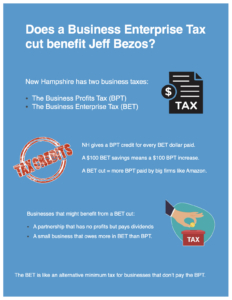
So we created a handy little explainer (see below).
The BET is not the same as the BPT. It was designed to tax businesses that record little or no official profit.
Some types of businesses distribute earnings to partners instead of recording corporate profits, for example.
The BET functions as a sort of alternative minimum tax for businesses that have little to no official profits.
To avoid double taxation, businesses that pay the BPT can take a credit against this payment for every dollar they pay in BET.
This means that BET rate cuts don’t affect big corporations that pay the BPT. A $1 reduction in their BET liability creates a $1 increase in their BPT liability.
So, no, Amazon, Apple, Tesla, Target and other large corporations are not getting a big tax break from the BET rate cuts. Their New Hampshire tax liabilities remain the same.