During extreme heat waves and cold snaps, the U.S. Department of Energy (DOE) under President Donald Trump has been issuing emergency orders that allow utilities to exceed their environmental emissions limits in order to keep the power on for people. Those periods have also provided object lessons about what sources of electricity generation can be relied upon during an emergency.
For North Carolina, these emergency periods include June 24–25, 2025; Jan. 27–30, 2026, later extended to Feb. 3; June 11–12, 2026; and, most recently, July 2–6, 2026.
Here is what the hourly power generation from Duke Energy Carolinas and Duke Energy Progress (collectively, Duke) looked like during the recent July 4 holiday heat wave.
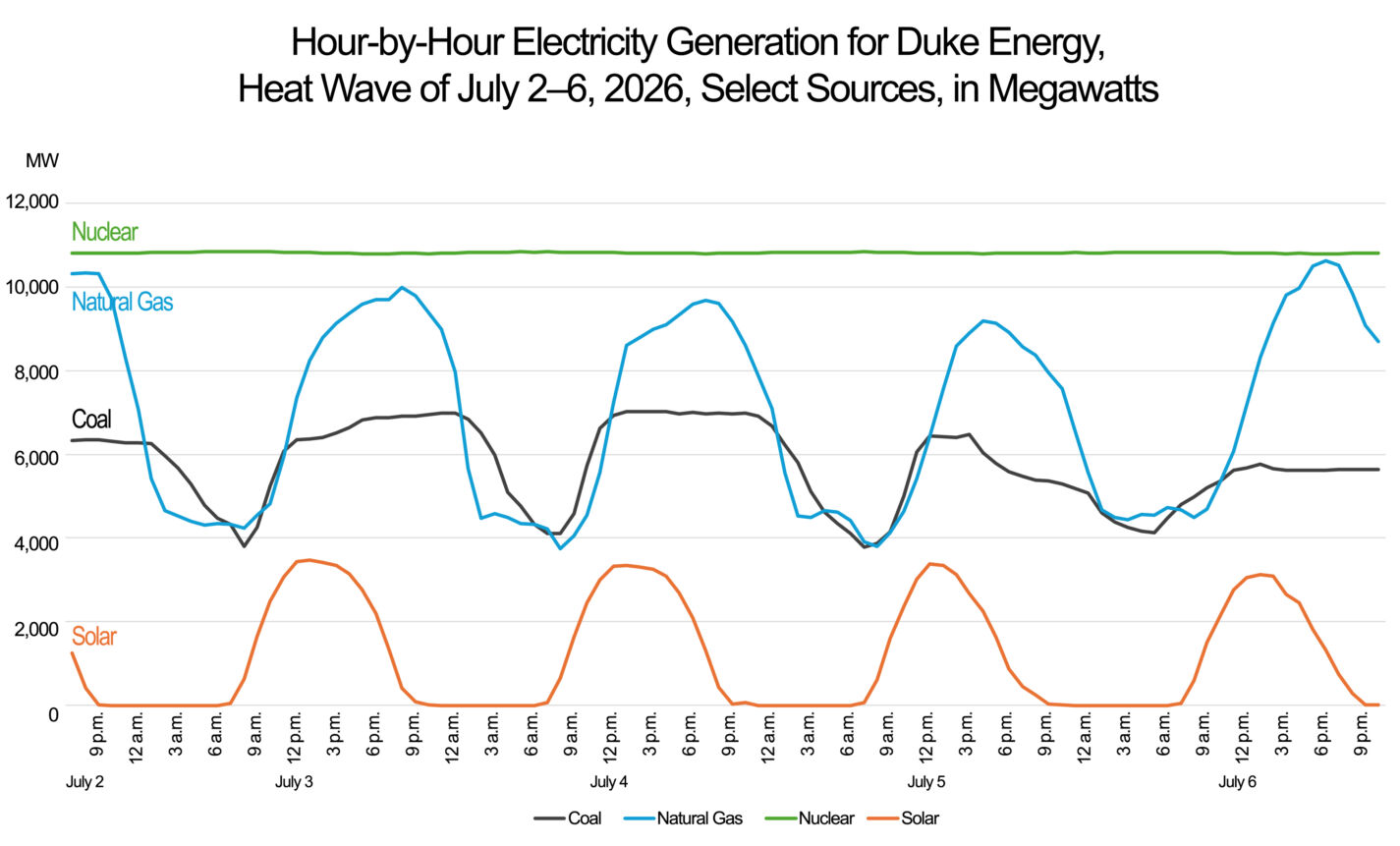
Source: U.S. Energy Information Administration’s Hourly Electric Grid Monitor
As seen during the previous emergencies (see discussions here, here, here, and here), nuclear generation was the stalwart producer, a picture of unwavering reliability. Coal and natural gas fluctuated as demand flagged in the early morning periods, with greater variability from natural gas as befitting a readily dispatchable resource.
Solar produced electricity only during the days, since it cannot produce when the sun goes down. Be that as it may, people still cool (or heat) their homes and have other power needs in the evenings and even overnight. When solar goes dark, you can see high loads being carried by natural gas and coal until well into the early morning hours.
That is the case because North Carolina still has natural gas and coal power plants. Under the Carbon Plan law, however, they’re supposed to be phased out by 2050 and replaced by zero-emissions sources, primarily solar and four-hour batteries. The graph above gives an idea of — or rather a warning about — how such a grid would behave during future emergencies.
Extreme temperature events have shown that nuclear, natural gas, and coal are the power sources North Carolinians can’t do without in an emergency.
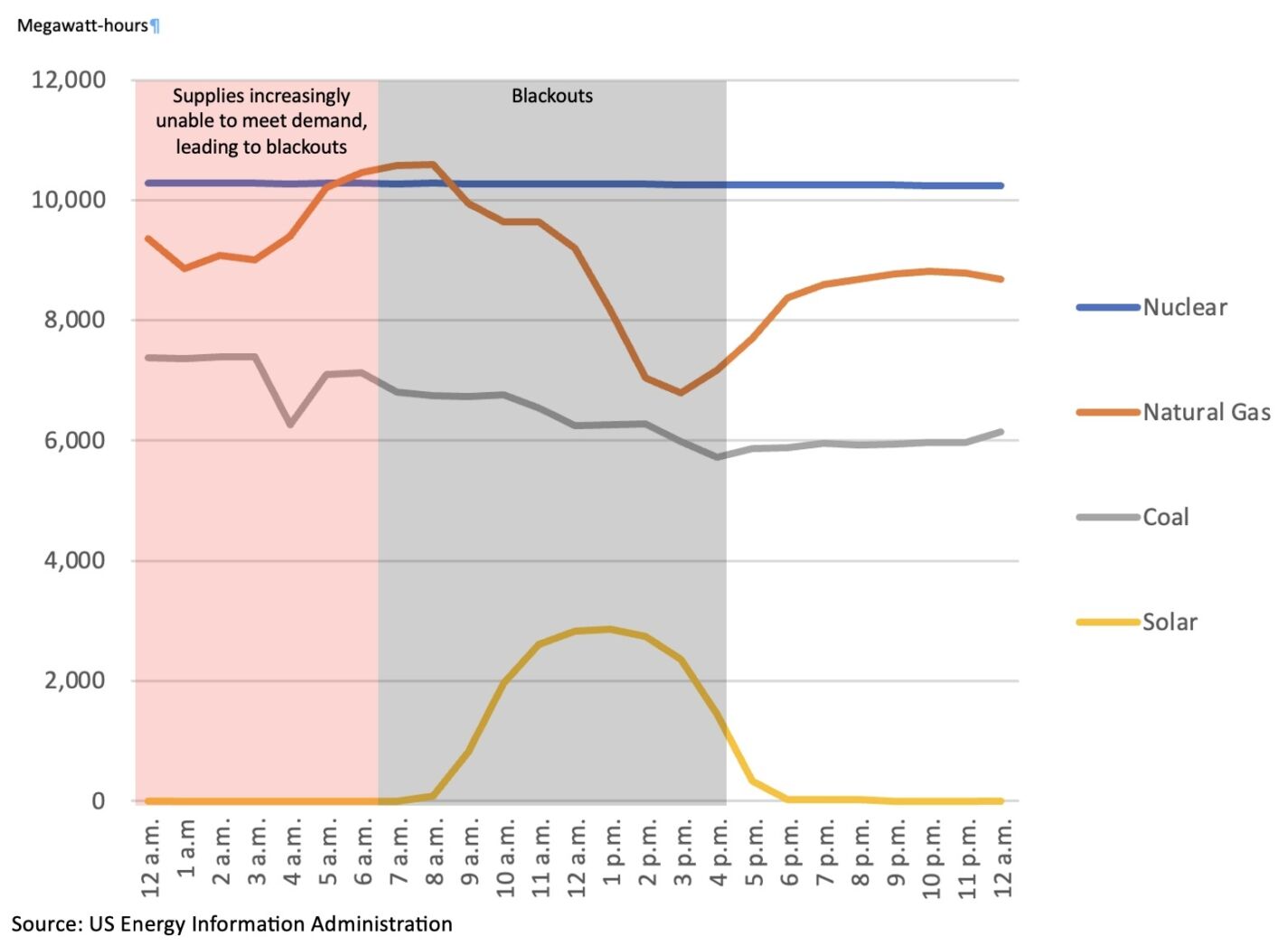
We got a foretaste during the Christmas Eve blackouts of 2022. Instrumentation failures at two natural gas power plants and one coal power plant caused expected power supplies to drop, and planned outside power purchases did not come about. The grid suddenly became a lot more environmentally friendly at the worst possible time: in the early morning hours when solar could not produce.
Timeline of the Christmas Eve 2022 blackouts, with hourly electricity generation, select sources
Subsequent political posturing sought to distract people from that lesson. Gov. Roy Cooper took up the narrative that solar on that day “performed as expected” and even called it “lower-cost” and “reliable,” which are palpably false.
Predictably, media interpreted solar “performed as expected” to mean that solar “produced during the whole period, which all right-thinking people knew to expect.” What it really meant is that solar did what solar does — i.e., solar “behaved as it was expected to behave when it was dark and when the sun came up later.” So in those early morning hours, when power demand overwhelmed available power supplies and blackouts began, all the solar facilities combined were producing absolutely zero power.
It was dark when the blackouts began. We expect solar to produce nothing in the dark.
As expected, solar began producing later on that morning through the afternoon. Thankfully, it was a sunny day.
The false narrative fomented by Cooper and his allies was that we wouldn’t have had blackouts if there were more solar and less coal and natural gas in the energy mix. The subsequent extreme temperature events have provided opportunities to show how nuclear, natural gas, and coal (“fossil fuels”) are the power sources North Carolinians can’t do without in an emergency.
Look at the graphs above and ask what would happen to North Carolina if we were ruled by Cooper’s demanded “transition away from fossil fuels” and our power grid depended upon Cooper and friends’ preferred sources of electricity generation.