Shawn Tackett, a resident of West Virginia who had spent ten years in federal prison, faced difficulties adjusting to life on the outside. Although he had earned various trade certificates during his time in prison, his criminal record deterred employers from hiring him for jobs in those fields. Moreover, since he did not possess a driver’s license, it was impractical for him to take public transport to a low-paying job. As a result, Shawn reverted to his previous habits and got incarcerated again.
Appalachian-Sized Roadblocks
Tackett’s story underscores the hurdles many formerly incarcerated individuals face when reentering society. A chief among these is occupational licensing. This labor regulation that requires individuals to obtain government permission before practicing certain professions often
presents a significant hurdle. Requirements for a license can be demanding, involving rigorous educational or training criteria, examinations, and additional stipulations set by the licensing authority.
While some argue that licensure protects the public, research suggests these regulations can hinder individuals’ ability to find meaningful employment and achieve upward economic mobility. Additionally, these requirements may inadvertently increase criminal activity by limiting those with prior convictions from securing gainful employment in certain occupations. As a result, these licensing rules can pose significant obstacles for formerly incarcerated individuals who hope to reintegrate into the workforce.
Shining Light on the Mountain State
Our new policy brief, compiled in part with Darwyyn Deyo, Assistant Professor of Economics at San José State University and Research Affiliate at the Knee Center for the Study of Occupational Regulation at West Virginia University, explores the relationship between licensing barriers, crime rates, and employment prospects while also examining the recent reforms West Virginia has enacted which have hoped to address the challenges faced by West Virginians with a criminal record seeking licensure.
Occupational licensing barriers affect different demographic groups in varying ways. For instance, younger workers often face workforce delays due to additional schooling or apprenticeship requirements. Additionally, licensing can be burdensome for lower-income occupations, where the return on investment for education is not substantial and delayed earnings have a major impact. Furthermore, there may be disparities among ethnic groups, with Black workers in West Virginia less likely to hold licenses than other groups. Economic opportunities can be expanded for all West Virginians by removing or reducing licensing burdens.
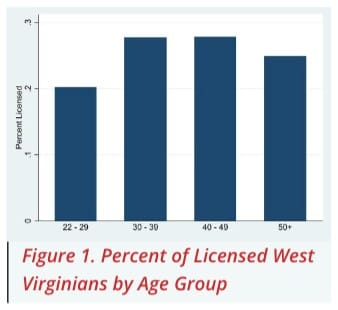
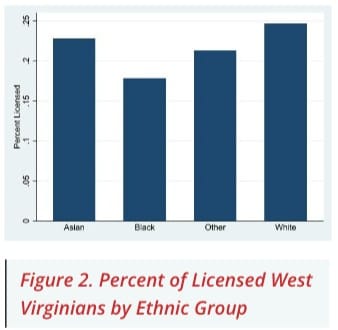
The combined growth of occupational licensing and mass incarceration in West Virginia exemplifies a unique challenge. Thousands of West Virginians are effectively barred from pursuing a renewed sense of hope and prosperity. Seventy years ago, only 5 percent of workers in the United States required a license. Today, almost 22 percent of all U.S. workers, and 24 percent of West Virginians, need a license for their job. The state’s high incarceration rate of 731 per 100,000 people further exacerbates the situation, limiting opportunities for individuals seeking a fresh start. Moreover, the recidivism rate is 24 percent, with 42 percent of those due to new criminal offenses and the rest from parole violations.
Blasting Through Barriers
West Virginia has passed three laws since 2019 to reduce the legal disabilities imposed on individuals with criminal convictions, commonly called “collateral consequences.” Previously, West Virginia’s only law related to consideration of convictions in granting licensure was a rule which prevented licensure authorities from considering expunged convictions. (W. Va Code § 5-1- 16a(b)) But, under House Bill 118, enacted in 2019, a new set of regulations became imposed, which stipulates that licensing boards cannot disqualify individuals based on their criminal convictions “unless that conviction is for a crime that bears a rational nexus to the occupation requiring licensure.” (§30-1-24(a)).
The law also explicitly prohibits the use of the term “moral turpitude” unless the underlying crime meets a “rational nexus” standard (§ 30-1-24(b)). This new standard considers things such as the seriousness of the crime, the passage of time since the crime occurred, and evidence of rehabilitation. Still, the law does not mandate that the board provide reasons for denial of licensure. However, those denied may reapply after five years, with exceptions for those who have committed violent or sexual crimes.
Then, in 2020, West Virginia enacted House Bill 4352 and House Bill 4353, which removed post- criminal conduct in professional and occupational initial licensure or certification in decision-making and created a rational nexus requirement between prior criminal behavior and initial licensure decision-making, respectively. The conglomerate of legislation passed since 2019 has allowed occupational boards to more fairly determine whether to revoke someone’s license based on criminal history.
The Road Ahead
While West Virginia has implemented some collateral consequence reforms, there is still room for improvement. Reforms in the state’s collateral consequence laws could alleviate barriers and enhance workforce access for individuals with criminal records.
West Virginia has made progress in its licensing laws with these reforms in 2019 and 2020. There is still more work to do. For example, extending the prohibition of blanket bans to medical and security licenses would promote access to the workforce while maintaining public safety through restrictions directly related to the occupation. Raising the relatedness test from “rational nexus” to a more stringent standard would also ensure that licensing decisions are based on relevant and justifiable concerns.
Additionally, exploring alternative pathways to licensure, such as apprenticeships and competency-based evaluations, can provide individuals with practical skills and allow them to enter license professions without unnecessary barriers.
By implementing targeted reforms, policymakers can create a more inclusive and accessible workforce, expand economic opportunities, and foster a fairer system for all West Virginians. This wouldn’t just benefit individuals like Shawn, but also the state as a whole —through reduced crime rates, lower government spending on social services, and a more productive workforce.