- A pair of bills in the General Assembly reflects very different views of early voting
- Research shows a weak relationship between early voting and voter turnout
- A reasonable compromise would be to reduce the number of early voting days but require one Sunday of early voting
A pair of bills on early voting were submitted in the General Assembly during this year’s short session. Neither went anywhere, but they exposed the mindsets of legislators from both parties on what should be done about early voting in North Carolina. Which, if either, reflects a better policy position for the state’s voters and taxpayers?
Different visions for early voting in the General Assembly
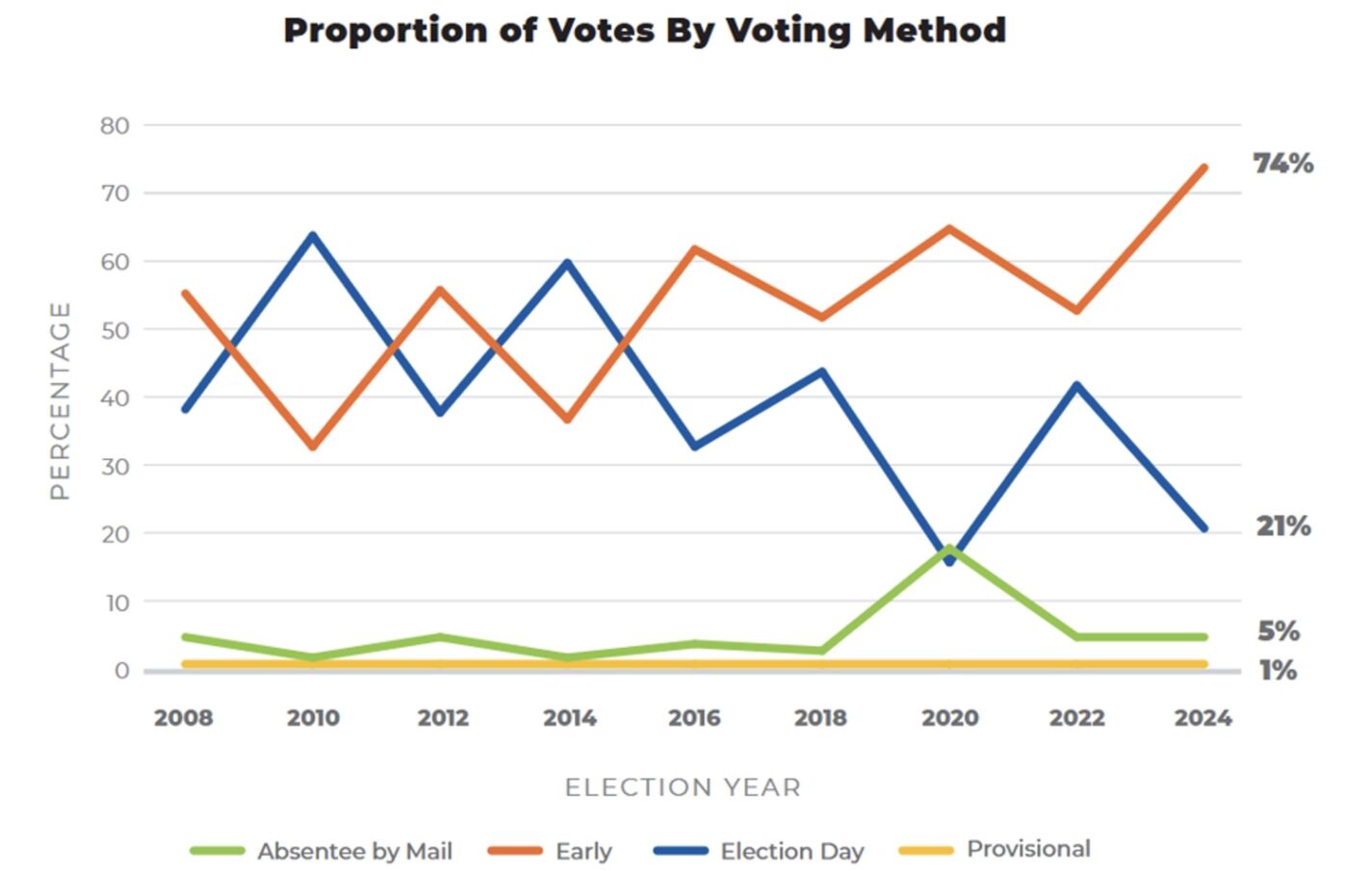
As seen in the chart below from the John Locke Foundation’s 2026–27 “North Carolina Policy Solutions” guidebook, early voting is by far the most popular form of voting in North Carolina.
Figure 1: Change in general election voting method from 2008 to 2024
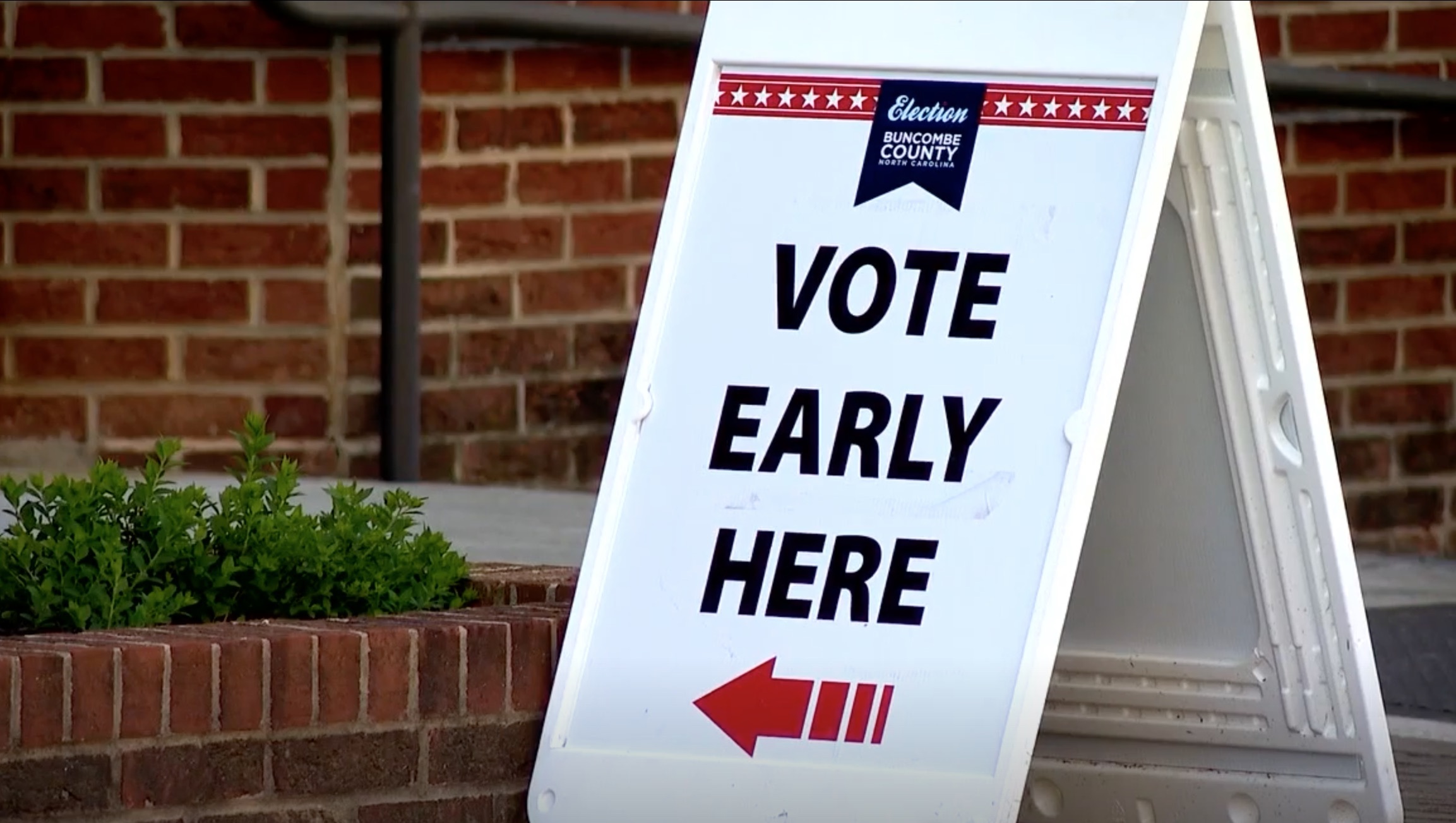
Under current law, each county must have at least 13 days of early voting, including on each weekday starting on “the third Thursday before an election” and the last Saturday before election day. Counties also have the option to hold early voting on Saturdays or Sundays during the intervening weekends, for a possible maximum of 17 days of early voting.
Some Republicans would like to see those numbers reduced. Senate Bill (SB) 1084 would change the “third Thursday before an election” in current law to “second Thursday.” That would reduce the number of early voting days to between eight and 10.
Republicans also introduced several bills in 2025 that would have reduced the number of early voting days.
Some Democrats want to go the other way. House Bill (HB) 1240 would amend the North Carolina State Constitution to require counties to “[d]esignate a minimum of 14 days prior to election day for early voting.” It would also enshrine same-day registration during early voting in the constitution.
Article VI of the North Carolina Constitution states that “[a]ll elections by the people shall be by ballot,” but it does not specify a mode of voting. If HB 1240 were to pass, early voting would be the only voting method guaranteed by the state constitution.
What are we to make of the partisan distribution of those bills? While there are legitimate policy discussions to be had about early voting, the most likely explanation is that both parties believe that early voting benefits Democrats by increasing their turnout relative to Republicans. Is that true?
Does early voting increase turnout to the benefit of Democrats?
The question of whether early voting benefits Democrats rests on two assumptions. First, Democrats depend on marginal voters (who do not vote in every election) more than do Republicans. Second, early voting increases turnout, bringing more of those marginal voters to the polls.
If Democrats are more dependent on marginal voters, then we would expect Democrats to perform better as turnout increases. The data on the relationship between voter turnout and election outcomes show that this relationship is weak at best, however.
In their research for the book “The Turnout Myth,” professors Daron R. Shaw and John R. Petrocik examined the belief that laws affecting turnout confer a partisan advantage. They do not:
The preponderance of the evidence … [suggests] that even if changes to election-administration rules have a significant effect on turnout — which itself is far from clear — such changes would not have a readily predictable impact on election outcomes.
Shaw and Petrocik’s other finding, that election-administration rules have a weak relationship with turnout, is supported by other research. That finding is particularly true regarding early voting, as detailed in a 2024 article in “American Politics Research”:
[T]he most common empirical finding is that the adoption of in-person early voting has no effect on overall turnout (e.g., Berinsky, 2005; Fitzgerald, 2005; Gronke et al., 2007; Larocca & Klemanski, 2011), or perhaps may even lower it (Burden et al., 2014).
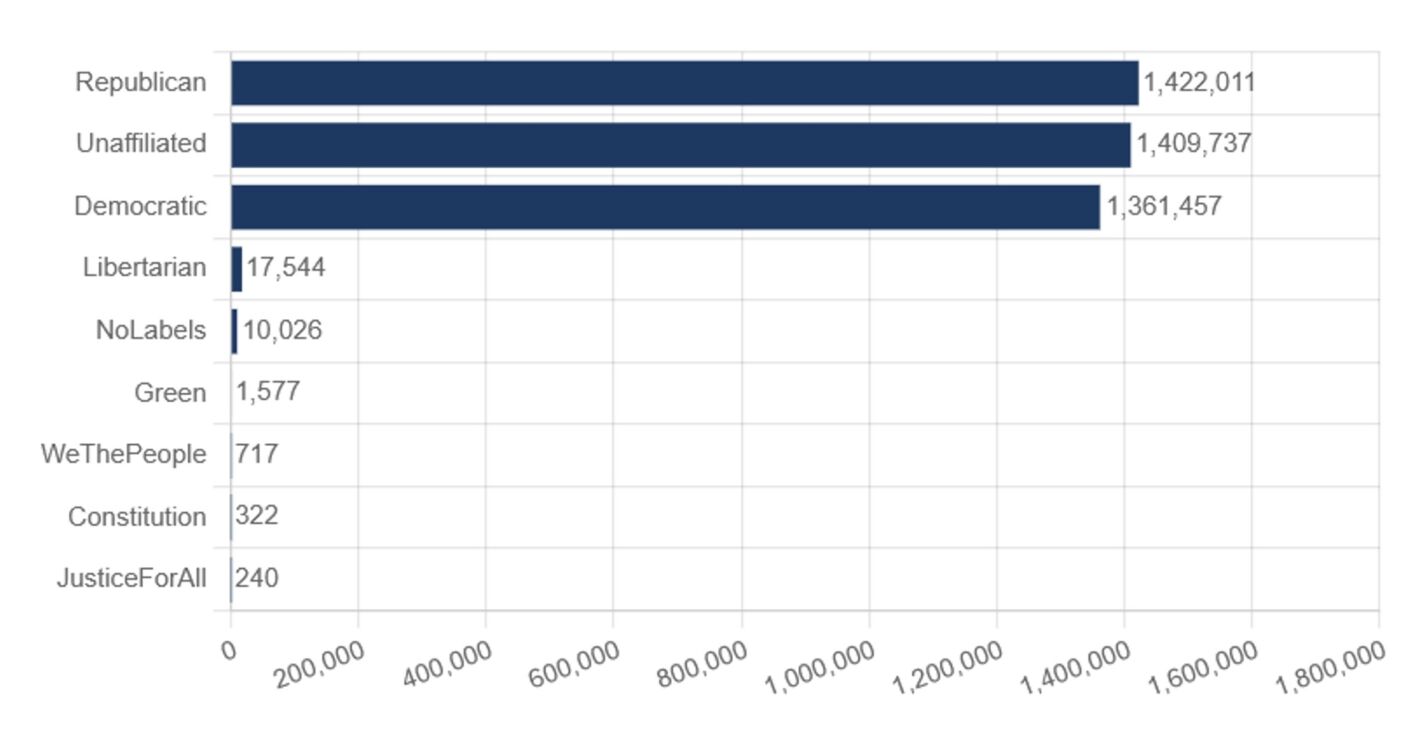
In any case, variation by party in the usage of early voting may be a thing of the past in North Carolina. As seen in the graphic below from the John Locke Foundation’s Vote Tracker, 2024 was the first general election in which more Republicans than Democrats voted early.
Figure 2: Detail from Vote Tracker showing the total number of early votes by party in 2024
Source: Vote Tracker
Is there an ideal number of days of early voting?
So, what are we to do with this information?
Eliminating early voting is not feasible. Americans love convenience. Even if early voting does not increase the number of people who vote, those who do vote like it. A Pew poll found that 80 percent of Americans support early voting, and it’s unlikely either political party would dare alienate a significant share of voters by eliminating it. It is hardly surprising that, while less than 10 percent of nations in the world offer early voting for all voters, 47 states and the District of Columbia do.
The real question is not whether North Carolina should have early voting, but how many days of early voting would be ideal.
Early voting is not free. County election boards must stretch their budgets to cover personnel, equipment, and, in some cases, short-term facility rentals. Each additional day of voting requires them to stretch them much further. During a recent debate in Columbus County, the county elections director reported, “It would cost more than $59,400 to open five early-voting sites for 13 days and more than $64,000 for 14 days.” That is not an insignificant expense for a small county, and larger counties often pay much more to operate more facilities for more days.
A reasonable compromise would be to reduce the early voting period from 17 days to 10. That reduction, usually championed by the political Right, would be accompanied by a requirement that counties open early voting on the one Sunday within that period. “Souls to the Polls” activities on Sundays are associated with the Left.
Another advantage of a shorter early voting period is that “votes are cast in relative proximity to each other,” which limits the chance that the earliest of early voters will cast their ballots on limited information and later regret their choices.
While we will likely never have broad agreement on the ideal number of early voting days, this proposal will maintain voter convenience and conserve local government resources.