The workhorse of the state’s business subsidy programs is not the one that gives out deals for hundreds of millions of dollars. Instead, it’s the program where assistance is limited to $10 million payouts, the Michigan Business Development Program. This program has made 875 deals since it began in 2012. But while it makes a lot of deals, it also falls short. It’s just not an effective use of taxpayer money.
One of the basic problems is that it gives taxpayer money to companies and doesn’t ask for anything in return. All businesses that have a project where they expect to create enough jobs — 25 to 50 of them — are eligible, regardless of whether they would do anything differently without money. The only nod to accomplishing anything is that preference may be given to businesses “that need additional assistance for deal-closing and for second stage company gap financing.”
Not that companies are competing for a limited pool of funds. Since the program began, lawmakers have steadily approved tens of millions of subsidies for it each year. But a significant share of that money never gets paid out. Companies often don’t make investments or never hit their job targets or fail to meet some other term of the deal, and thus the state doesn’t need to make payments.
The deals made in the early years of the program tended to meet expectations. Companies created as many jobs as expected and collected 83% of what was offered in 2012 deals. In the following year, companies created 98% of the announced jobs and collected 89% of the authorized money.
That rate has declined over time. In 2018 deals, only 57% of jobs were created and 58% of approved funds were paid. Just one-third of approved funds were disbursed in 2023 and 2024, though this will likely increase because most of the grant periods are ongoing. Still, administrators always have more money left in the bank because deals fall through and the state doesn’t always have to pay out.
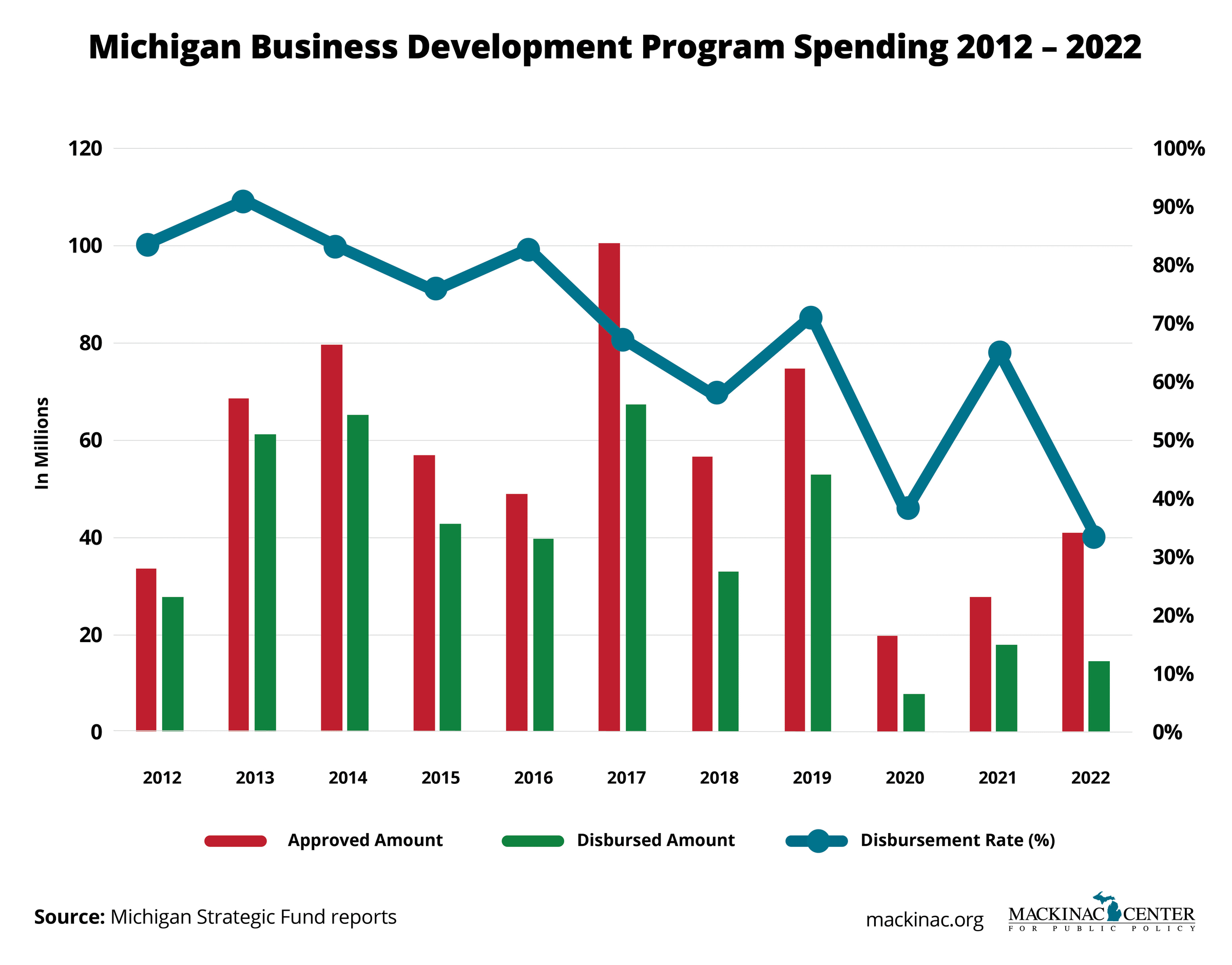
Lawmakers also are spending more on the program even while their success reaching goals has decreased. Administrators made $33 million in deals in the program’s first year, and most of that was paid out. They made deals worth more than $100 million in 2024. But only $34 million has been paid out for those deals so far.
There is another reason to believe that the program does not leverage its funding to ask recipient companies for something in return. If administrators run out of money, they can always ask for more.
Giving taxpayer cash to support expansions that would have happened without subsidies is all cost to taxpayers for no economic benefit. Lawmakers could have a larger effect on the economy by spending the money on things that wouldn’t happen without public funding, like filling potholes or building parks. Or they could leave it in taxpayers’ pockets to begin with. Since the program began, the people of Michigan have paid $507 million out of a total $792.2 million in approved spending. Each year this program costs about what it takes to manage the state’s fisheries.
Even with low standards, companies struggle to meet expectations. Of the 875 projects tracked, only 336 have successfully reached the end of their grant agreement, around the same number that have been dismissed or terminated. The rest are still in progress.
When companies get to the end of their grant agreement, they also stop reporting to the state. This can overstate the program’s success. The state last reported that auto supplier Gedia had met its expectations on its 2017 deals and had created 78 jobs. But those jobs don’t exist today. The company sold its buildings and laid off its employees in 2023. The company likely met its agreement, though, and gets to keep the $500,000 in taxpayer funds.
The state subsidizes select businesses for things the business would have done without taxpayer funds. And the Michigan Business Development Program still falls short of expectations. It ought to be a warning that the future is uncertain. It also ought to be a warning to lawmakers that they’re wasting taxpayer money.