How free is Michigan’s economy? By one widely used measure, not very. Michigan ranks 31st among the 50 states on an objective index of economic liberty. That middling showing carries consequences. States with more economic freedom tend to see stronger growth, more jobs and greater population gains. Michigan’s relative stagnation reflects the poor policy choices its leaders have made.
The Fraser Institute’s “Economic Freedom of North America” index measures the extent to which individuals can make their own economic decisions about working, producing, investing, and consuming, free from government interference. Where those choices are constrained, economic performance tends to suffer.
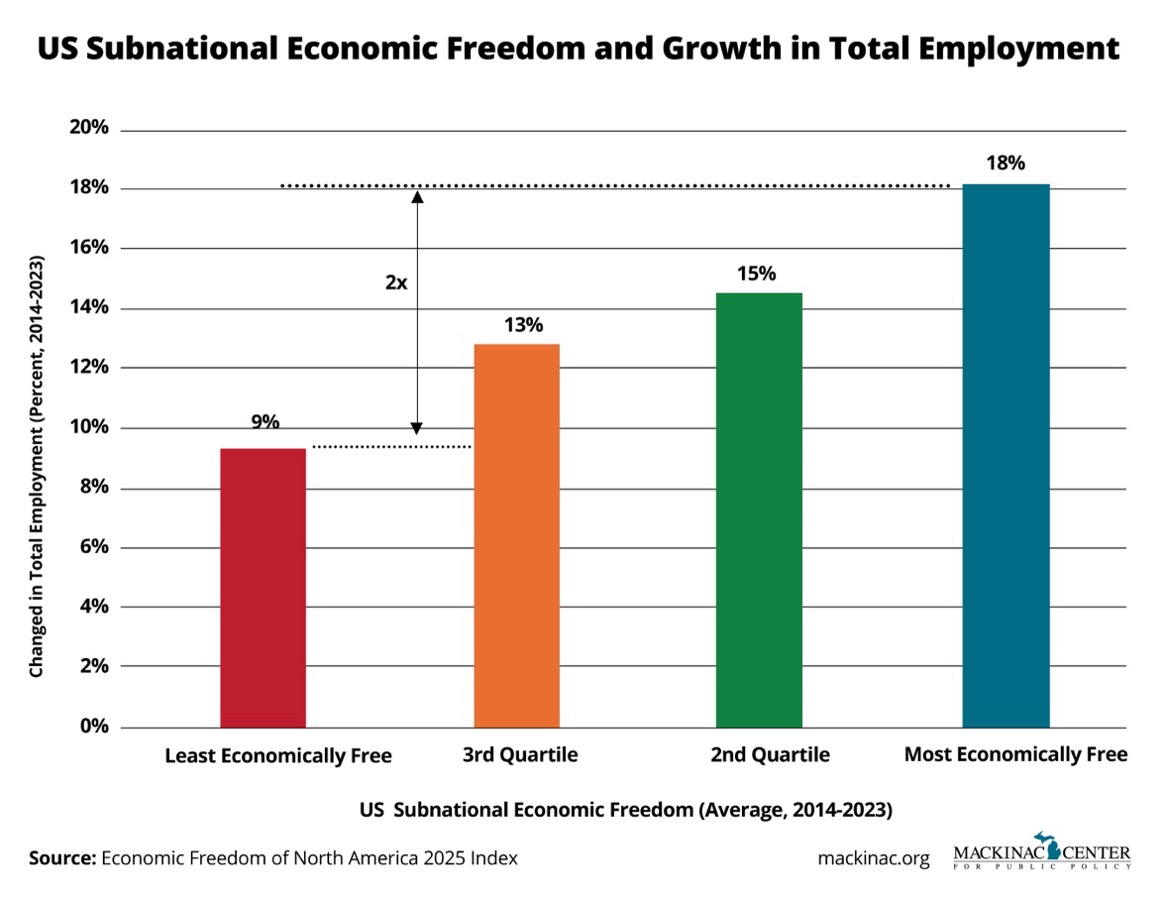
The gap between more free and less free states is stark. The most economically free states have recorded double the employment growth of the least free states, according to the EFNA index. Michigan has not been a job-creation dynamo in recent years. Since 2020, it has ranked 47th in job growth among the states, according to the Bureau of Labor Statistics. We held that rank last year, too.
We are also 41st in per-capita state gross domestic product, a measure of the value of all the goods and services produced in our state. It is commonly used to measure economic output and well-being. A 2019 study published in an economics journal, used the index and found that a 10% increase in “a 10% increase in economic freedom is associated with a 5% increase in real per‐capita GSP.” (In recent years, scholars have used “state domestic product” rather than “GSP,” which stood for “gross state product.”)
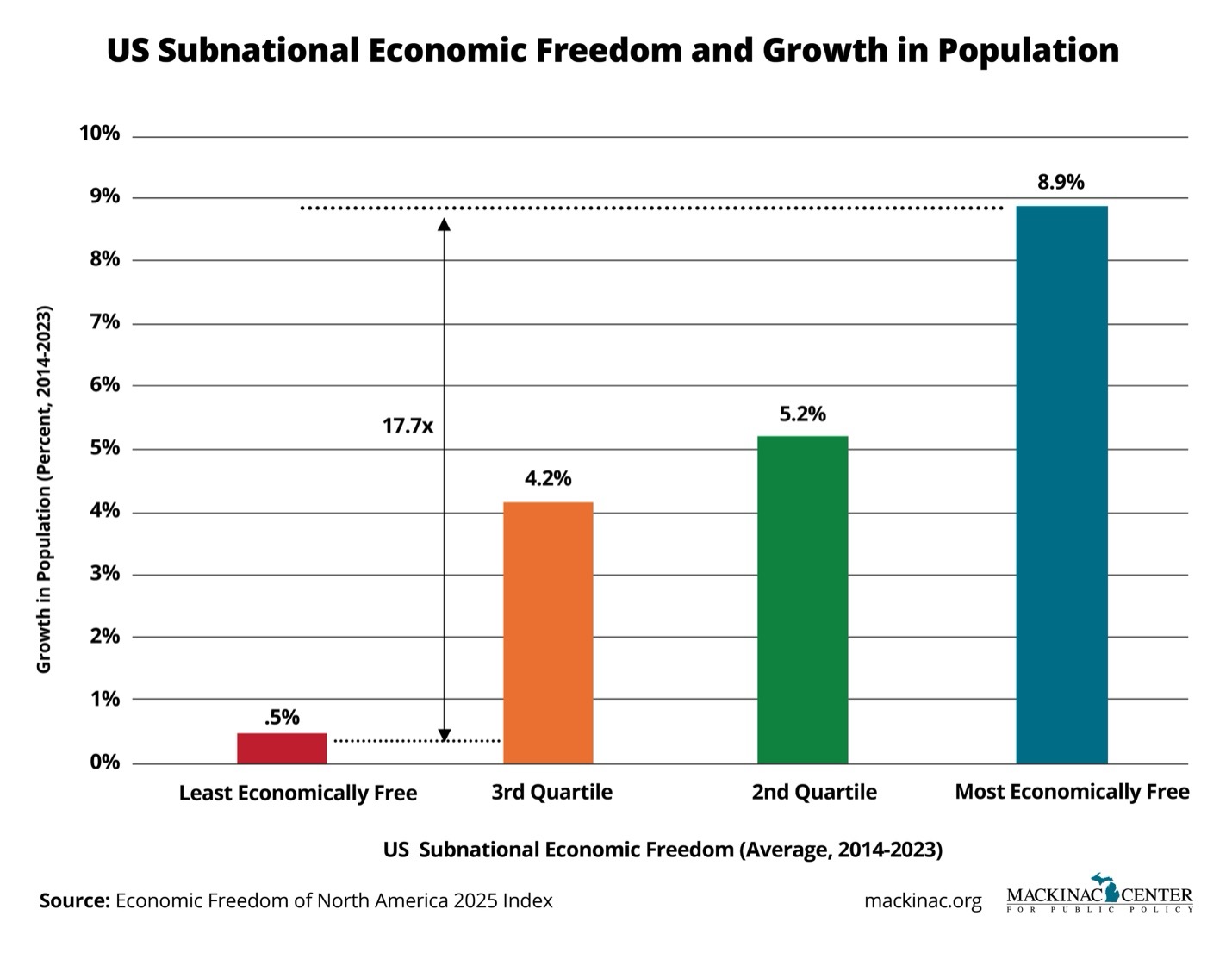
People respond according to economic opportunities: The freest states had nearly 18 times more population growth than the least free states from 2014 through 2023, according to the EFNA. People vote with their feet, and they vote for economic freedom. They haven’t voted for Michigan.
Michigan’s population in 2016 was barely over 10 million, and it grew by only 1.1% through 2025, according to Census Bureau estimates. From mid-year 2024 to mid-2025, the state’s population grew just 0.28%, making for the 16th-worst record in the nation.
The Fraser Institute’s index comprises ten variables under three major policy areas: government taxation, government spending and labor market regulation. A state’s score on each policy is a proxy for the economic freedom its people enjoy. A state’s measurement on any variable ranges from 0 to 10. The most-free state on each variable gets a 10, the least-free gets a 0, and all the others are scored proportionally in between 0 and 10. Michigan’s current freedom score, just 6.4 out of 10, has not exceeded the national average since at least 2006.
Skeptics may dismiss such findings and argue that these are simplistic measurements. They may say that this accounting omits other, confounding factors such as weather. Such assertions, however, neglect more than 450 academic studies that use the Fraser Institute dataset. These studies look at states and provinces and control for other factors. Most studies find associations between economic freedom and positive economic measurements, such as growth, lower unemployment and reduced poverty.
If creating economic opportunity and prosperity is the goal of policymakers, they must adopt or adapt the public policies that lead to the same. That means they should pursue greater economic freedom: Cut taxes, enact (or reinstitute) a right-to-work law, ease licensing requirements, and encourage energy abundance and reliability.
Promoting economic opportunity and prosperity also means not adopting certain ideas.
It means not subsidizing buildings for billionaires, or corporations, or even small, start-up firms. The Mackinac Center’s robust scholarship on state economic development programs is clear. These handouts demonstrate an impact that ranges from zero to negative. Other scholars have come to similar conclusions. One 2018 study in the Journal of Entrepreneurship and Public Policy found “a robustly negative relationship between development incentives and patent activity,” (a proxy for entrepreneurial activity). The study also found “a positive relationship between economic freedom and patent activity and net business formation.”
Michigan’s challenge isn’t mysterious. The state has chosen policies that limit economic freedom and, in turn, economic growth and well-being. The results are evident in its poor performance in job creation, economic output and population trends.
The good news is that policy is a choice. States that have embraced economic freedom have seen the payoff in growth, opportunity and inbound migration. Michigan can join them. But it will require a clear break from the status quo and a renewed commitment to policies that let individuals — not government — drive the economy.