Earlier this week the Office of North Carolina Office of Non-Public Education released new enrollment numbers for private schools and home schools in North Carolina. My colleague, Kaitlyn Shepherd analyzed changes in the private school numbers here. Now, it’s my turn to do the same for homeschooling.
First three general observations:
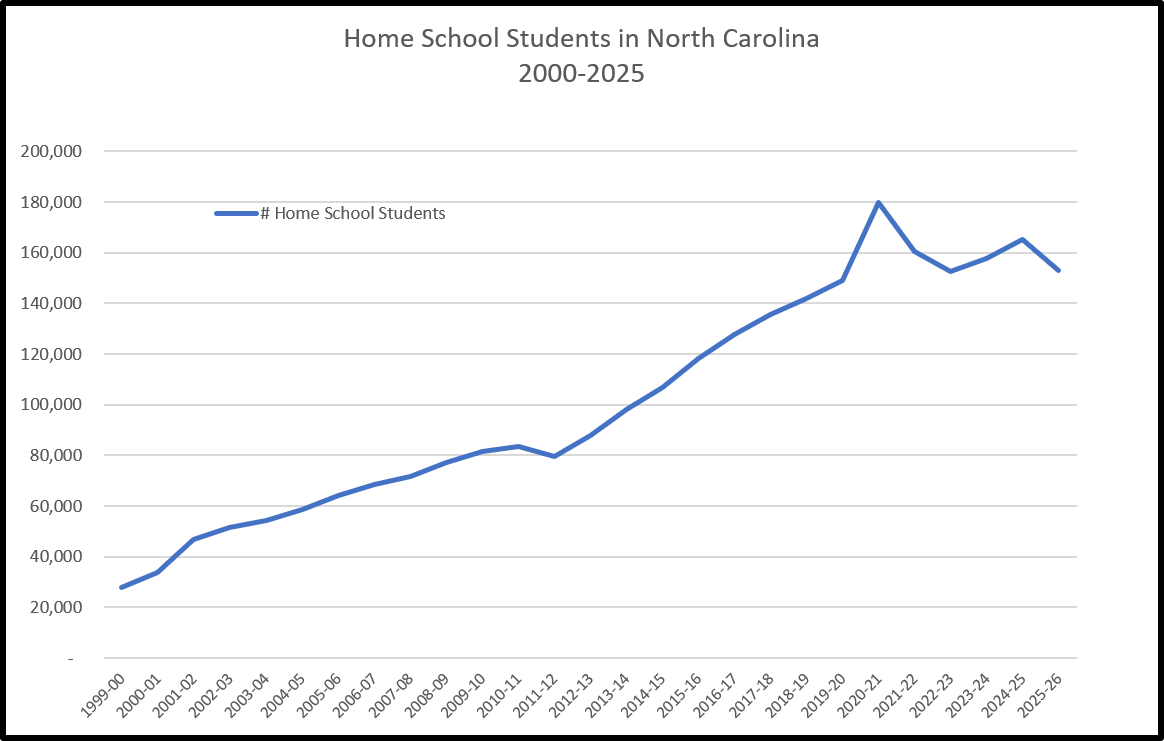
Enrollment. For the 2025-26 school year 152,897 students were registered in North Carolina home schools. The numbers represent a decline of 7.4 percent from last year’s total of 165, 243. Enrollment had increased for the last two years before this year’s decline. The decade has been marked by volatility with expansion during the pandemic and more recent retrenchment.
Homeschooling Hubs. Once again, the largest concentrations of home schoolers in North Carolina were the state’s two largest urban counties; Mecklenburg and Wake Counties. Wake County had 15,642 students registered in home schools, an increase of 188 students over the previous year. Likewise. 11,746 students were registered in home schools in Mecklenburg County, an increase of 120 students over the 2024-25 school year.
Home Schools by Type: Another trend worth highlighting is the change in the type of home schools. In 2014-15, 61 percent of all home schools in North Carolina were classified as “Religious”; 39 percent, “Independent”. In recent years, those percentages have shifted. In 2025-26, the percentage of “Religious” schools has declined to 52 percent, while the percentage of “Independent” schools has increased to 48.
Why the decline in home school numbers?
The decline in the number of home schoolers is the most prominent of these three trends mentioned.. The numbers stand in stark contrast to the changes private school and charter schools experienced where enrollment increased 6 percent and 3 percent respectively, over the last year.
So, what accounts for the declining numbers? Five factors may help to account for the changes.
Record purging. North Carolina law requires home school households to annually file with the state when the home school is started as well as when the home school is closed. Families are more diligent in filing information about the start of a home school and less so when the home school is actually closed. The practice led to some inflated numbers in recent years. A purge of schools by the office of non-public education has sought to remedy the problem. The problem however, is far from solved.
Discrepancies in estimates. Home school enrollments are based on estimates of the number of homeschoolers in each household. The state uses the figure of 1.6 students per home school household. Home school associations say that number should be higher and have been advocating for using 2.0 students per household.
Opportunity Scholarship. Nearly two of every three students in private schools, now receives the Opportunity Scholarship. Of the 8,260 new OSP recipients, some of those are likely home school students.
Birth Dearth. Birth rates peaked in the United States in 2007 and 2025 was the highest year for high school graduates. Over the last ten years, North Carolina birth and fertility rates have generally declined, remaining below the replacement level of 2.1 children per mother. Those numbers have big impacts on the economy and education.
The number of graduates in North Carolina is projected to see minimal growth, increasing slightly from 122,000 in 2025 to 123,000 in 2041. As there are fewer children there are fewer children enrolling in schools whether they be public, private or home school. While growth in urbanized counties can mask those trends, a review of homeschool enrollment by county found that seventeen counties had fewer home school students in 2025-26 than in 2014-15.
Despite a decline in overall numbers, North Carolina — along with California and Texas — continues to have one of the largest home-schooling populations in the nation. The surge in numbers during the pandemic was driven by parents wanting to find more personalized instruction for children with a more flexible curriculum and a desire to align education with specific moral or religious values. With a favorable law and strong local groups, home schooling will likely continue to fill that need for thousands of families across North Carolina for years to come.