
- A new report from the John Locke Foundation’s Center for Effective Education explains how state and local policymakers in North Carolina can effectively implement open enrollment to expand access to public schools
- Recent poll results show the depth and breadth of public support for open enrollment across all economic, political, racial, and geographical groups surveyed
- Policymakers interested in implementing open enrollment can use a variety of reforms, including requiring all districts to participate and prohibiting districts from charging tuition and fees to families
A new report from the John Locke Foundation explains how state and local policymakers in North Carolina can effectively implement open enrollment, a type of school choice that expands access to public schools. The new study comes even as the General Assembly moves forward with legislation that would commission the North Carolina Collaboratory to study and report on how school districts throughout the state can allow students to attend any school within their assigned district.
Open enrollment gives families more options within the public school system by letting parents pick any traditional public school with open seats rather than having to send their kids to their residentially assigned school. Depending on the policy, students can be sent to other public schools within their home school district (within-district open enrollment) or to schools in a completely different district (cross-district open enrollment).
Minnesota became the first state to adopt open enrollment in 1988. Since then, most other states have passed some form of open enrollment law statewide, whether that be cross-district, within-district, or both.
North Carolina isn’t one of those states, however. In fact, according to a 2025 report from the Reason Foundation, North Carolina remains one of the worst states in the country when it comes to open enrollment.
Locke’s new report, “Understanding Open Enrollment: The Next Frontier in North Carolina School Choice,” gives policymakers the information they need to implement open enrollment effectively in North Carolina, including state and district case studies, public opinion polling, myth busting, and implementation guidance.
North Carolinians from all walks of life support open enrollment
One section of the report gauges what North Carolinians think about open enrollment by presenting the results of three polls. The results show not only the depth of public support for open enrollment, but also its breadth across all economic, political, racial, and geographical groups surveyed.
The first poll, a January 2024 survey of 600 registered voters across North Carolina, found that nearly two-thirds of North Carolinians (63 percent) expressed support for a law allowing children to attend any public school in North Carolina, regardless of their home address. Just 28 percent opposed the idea, and 9 percent reported being unsure.
Support or opposition for open enrollment in North Carolina
As you may know, children in North Carolina are assigned to a public school based on their home address. Would you support or oppose the state assembly passing a law that would allow children in North Carolina to access any public school in the state regardless of where they live?
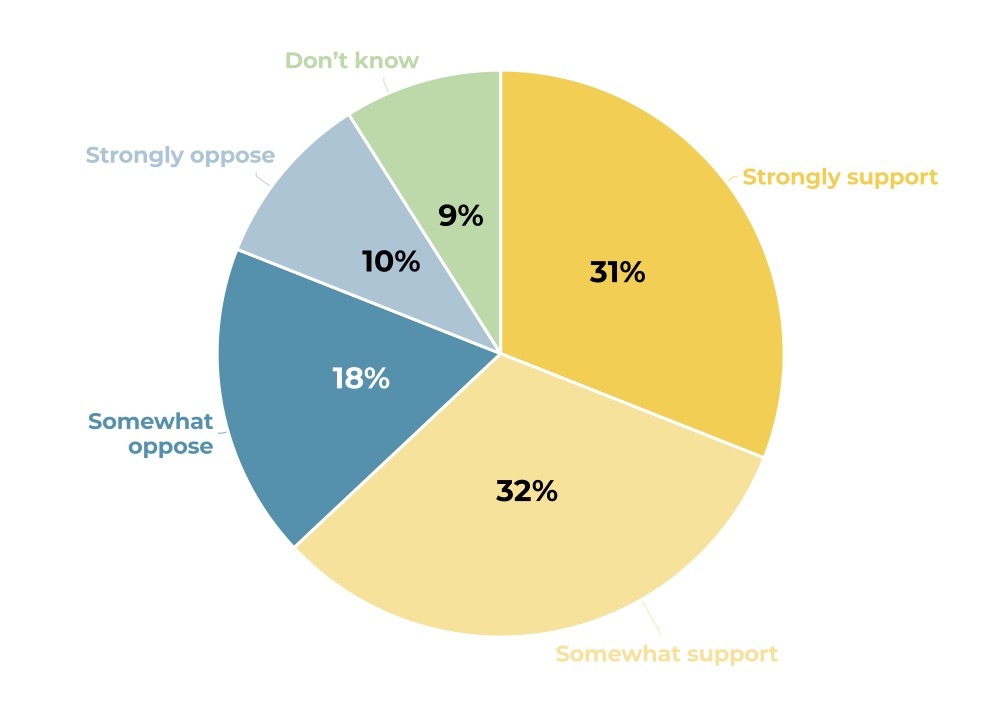
Source: yes. every kid. foundation.
Nearly half of respondents (45 percent) said that open enrollment would improve public schools, while just 30 percent said it would weaken them and 12 percent were unsure. Eighty-one percent of respondents supported the idea that children shouldn’t be excluded from being able to choose their public school simply because of where they live or their family’s income.
The second poll, which compared the views of more than 600 North Carolina parents with national sentiments, also identified strong support for open enrollment. More than three-quarters of parents in North Carolina and nationally (77 percent) reported favoring the idea of letting students move to the public school of their choice.
Views on open enrollment among parents in North Carolina and nationally
Based on what you know, or have heard from others … In general, do you favor or oppose … Open enrollment: Allows students to transfer to the public school of their choice, instead of just the school they are assigned to, based on where they live.
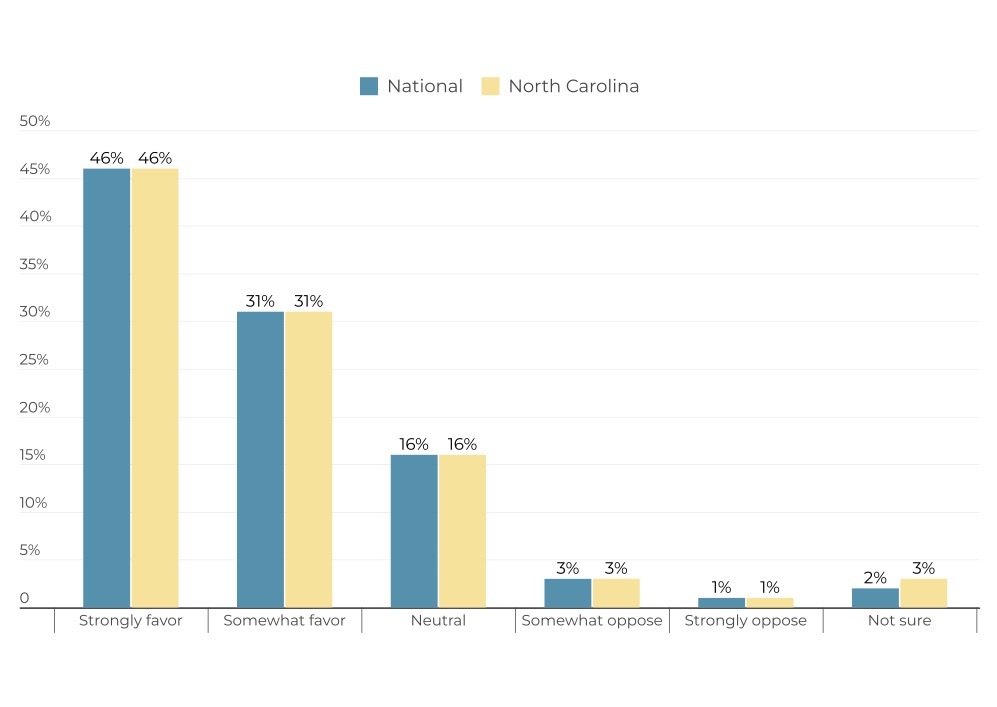
Source: 50CAN
According to the third poll, which surveyed 700 general election likely voters in North Carolina, nearly 79 percent of respondents expressed support for within-district open enrollment. Just 13 percent were opposed.
Support for open enrollment was strong across all demographic groups surveyed, including party lines (75 percent or higher), geographic boundaries (76 percent or higher), age ranges (77 percent or higher), levels of educational attainment (73 percent or higher), and income levels (78 percent or higher).
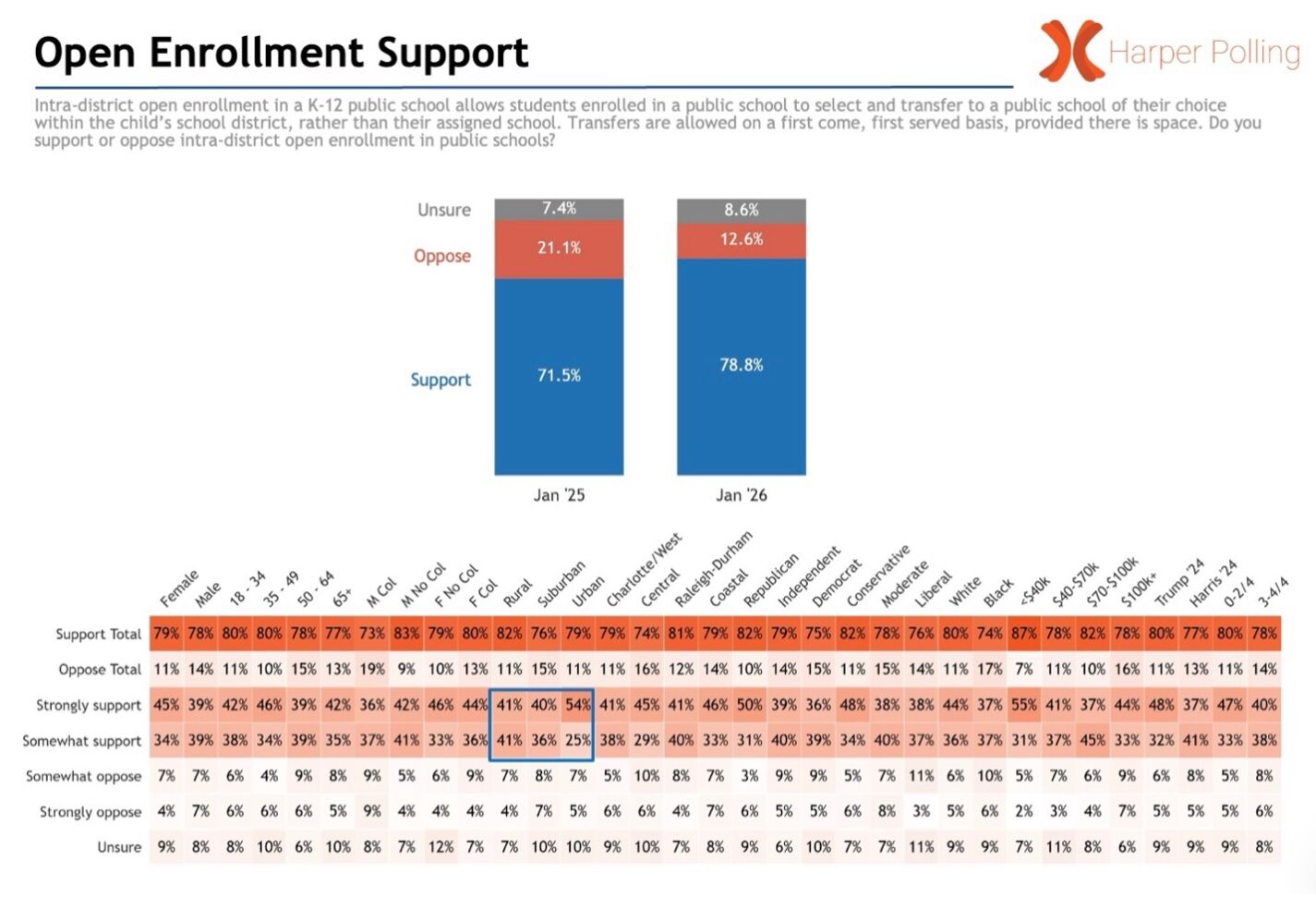
Source: Harper Polling for Carolina Journal
State and local policymakers considering how to implement open enrollment in North Carolina can proceed confidently knowing that residents of all different backgrounds support the idea.
Common objections to open enrollment don’t hold water
Another section of the report explains how six common objections to open enrollment are just myths that wither under scrutiny.
One of the most common myths is that open enrollment drains money from public schools. Within-district open enrollment, however, does not significantly disrupt funding, and districts typically retain some state and local funding for students who choose to enroll in other districts. Furthermore, districts can use open enrollment as an opportunity to innovate, specialize, and attract new students (and their accompanying education dollars).
Another common objection is that open enrollment doesn’t benefit rural students. Contrary to opponents’ concerns, however, in many states open enrollment has actually led to enrollment gains for rural districts. In Wisconsin, for example, 31 percent of students using open enrollment (nearly 23,000) transferred to rural school districts in 2022–23. Rural districts in states like Texas and Iowa have also used open enrollment to stabilize declining populations, increase revenue, and increase enrollment.
How North Carolina policymakers can implement open enrollment effectively
The report concludes with several recommendations for North Carolina policymakers who want to implement open enrollment effectively to provide greater educational freedom for students and families.
Require all school districts to participate in open enrollment
This requirement would prevent affluent districts from choosing not to participate and thereby limiting choices, especially for lower-income families who could benefit the most from access to better schools or districts.
Prohibit districts from charging tuition and fees
Such a prohibition would encourage students from less affluent families to participate.
Provide transportation options or services
Requiring parents to provide transportation can prevent low- and moderate-income families from participating. Instead, states can require districts to offer transportation along regular bus routes, let them hire private companies, allow them to use passenger vans instead of school buses, or reimburse low-income families for transportation expenses.
Be committed to transparency
Districts should be required to publish information like seat capacity numbers by school and grade level; application policies, procedures, and timelines; the availability of any transportation options; and the procedure for appeals. The state should publish yearly reports tracking key metrics like the number of new applications, the number of new and continuing transfers, the number of denied applications, and the reasons for denials.
Encourage flexible school funding
When funding follows students, districts have an incentive to accept them. Short of comprehensive school finance reform, policymakers could consider other ways to encourage flexible funding, provide weighted funding or grants for needy students, and supply transportation funding.
Foster statewide accountability
Transparency helps parents and policymakers hold districts accountable if policies are not implemented fairly and consistently. Linking financial resources to market performance can motivate districts to improve and attract new students.
Seek uniform data collection and standardize processes like compliance and performance audits
Auditing districts’ compliance with state open enrollment laws, setting a statewide definition of “capacity,” and publishing data to answer key implementation questions can help ensure the program lives up to its promise of unlocking educational opportunity for students