When it comes to spending public money, Texans want transparency and accountability. One way to deliver on these demands is through the third-party efficiency audit concept, which is a tool to “assess how well [government] agencies work to keep costs down while providing their services, and if those services are aligned with the purpose of the agency’s existence.” Ample evidence exists to show its effectiveness and potential.
With these audits, independent firms evaluate public expenditures and determine where, if at all, governments can do things better. These audits provide insight and actionable intelligence to stretch the public’s dollars and use them more effectively.
While state government does not currently require local governments to undergo these types of investigatory examinations, new polling data by Pulse Decision Science reveals that the public is very much in support of it. In a survey of 800 registered voters, conducted from June 5th-9th, 2026, 90% of respondents indicated support for requiring local governments to submit to regular efficiency audits. Just 5% of those polled responded negatively.
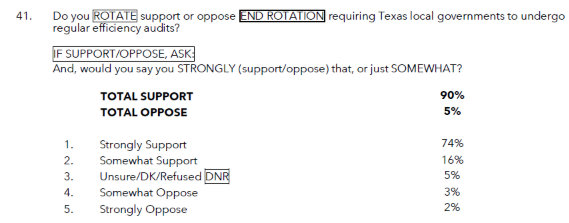
What these poll results suggest is that Texans are sick and tired of government overspending—and they want a solution. Moreover, taxpayers want the knowledge provided by efficiency audits to see how well cities, counties, and school districts are spending public money, what return on investment exists, and whether any waste, fraud, and abuse might be uncovered.
Public opinion firmly rests on the side of creating a new efficiency audit requirement for local governments. The question now is, are state legislators ready to deliver on it?