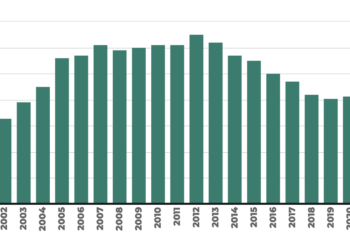
Michigan’s unemployment insurance taxes generated $1.14 billion in 2025, more than half of what the state government raises through the corporate income tax. The unemployment insurance tax is, by definition, a tax on employing workers, so it’s vitally important that policymakers get the tax’s design right and reduce burdens on the people of Michigan.
Unfortunately, the state’s unemployment insurance system falls short of those goals.
Unemployment insurance tax systems have multiple rate schedules, with businesses paying different rates based on their charging experience — in plain English, their layoff history. Businesses with a track record of paying into the system with few unemployment claims by former employees get lower rates than businesses with a higher proportion of employee claims.
Surtaxes and special assessments, however, break this model. They can be imposed on employers regardless of their “experience rating.” Worse, these assessments tend to be highest during economic downturns, when businesses are already struggling to avoid layoffs and can least afford the additional tax burden.
In theory, unemployment insurance taxes should raise revenue in good years that can be banked for a higher number of claims in bad years. In practice, Michigan’s system is behind the curve. The state is setting itself up for a situation in which it would have to raise UI tax rates at the worst possible time.
According to federal calculations, Michigan’s unemployment compensation trust fund ended 2025 at 48 percent of the recommended minimum solvency standard. If the country slid into recession any time soon, Michigan would almost certainly deplete its reserves and be forced to take out federal loans to make payments. When Michigan has outstanding federal loan balances, two surtaxes kick in.
The first, the solvency tax, is imposed on so-called “negative balance employers,” those for whom charged unemployment compensation payments exceed the amount they’re paying into the system. The second, the obligation assessment, applies to all employers, even those with no recent history of layoffs. Together, these surtaxes could drive up employee costs by $425 per employee. Combining these with ordinary unemployment insurance taxes could raise the tax burden to more than $1,000 per employee.
Higher taxes during an economic downturn make it harder for employers to weather the storm and harder for better-positioned employers to hire laid-off workers.
The cost of unemployment compensation programs, and thus the amount that UI taxes must raise, is the product of many factors: how generous the compensation is, who qualifies for it, how well the program is administered, and how many people are unemployed.
Over the past three years for which data are available, Michigan had an improper payment rate of 20.7%, more than double the 10% target and well above the 14.4% national average. Improper payments totaled $433 million between 2022 and 2024.
The “improper payment” category includes payments to ineligible individuals, over- and underpayments to eligible individuals, and payments that were made without proper documentation or that otherwise failed to meet procedural requirements.
Nearly a quarter of Michigan’s improper payments were due to “separation issues,” meaning that payments were made to people who quit voluntarily or were fired for cause and thus were not eligible for benefits. Twenty-eight percent of improper payments involved underreported earnings from part-time jobs while on unemployment. Thirty-five percent of improper payments went to laid-off employees who did not meet (or failed to document) the minimum work search requirements.
Michigan should revise the way it accounts for improperly awarded benefits, which currently distorts the market and unfairly increases the UI tax burden on employers.
The state also tends to treat employee claimants very favorably on appeal. At the first level of appeal, Michigan ranked fifth in share of reversals in favor of claimants, and its likelihood of reversing in favor of claimants was 32% higher than the national average over the past three years. Conversely, when employers appealed a decision, Michigan ranked 42nd in the share of reversals, with a reversal rate 18 percent lower than the national average.
Such data cannot tell us who should have won — claimants were no doubt in the right in some cases, and employers in others — but the ratios are surprising in a state with such a high rate of improper payments. Michigan doesn’t seem to scrutinize claims as well as its peers, and the state’s appeals system is unusually likely to reverse decisions in favor of claimants.
The upshot is that Michigan employers pay for more erroneous claims and fare worse in appeals than job providers in the average state, driving up taxes, raising compliance and administrative costs, and drawing down trust fund balances.
Michigan ranks 28th on the unemployment insurance tax component of the Tax Foundation’s State Tax Competitiveness Index, indicating substantial room for structural reform. The two surtaxes drag down the state’s ranking, as does the state’s policies regarding the experience ratings of employers’ whose benefit awards are reversed.
Reforming unemployment compensation systems isn’t easy. But even in a “good” year like 2025, Michigan’s unemployment compensation system is a $1 billion program funded by taxes on employment. The system deserves greater attention, with reforms to improve payment accuracy and reduce the countercyclicality of tax burdens.