- A new report ranks counties in North Carolina according to their energy poverty gaps
- The rankings are based on what impoverished households pay for electricity compared with what they can reasonably afford
- The report offers several recommendations to uphold affordable, reliable electricity and protect households most at risk of energy poverty
A new report from the John Locke Foundation’s Center for Food, Power, and Life gauges the extent of energy poverty in North Carolina and proposes several recommendations to return the state’s policy focus back to affordable, reliable electricity.
The report, “Energy Poverty in North Carolina: Securing Affordable, Reliable Power,” develops a county-by-county index of energy poverty in North Carolina, producing two rankings, one for households served by one of the state’s three investor-owned utilities (IOUs), and the other for households served by one of the state’s 76 municipal utilities or 32 electricity membership corporations (EMCs).
The rankings rely on data from the 2023 American Community Survey (ACS) from the U.S. Census Bureau and residential electricity prices from July 2023. They are based on what impoverished households in each county pay for electricity compared with what they can reasonably afford. Electricity affordability was determined according to a limit well established in the research literature: no more than 6.5 percent of household income. The rankings reflect the gap in each county between the 6.5 percent affordability threshold and estimated percentage of median household income spent on residential electricity by households living below the poverty line.
The report set four levels of energy poverty, with Level 1 being the severest. Level 4 is for counties with an energy poverty gap of less than 3 percentage points above the affordability threshold. Level 3 spans 3 to up to 5 percentage points above the affordability threshold, and Level 2 ranges from 5 to up to 6.5 percentage points above it. Level 1 is for counties at 6.5 percentage points or more above the affordability threshold (i.e., at least double the threshold).
What is energy poverty?
The report mentions three ways in which the research literature attempts to measure energy poverty:
- Energy insecurity: the inability to maintain adequate home energy
- Energy burden: the total share of household income devoted to energy needs
- Energy affordability gap: the difference between what a household pays for energy and what is reasonably affordable
The report focuses on the affordability gap because it “provides a direct estimate of the scale of the affordability challenge within each county.”
Why focus on energy poverty?
Electricity is not just any household purchase; it’s an absolute necessity. For families in poverty, it’s not an expense they can simply give up as it gets more expensive. The trade-offs they face when rates spike are more severe than choosing to cut back on fast food or movie nights. They face putting off paying bills, cutting back on groceries, holding off on medications, or severely restricting their electricity consumption — all of which can endanger their health. As one retiree put it to WRAL years ago, the choice is this: “Do I stay warm or eat?”
Alongside reliable and adequate electricity, the overarching importance of affordable electricity has long been known and protected in North Carolina’s utilities law. As the report explained:
That law declares … that “the availability of an adequate and reliable supply of electric power and natural gas to the people, economy and government of North Carolina is a matter of public policy.” Going further, the law requires “adequate, reliable and economical utility service to all of the citizens and residents of the State” and “the least cost mix of generation and demand-reduction measures which is achievable.”
Unfortunately, in recent years, North Carolina policymakers have gotten away from this wisdom. Electricity rates have been increasing, a natural consequence of passing laws that elevate political preferences above the hard and fast standards of affordability and reliability.
What did the rankings find?
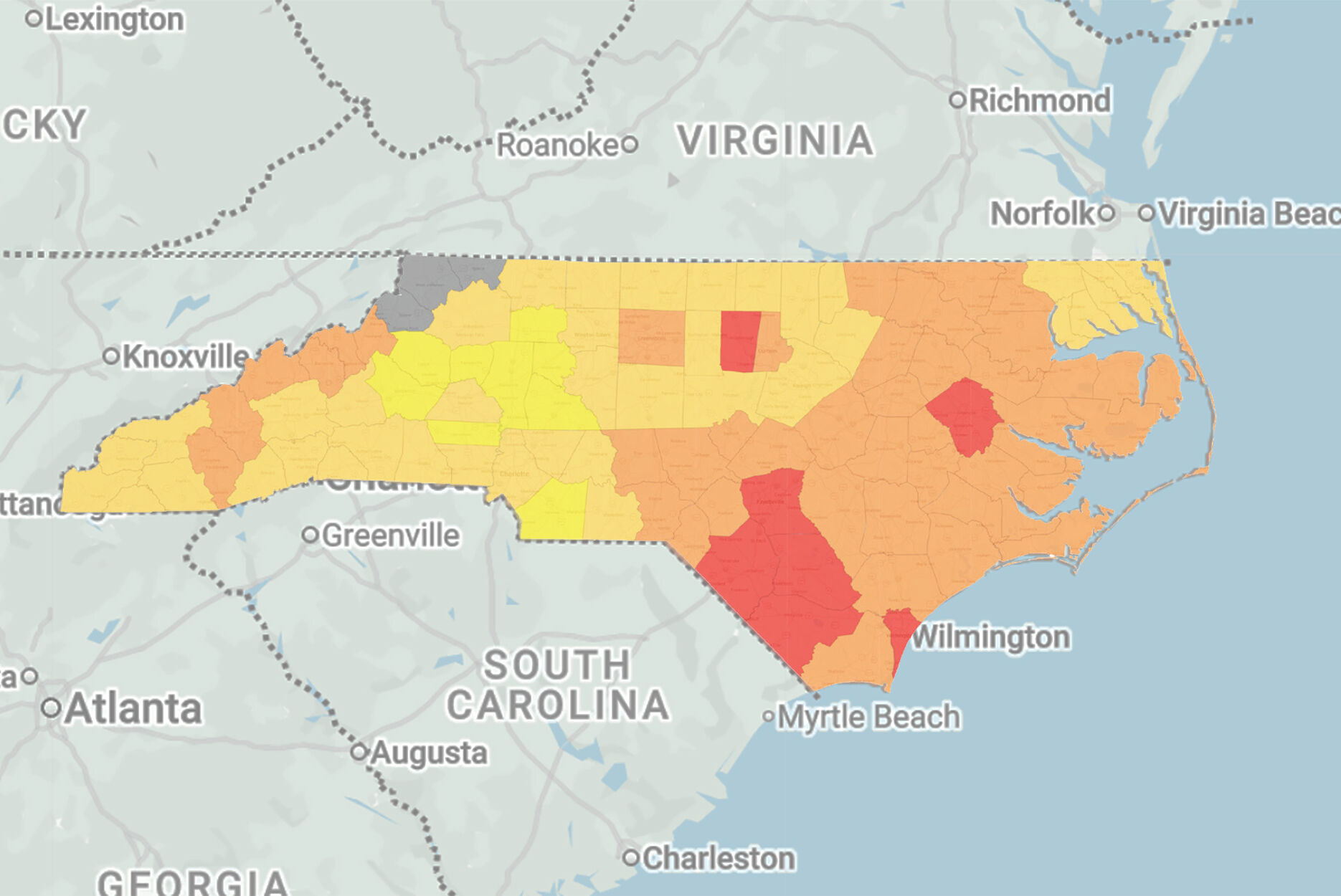
For the investor-owned utilities, or IOUs (see the interactive maps below), the report found seven counties at Level 1 (the most severe level of energy poverty): Bladen, Columbus, Cumberland, New Hanover, Orange, Pitt, and Robeson. Forty-two counties were severe enough to reach Level 2. Another 39 were at Level 3. Nine counties were at the lowest level of energy poverty (Level 4), with gaps less than 3 percentage points: Alexander, Burke, Caldwell, Davie, Iredell, Lincoln, Rowan, Union, and Yadkin.
As the report explains, the IOU map “shows an evident split between the eastern and western parts of the state, likely reflecting the higher electricity rates for the IOUs [Duke Energy Progress and Dominion Energy] serving mostly the eastern counties.” As the report discusses, this disparity was acknowledged in the initial Carbon Plan before the North Carolina Utilities Commission (NCUC). The plan noted that Duke Energy Carolinas, which largely serves the western part of the state, “has a higher percentage of low fuel cost nuclear generation” and much less solar generation and associated transmission and distribution needs.
For the municipal utilities and the EMCs, the report found over one-fourth of counties (27) at Level 1. Another 30 were at Level 2, while 34 were at Level 3. Only four counties — Davie, Graham, Iredell, and Rowan — were at Level 4.
As the map shows, the distribution of energy poverty is more mixed here than it is for IOUs, but there are noticeable pockets of severe energy poverty gaps in the mountains, a portion of the northern Piedmont, and the northeast.
What can policymakers do?
The report then discusses several factors contributing to higher electricity rates and offers recommendations to policymakers. Recent policymaking that prioritized outcomes other than affordability and reliability have played a significant role. The report recommends the following reforms:
- Repeal the Carbon Plan law
- Pass baseload-for-baseload legislation
- Require the NCUC to compare the all-in costs of new power plants
- Pass an Ensuring Reliable and Affordable Electricity (“Only Pay for What You Get”) Act
- Repeal the Clean Energy and Energy Efficiency Portfolio Standards
- Pass Consumer-Regulated Electricity (CRE) legislation
Future research briefs will examine these recommendations and the reasons behind them in greater detail.