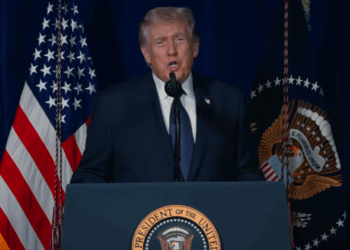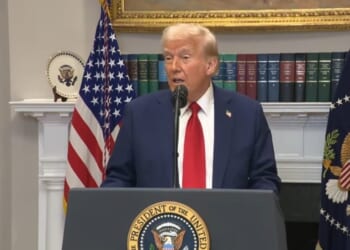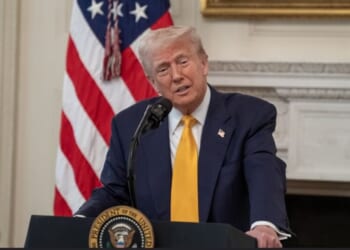

President Donald Trump’s primetime speech Thursday revealing that American spy agencies suppressed evidence that China hacked into massive reams of voter data shows that not even the Commander In Chief has full transparency into their secret work.
The CIA confirmed the Chinese government hacked over 200 million files of voter registration data from more than a dozen states in 2020, and the FBI had raw intelligence that was buried before it could be verified about fake ballots for Joe Biden, but senior intelligence officials dampened the impact of this intelligence before it reached him in the Presidential Daily Briefing. The revelation may deepen the suspicions of many Americans that spy agencies constitute a Deep State unaccountable to outsiders, even the president — referred to in the intelligence community as “Customer #1.”
Senior officials in the CIA and the FBI privately expressed reluctance to elevate intelligence about Chinese hacking to Trump because he could use it to his advantage on the campaign trail, the speech and declassified documents revealed.
A senior FBI official working on foreign influence operations — just the sort of official who should have rung an alarm bell about Chinese access to sensitive American data — instead buried it. The official said even referred to the power of the so-called “shadow government.”
“One email among intelligence analysts admitted that they had ‘deliberately massaged’ the Presidential Daily Briefing to withhold information regarding Chinese activities related to the election,” Trump said. “Another official inside the FBI wrote that she was running a ‘shadow government.’”
“All they kept saying is that ‘this is the most secure election of all time.’ A standard, very pat line,” Trump said.
The new declassified materials were uncovered through the work of a task force helmed by journalist John Solomon. The task force includes the U.S. Intelligence Board and the declassified documents were reviewed by Trump’s intelligence chiefs.
Trump’s speech also alleges other Chinese influence operations, including the recruitment of American corporate leaders and bribing of journalists to hurt Trump’s election chances.
It’s not clear whether any of the actions by China tilted the 2020 election.
It is clear though that the new revelations add to the evidence that Trump faced unusual obstacles in the 2020 election, including the delay of the Pfizer vaccine until December 2020 and chaos in Fulton County, Georgia, including processing delays and mishandled absentee ballots.
Trump has fought to pass the SAVE America Act, an election integrity bill that would require proof of citizenship to vote, among other provisions, but it faces resistance from congressional Democrats and some Republicans.
The FBI and CIA didn’t respond to a request for comment.
The CIA
It was previously understood that Chinese spies had analyzed multiple U.S. states’ election voter registration data from a highly redacted April 2020 National Intelligence Council (NIC) memo authored by National Intelligence Officer (NIO) Christopher Porter.
But senior intelligence officials tussled in 2020 over whether China had acted on the data it obtained to steer the outcome. Porter led the group that argued China had likely acted on its trove of American voting data.
Porter attempted to issue a warning about the risk posed by China but a senior manager at the NIC, a longtime CIA officer, suppressed the whistleblower’s report because of concerns about Trump’s tough rhetoric about China, Porter said.
The detractors won out, and in March 2021 former President Joe Biden’s intelligence chief, Director of National Intelligence Avril Haines, issued a report stating that China did not interfere.
A January 2021 memo by Trump’s CIA Director John Ratcliffe, then serving out his final few days as the director of National Intelligence in Trump’s first term, echoes Porter’s story of intelligence being suppressed from higher-ups.
Ratcliffe said that an intelligence report had been spun to made it look like Porter was the only intelligence official who believed that China had interfered, which was inaccurate.
CIA management took actions “pressuring [analysts] to withdraw their support” from the alternative viewpoint on China “in an attempt to suppress it,” Ratcliffe argued.
“Placing the NIO Cyber on a metaphorical island by attaching his name alone to the minority view is a testament to both his courage and to the effectiveness of the institutional pressures that have been brought to bear on others who agree with him,” Ratcliffe wrote.
The FBI
All raw reporting about 2020 election interference had to be routed through FBI Director Christopher A. Wray’s headquarters in Washington, D.C. after a report about fraudulent Chinese drivers licenses emerged.
Just one day after Wray testified to Congress that he had seen no evidence of large-scale voter fraud, an August 2020 FBI field office report about Chinese authorities planning to export fraudulent drivers licenses to sympathizers in America was recalled in an “abnormal” way, documents declassified by the Senate Judiciary Committee in July 2025 revealed.
One FBI official described the human source who provided the tip as “competent” and “authentic in his/her reporting.” The FBI’s source confidence in their own subsource as being in the “9-10 range.” The subsource allegedly obtained the information from Chinese officials.
The tip followed public reporting about the seizure of 19,888 counterfeit drivers’ licenses from China and Hong Kong, mostly of college-aged individuals.
Because the report was recalled, the tip was never fully investigated.
Vulnerabilities
Voter registration data always includes names and addresses, and depending on the state can also include full or partial social security numbers, drivers’ license numbers, and/or state ID numbers, political party affiliation, phone number, email address, voting history and voting method, per the National Association of Secretaries of State.
An earlier January 2020 NIC memo written by Porter on election security rang alarm bells about the vulnerabilities of voting machines, online voter registration databases, pollbooks used to check voters in at polling stations and state and local election websites.
“A committed adversary could exploit access to these systems to disrupt election processes across the country,” the report warned.
Regarding voter registration data, the memo warned that “states house their voter registration databases predominantly on Internet-connected systems that are designed for easy access because maintaining up-to-date voter registration records is a nearly continuous process. Adversaries could alter data to potentially prevent individual voters or groups of voters from voting, causing delays on election day or forcing voters to use provisional ballots.”
US Intel’s China Problem
Trump’s speech suggests the U.S. intelligence community took actions that provided cover for the country’s most formidable adversary.
Beijing has grown ever more brazen in its encroachments onto American shores — buying up property around U.S. military bases, smuggling vaccine research and biological materials out of U.S. labs, and eavesdropping on the U.S. Army. But the U.S. intelligence community has been slow to keep up.
For nearly 25 years, the intelligence community’s tiny group of dovish China experts — and that has only recently begun to change — according to former intelligence officials. A historical emphasis on Russia and the War on Terrorism consumed most of the intelligence community’s considerable resources.
The intelligence community had just a dozen or so true experts in China from the 1990s through the mid-2010s, according to Nicholas Eftimiades, a 35-year former intelligence officer specializing in China, told the DCNF in an interview. By contrast, the U.S. government trained thousands of Sovietologists at the height of the Cold War, he said.
Conformity to a neoliberal worldview on China that prioritizes free trade and unfettered scientific cooperation may persist in the sprawling $100 million American intelligence apparatus, whistleblowers say.
Several intelligence community whistleblowers have emerged in recent years to voice concerns that a politically driven desire for Trump to lose the election played a role in suppressing intelligence about China, including information about the origins of the COVID-19 pandemic. Concerns about the COVID-19 pandemic and its impact on the economy defined the 2020 election, and some of the strongest evidence that research at a Chinese military-connected lab had ignited the crisis never reached the president.
Content created by The Daily Caller News Foundation is available without charge to any eligible news publisher that can provide a large audience. For licensing opportunities of our original content, please contact licensing@dailycallernewsfoundation.org